Let him shout (at Trump or anyone else)

In the dim and not-so-distant past when it seemed impossible Obama would be replaced by a misogynist as the President of the USA, I watched a video of someone protesting at a Trump rally. The internet was full of footage of protestors at Trump rallies, and inevitably Trump insulting the protestors, but this was different. Different because the protestor was a 12 year old boy, who has cerebral palsy, who uses a wheelchair, who talks using a communication device.

JJ Holmes lives in America and had been following election coverage by using his iPad to search for Trump events, typing the words in using his nose. He knew Trump had mocked disabled people and eventually convinced his mum to take him to a Trump rally so he could protest against him. She warned him it might get ugly but he wanted to go anyway.

He pre-programmed phrases into his computer before they went, so that at the rally he could shout slogans like ‘Trump mocks the disabled’ and ‘Dump Trump’. He could play the messages through his communication device by pressing a button with his leg (there’s a brilliant video of him using the button here. As it wasn’t that loud, his mother and sister chanted along so he couldn’t be drowned out too easily.

After a bit the supporters surrounding them turned rowdy. Trump heckled JJ from the stage and told security to ‘Get them out’, and they were jostled out amidst JJ’s wheelchair being shoved and some pretty horrible things being said to all three of them.

So…

I mean obviously there’s much to be depressed about in this little anecdote, and that’s before we even knew Trump would become President.

But out of the murk I find inspiration: a 12 year old disabled boy convinced his mother to take him to a political rally to protest Trump’s attitude toward disabled people! He programmed chants in to his communication device!

I can’t tell you how proud I would be to have raised a son who was so politically aware and knew the power of protest. A boy who knew he was disabled and knew that was okay. Who knew that Donald J Trump (as JJ refers to him) was wrong to belittle disabled people. Who was brave enough to go to an adult event and make himself heard. Who was willing to be heckled and shoved to make his point.

I would be so proud of my son for learning to communicate with his nose and his leg, and having the patience and determination to make himself heard.

I am filled with admiration for a mother who took her 12 year old seriously, and facilitated his protest even though she knew it could get ugly. Who told journalists, ‘He’s not some puppet I wheeled in there. This was him – this was all him.’ I would be proud to be such a staunch ally. To treat communicating through a device as equal to talking (or shouting). And to have raised a daughter who wants to protest too.

I’m proud of a world where disabled people are helped by technology and supported to communicate when they can’t speak.

What the whole story relies on is JJ’s ability to shout (even if his device’s voice output isn’t quite loud enough to be heard above enthusiastic Trump supporters).

Ben has been using his eye-gaze computer for some time now and is beginning to create messages or questions within his communication software, or he uses the computer to read himself stories. We try to give him as much autonomy over the computer as possible (whilst hovering around, interfering, facilitating and modelling) so he can choose what he wants to do. When he chooses to use it for communication, we take the messages he says seriously.

By ‘says’ I mean that as he selects words within the communication software, they go in to a window at the top of the screen. When Ben goes to the ‘speak’ cell the computer says all the words out loud. When he is reading himself a story he selects the ‘speak’ cell and a paragraph of, for example, Mr Stink by David Walliams, will be read aloud by the computer.

But the loudest volume of Ben’s computer isn’t that loud. He can hear it as he is quite close, but you can’t really hear it if you are across the room, and you definitely can’t hear it if Max or Molly are squawking. So Ben’s speech and language therapist recently gave us a speaker to sit on top of the laptop, the volume of which can be controlled within the communication software. It can be turned up really loud, because if you are going to give an AAC user the opportunity to communicate as a neurotypical child would, you need to give them the ability to SHOUT if they want to. Or whisper. Or somewhere inbetween. Ben should be able to compete in volume with his siblings even if it’s not something I particularly relish the thought of.

In the same way that I ask Max many, many times a day to please not shout, Ben should be able to be loud and annoying. There is a temptation to think of children like Ben as ‘good’ because they are relatively quiet and controllable, but part of being a child (any child) is being disruptive and protesting and Ben should have as many opportunities to do that as he has to be compliant. If we get to the point of Ben purposefully turning up the volume of his computer and shouting at us all, and me having to tell him to turn it down, that will be a good problem to have.

Meanwhile, JJ’s recovery from the Trump rally ordeal was helped by him meeting Obama the following day who was every bit as friendly as you would expect, crouching to his level, listening to JJ’s messages and shaking his hand.

imrs-php

(Holmes family photo taken from Washington Post website)

According to a Clinton official, when he was told he was about to meet Obama,  ‘JJ jumps out of his seat and erupts into cheer . . . his smile almost bursting out of his face. His body overcome by light, when just the day before it almost succumbed to hate.’

Let’s keep heading toward the light, people. Let’s confront bullies and prejudice. Let’s give all our kids the ability to communicate, to shout and to protest. Let’s take them seriously and hope that one day we might meet Obama.
img_6179

A House for Ben

We are adapting our house to make sure it works for Ben. We have moved out and have so far paid builders thousands of pounds to rip things apart and make a perfectly good house look like it’s been hit by a natural disaster.

playroom-3

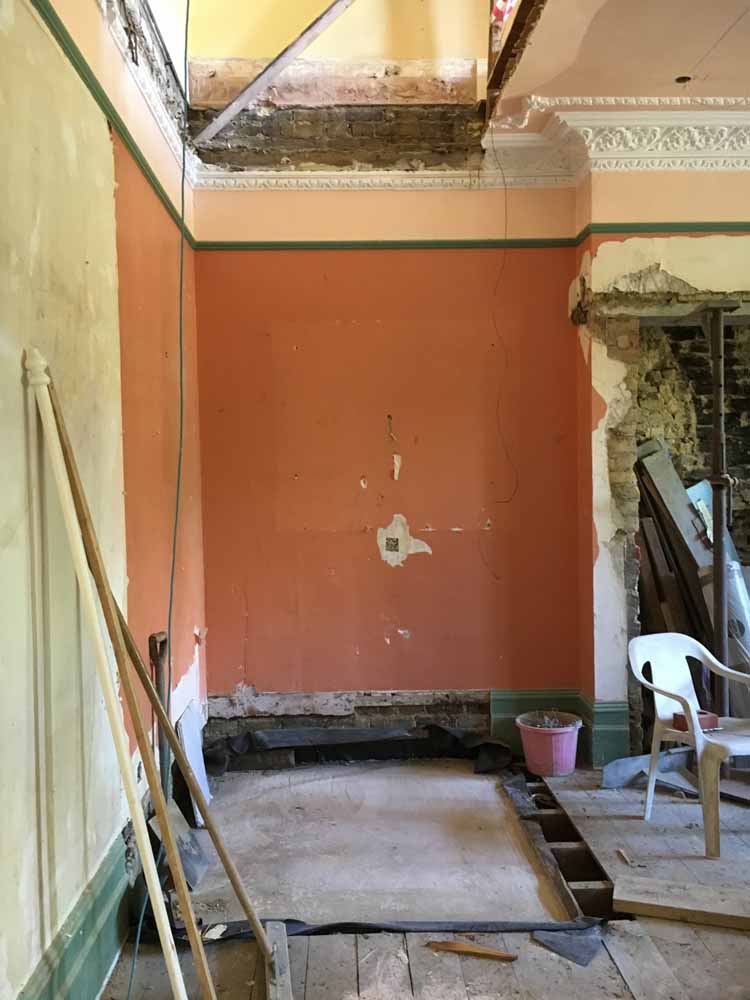
(Photo – what will be the lift, lift lobby and therapy/play room)

It’s a big, disruptive, expensive construction project of the kind we (hopefully) will only do once. We plan to move back in to the house next year and then never move again. Or at least not until the house doesn’t suit Ben any more, which we hope won’t be for an extremely long time.

This kind of project throws up a host of issues on every level from extremely detailed (what kind of sockets?) to big questions about the way we want to live our lives. Decisions about designing your family house go to the core of who you are and how you live (or want to live). I’m an architect and these are the issues that first drew me to architecture: how do buildings reflect who we are as people, what we care about and what we do day-to-day. This stuff is deeply personal and others in the same situation would make different decisions. We are extremely privileged to be in a position to be able to craft our house so carefully.

(Photo – hole for the lift in what was the kitchen)

Most buildings in the world are inaccessible to Ben but we can create a little island of utopian level access, where he can go (almost) everywhere and everything is designed to make all of our lives as easy as possible.

But how do you adapt a house for a disabled person who is currently six years old but will hopefully still be living there when they are twenty six?

How to you make a house perfect for the disabled child, whilst not compromising the personality of the property and making it a house for our whole family?

Should we compromise on the kind of house we want to live in to make it disability-friendly? Is it possible to have have a house that works perfectly for a wheelchair user but that isn’t the first thing you notice?

There are two principles that we have had from the beginning: the house needs to feel like a family house, specifically OUR family house with all of the characteristics it would have had if Ben wasn’t disabled; and the house needs to work perfectly for Ben and enable social connections for him – between family and with visitors. We are currently hyper-aware of some of the downsides of being in a house that hasn’t been specifically adapted. It’s getting harder to give Ben a bath, and even small changes in level get harder to get his wheelchair over as he gets heavier. Because it’s less easy to carry him, Ben rarely comes upstairs to our bedroom or to Max’s room.

If you go to as many adapted or accessible properties as I do, you’ll realise that ‘experts’ are often expert in how to make a house work for a wheelchair user and that isn’t the same thing as making a home for all of the members of the family in it. The cheapest and easiest way to adapt houses is often to tack an extension on to the back. This makes lots of sense, except it often involves siblings and parents sleeping upstairs and the disabled child never going to their bedrooms. If, like Ben, the child has carers then you can end up with unofficial zones within the house where the disabled person and carers spend most time in particular parts of the house and there’s not enough crossover with other members of the family.

sitting-room

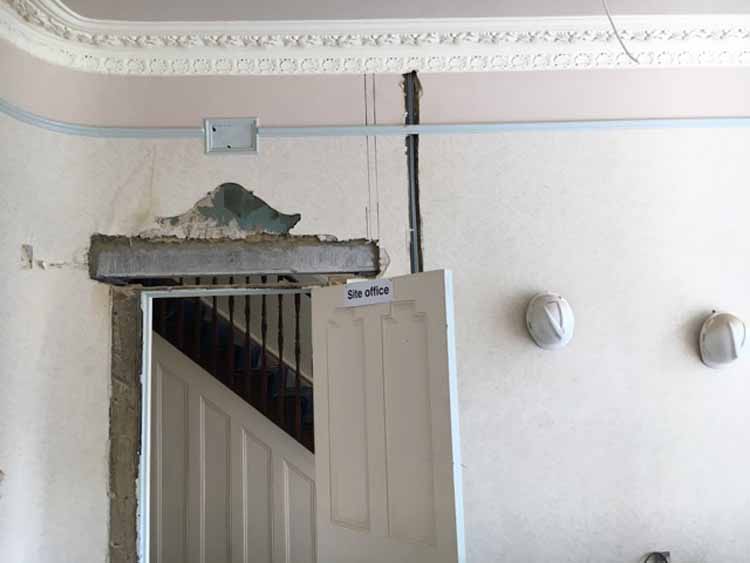
(Photo – widened doorway)

Ben will be at the centre of our house, literally. There are three floors, and his bedroom will remain on the first floor. We will all pop in and out, or wander past, his room all the time. It also means we, as parents, remain totally involved in every aspect of his life. Even if there are days when carers are spending most time with him, we are there in the background interfering and suggesting, as is the prerogative of a parent. This will be facilitated by a through-floor lift that will take Ben up to his bedroom, but also further up to our bedroom and Max and Molly’s.

sam-bed

(Photo – Ben’s bedroom)

Downstairs we will have normal reception rooms (one for family-only since we so often have carers in our house now) with wide doorways, a lift lobby big enough to turn a massive wheelchair and level (or near level) floor finishes. Not a single step on the ground floor. One should not underestimate what a feat this will be involving much chat about thresholds, demolishing a conservatory and building a new dining room. We will have a patio on the same level as the kitchen and dining room, which will ramp down to the garden. Ben will use the same doors as all of us and it should be a mere matter of pushing him where he wants to go, without bumping over ledges and going through alternative doors. The rooms are big enough that when Ben is in even bigger wheelchairs we will still be able to get round him. There will be enough room around the dining table that he should be able to sit anywhere, not just in the one spot that means we can still walk past.

extension-1

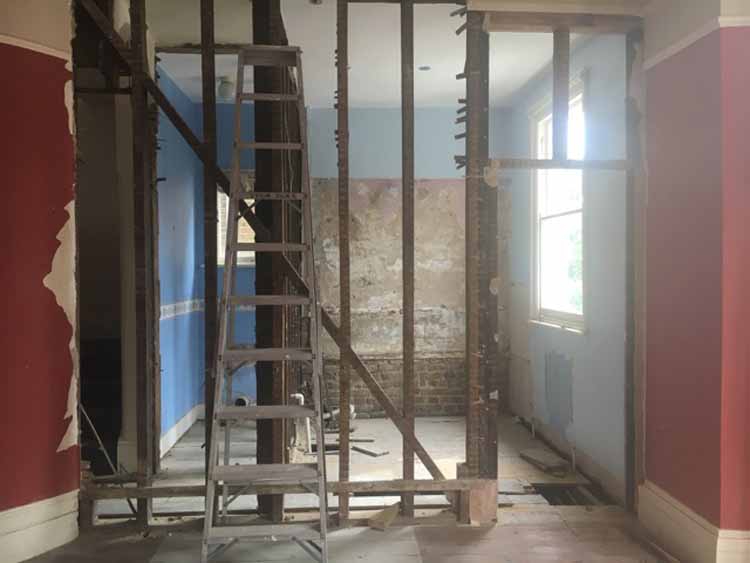
(Photos – demolished conservatory, building new dining room)

The house will have pieces of specialist equipment, at vast expense, though actually these aren’t as numerous as I anticipated. You don’t need that much stuff if the whole design of the house is built around the idea of a wheelchair being able to get everywhere. The lift is a massive thing (physically and in expense) but a simple idea. There will be track hoists mounted on the ceilings of four rooms (which will mean Ben can be lifted in a sling between wheelchair and bed, for example, rather than being lifted by us). There will be changing facilities on two floors. And there will be a bath.

sam-bath

(Photo – what will be Ben’s bathroom)

The bath has the subject of much conversation. It is, apparently, easier to shower people in wheelchairs. Easier for carers that is. But we generally operate on the basis of what Ben likes and needs, rather than what suits others. The boy loves baths, so we need a bath. And if that’s a whacking great big thing that goes up and down, needs the floor to be strengthened and a new heating system to produce sufficient hot water, so be it. It will be in a bathroom with two doors – one straight in to Ben’s room so he can go bath-to-bed in one carer-friendly straight line, and one on to the landing that leads to his brothers and sisters bedroom. Because the bath is essentially just a really expensive bath and so it will be the bathroom for all the kids.

We are lucky to be able to ask ourselves how we want our family to work, and therefore how we want our house to facilitate that, and to have the opportunity to alter the fabric of the building accordingly. It is all very exciting but it feels like a huge responsibility – like all construction projects, we’ll only get to do this once and we need to get it right.

(Photo – looking up three stories of the house through the hole made for the lift)

A friend of mine joked that once we have adapted our houses our kids will be able to visit each other, if not anywhere else. It’s not really a joke – as Ben gets bigger and his wheelchair gets heavier it is becoming harder for us to go to other people’s houses with him and we can’t visit places that don’t have disabled access. So the political becomes personal – we want to compensate for the world remaining inaccessible by making our house a truly welcoming place for Ben and his friends.

Having a break – the guilt of ‘respite’

IMG_6399

img_6401

For any parent of a disabled child, the subject of respite is a bit fraught. Often because accessing any is difficult, and will have involved tricky conversations/numerous phone calls with various professionals. Partly because the logistics of organising it and physically getting the child there with everything they require are onerous.

But mainly because it’s a double-edged sword. On the one hand we would really like a break. On the other hand we feel guilty for wanting a break. We are on the knife-edge of knowing that the respite place we have carefully considered is able to take care of our child, but also thinking that no-one is going to be able to take care of them properly.

Almost two years after we were first referred for respite provision, Ben has just had his first overnight stay without us. The somewhat casual timescale allowed us time to get used to the idea, due mainly to the first hospice refusing to feed Ben pureed food so us (and yes, I mean us, social services having still not managed to assess Ben) having to find a different place. We agreed to the new referral, then went for a visit, then spent a couple of hours going through aspects of Ben’s care plan, and then stayed there with him for a weekend, then the time came for him to stay there himself.

It’s a nice place. It’s run by nurses, so feels quite medical, but that means they are totally on top of medication and not at all intimidated by disability. It’s purpose-built building with lots of space, bedrooms opening on to gardens, a huge room for craft, fun and reading. Loads of books and friendly people floating around doing interesting things. There are other kids and their siblings, volunteers making bugs and Gruffalos.

To give some context, I am generally quite relaxed about being separated from my children. We are lucky enough to have lots of family in London who are willing to look after our kids. For the first three years or so of Ben’s life he spent one night a week with my mum, he’s spent loads of weekend with his other grandparents. Max has had ‘sleepovers’ of up to five days with grandparents and my sister and her partner. Molly is somewhat testing the model by being more dedicated to breastfeeding than I would ideally like, but at some point we’ll manage to offload her too. But of course, these people are all in our family. And as Ben has got longer and heavier, and the kit he needs has got larger, it’s got trickier for him to stay anywhere that isn’t our home.

We have therefore shifted the model so James and I (perhaps with a child or two) can go away, leaving Ben in our house with various permutations of carers and family. We realise how fortunate we are to be able to do this.

What the respite hospice offers is an opportunity for us to stay at home and for Ben to stay elsewhere, allowing us to be one child down (which with three of them is a welcome release of intensity), spend more time with the other two, and perhaps get some of the stuff done that we have been planning to do for months but never have time to (e.g. unpack boxes from our house move 2.5 months ago, or actually tidy up our tip of a house). I am keen on this idea.

Except that it also involves Ben staying somewhere else without us or any other family, which makes me feel guilty and nervous.

On the morning of Ben’s solo stay we packed up everything he needed (a full car of stuff) and James and a carer set off. I used Molly as a convenient excuse to not be the one to do the drop off. I called the hospice to say they were on the way, and it transpired that there had been some administrative confusion that meant they weren’t expecting Ben until that afternoon. The idea that Ben was about to arrive for his first stay without us, and they weren’t expecting him, that they weren’t all standing around anticipating the arrival of Ben, made me feel so sad and unsure. Should I call James and get them to turn back? The journey can take up to an hour so that would mean spending most of the day faffing around which would be the exact opposite of respite. As I burst into tears, the nurse said no, they would make it work.

When James got there it was actually okay, and Ben seemed alright, and by the time James and our carer left he was happily entertained and content. We spent the weekend with Max and Molly, and realised that looking after two kids is much easier that looking after three but still pretty relentless which was quite a helpful distraction. Max burst into tears on three separate occasions because Ben wasn’t there.

IMG_6387

Then we went out for supper to celebrate our 11th wedding anniversary, and appreciated that organising babysitting for two non-disabled kids is really straightforward. We ate delicious food, drank too many drinks, faded far too early, and came home to Molly screaming in the babysitters’ face. We had called the hospice and they said Ben was okay.

The following day we woke up to a house that only had our kids in it and us. Ben sleeps badly, and we’re lucky to have nightcarers who get up with him during the night and help us in the morning. We also have day carers almost every day which makes our family life possible. But the flipside of having a lot of help is that there is almost always someone in our house. It is a luxury to wake up and potter around in a dressing gown with only Weetabix for kids to think about.

We went for lunch, where we were just about able to have actual conversations with other adults, at tables with benches that wouldn’t accommodate wheelchairs easily. I had fun. But we were with family, and I felt bad that Ben wasn’t there. Even though we probably wouldn’t have gone for the lunch at all if Ben had been, partly because of the wheelchair, partly because trying to go for lunch with all three of our kids and actually expecting to talk to anyone is an absolutely ridiculous idea. We called again and Ben was apparently happy.

When James went to collect Ben that afternoon everything was okay. He seemed relaxed. There hadn’t been any disasters. When Ben got back home and saw me, Max and Molly he was totally thrilled. Max was so happy to have Ben back, equilibrium had been restored. Max was even content to not be able to watch his TV programmes because Ben doesn’t like them.

It was, by all measures, a success. Ben did fun stuff that he wouldn’t have done at home. Max and Molly got more of our attention, James and I had a bit of a break (it’s all relative).

So why do I feel so guilty about it? It reminds me a bit of Ben’s first week at nursery, when he was almost one. I dropped him off and called James on the way out in tears, saying I would never be able to go back to work because we couldn’t possibly leave Ben at nursery… Am I just further along the continuum of internal conflict that starts at angsting about whether kids should go to nursery or have a nanny (or any childcare at all), and ends at going away for a week with no kids? Or am I just trying to justify something that’s not fair on Ben?

I don’t think there’s a right answer, but for now I’m shattered and have a to-do list that stretches over two A4 pages and Ben was happy during this last stay, so we’ll crack on (as Max would say) and hope we’re doing the right thing.

Or at least not doing the wrong thing.

Playing for laughs (via eyegaze)

IMG_3853

I’ve got three kids! I don’t have much time to write blogs! And we have moved house, again, so things are as relaxed as usual round here.

In amongst the chaos and many, many boxes, Ben has been continuing to use his eyegaze computer. It travels to school with him every day and then he uses it at home for a mixture of entertainment and communication. Ben is building skills in using his eyes and navigating around software on a computer, and much of this is by playing games or other activities that he finds motivating. Like everything to do with kids learning something, anything, it’s best done through play as far as I can see.

We have various activities that he enjoys on his computer; his favourites are, unsurprisingly, stories. Some of which are ‘multiple choice’ where he has to pick the right word to continue the pre-programmed story. Others are computer equivalents of audiobooks where the entire text of a novel is on the computer and Ben can choose the story he wants, select the chapter, and then it is read out to him (in stilted computer voice, but he doesn’t seem to mind). Crucially, he has to keep selecting ‘Speak Paragraph’ in order for the story to continue, meaning that he has to engage consistently.

Ben’s current favourite book to read like this is Mr Stink by David Walliams. We have the actual book and read it to him frequently (actually I don’t, generally because I’m often preoccupied with a smaller child, but others do including my dad who assures me it is great and totes emosh). Other times Ben sits at the table reading it to himself via computer. It’s brilliant.

We hadn’t foreseen quite how fantastic the computer is for Ben and Max to use together. The laptop is touchscreen and so they can play games like, for example, Splat the Clown where Ben can splat using his eyes and Max using his finger. There aren’t many activities that they can do together like that, with total parity.

The current hit, however, is the most simple of all. By navigating through various screens within the PODD communication software Ben can get to a page which just has Yes, No and Don’t Know buttons.

Through trying to gauge Ben’s reliability of answering yes or no to questions (Ben doesn’t have a totally reliable yes or no, which is a work in progress for him and something about which I could – and may at some point – write an essay…), James invented a game of asking him sets of related yes/no questions, some of which are totally ridiculous. It is a good way of him practising giving us a clear yes or no when we know he knows the answer. He is definitely making progress on this. The thing we didn’t expect, and which is in danger of slightly undermining our carefully constructed strategy, is that Ben is now giving us the ‘wrong’ answer because it’s funny.

IMG_3854

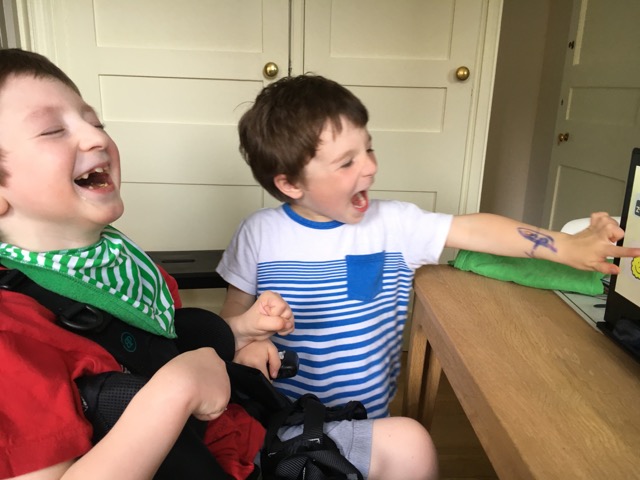
Oh the laughs! The advent of this game has also coincided with Max hitting the zenith of his life so far where he can successfully make every member of our family laugh. Let me assure you that watching one of your kids make the other laugh is one of life’s pure joys. Watching Eli make BOTH of the other kids laugh is very, very lovely and makes my heart sing. All the feelings.

So it isn’t just James and me asking the yes/no questions, but Max too, and Ben bloody loves it.

Sometimes when Max is asking the questions Ben doesn’t answer. Then while we are waiting, he navigates out of that page which is autonomy in action, and is the physically disabled equivalent of a child wandering off because they have lost interest. He actually then went to a different yes/no page, through a different pathway in the software (which I didn’t know you could do), and then we continued. His ability to do this, without us mediating, is as pleasing to me as all the chuckling.

‘Looking his best’: attitudes towards wheelchairs

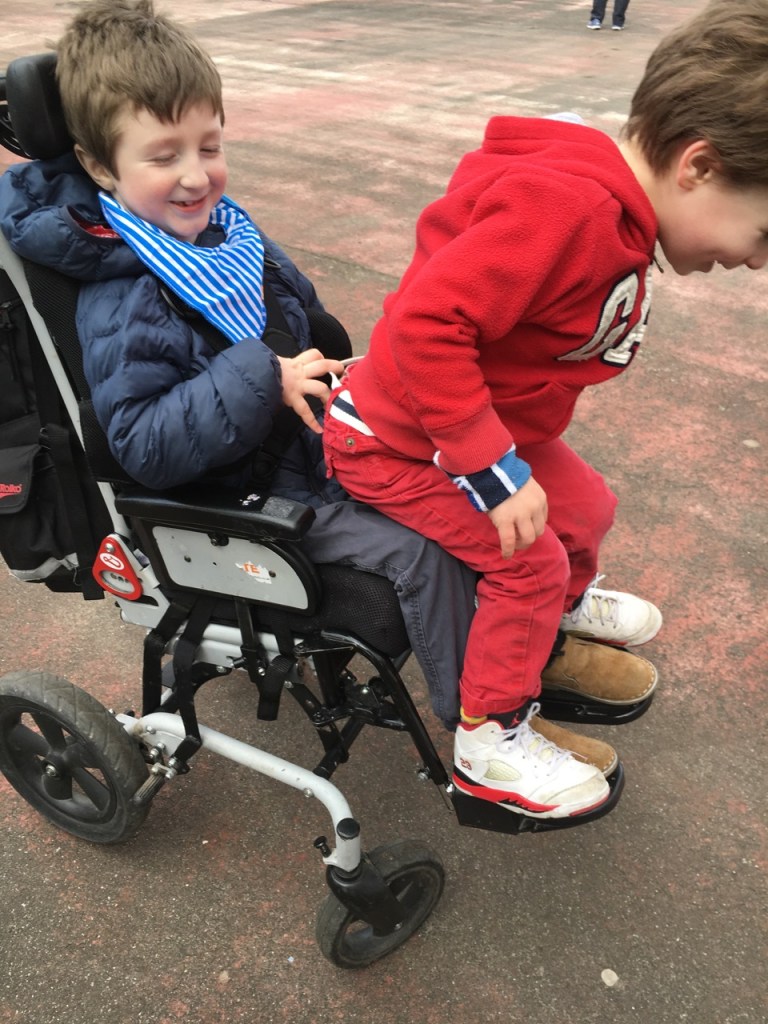
I have been thinking a lot recently about we approach Ben’s wheelchair. I have written before about the differing perceptions of wheelchairs – particularly, how once you are over the psychological hurdle of not walking, wheelchairs are freeing, wonderful things that can compensate for legs that won’t support a moving body. It’s a very simple and elegant solution to a problem. I think the outsider perspective that wheelchairs are constrictive and negative is largely based on someone’s fear that their own legs might stop working. Restrictions placed on wheelchair users are largely a result of the environment around them being inaccessible rather than the inherent disadvantage of using a wheelchair. Perceiving wheelchairs as negative isn’t inevitable – Max loves having a turn in Ben’s chairs and sometimes wonders whether he’ll have one when he grows up.

IMG_0792

When Ben was small we were fearful of him not walking (though it became clear pretty early that this was likely). When he was young he was in a buggy, which was age-appropriate and no big deal. As he got older he moved into a specialist buggy, and then into a paediatric wheelchair. We needed time to get used to each stage; they were harsh physical reminders to us of his disability. But we accepted and adapted, and actually his inability to walk was towards the end of our list of worries. Ben’s difficulty with eating and communicating were (and are) harder for him day-to-day and have more impact on his quality of life than his inability to walk.

I still don’t love his wheelchair – I don’t think it’s designed that well, or looks that nice. It was given to us by wheelchair services. Considering how much time we spend looking at and interacting with it, I’d quite like to be more involved in the choice. I sometimes resent the difficulty of manoeuvring it around, the fact it means we can’t go in some buildings or use lots of public transport. It’s hard to clean and occasionally bits fall off. But Ben using a wheelchair, and us therefore being able to go to ice rinks, museums and parks, is infinitely preferable to us being stuck at home. He is perfectly happy in it.

IMG_1864

I recently read a blog by Tonia Christle, a disabled woman, about her experience for growing up with a cerebral palsy. She writes about the early years:

‘I am five. 

My family likes taking pictures of my sister and me.  We like being the same.  Our clothes match, but not our bodies, because I have a walker and my sister doesn’t.  When we get our pictures taken, our family likes us to be the same, too.

They like me to stand without my walker.  They say it’s better that way.  They are grown-ups, so I listen.  I stand leaning against a wall, or hanging onto a chair or a cabinet, or my sister.  Just as long as my walker is not in the picture.  My walker makes me worse, so I stand far away from it.

I want to look my very best for the picture so I smile, hanging on very tight so I don’t fall.

My family never came right out and said they wanted “normal” kids.  However, as a young child, I listened to the way my family spoke about me and my adaptive equipment (which is very much a part of me.)  And, though I am now in my thirties, pictures of me with my walker, crutches or wheelchair are rare finds.  Many pictures are portrait-style and don’t even include my legs.’

I am definitely guilty of this to some extent. We have plenty of photos of Ben in his wheelchair (or home chair, or standing frame, or walker). But we also have photos where we have taken him out of his wheelchair so that the chair isn’t in the photo, so he ‘looks his best’. I have taken photos of his face (not his body) because I think this is most photogenic (which is partly because, of course, his face is VERY photogenic in my entirely unbiased opinion!).

IMG_5256

(I’m not pregnant again – old photo to illustrate our normally unsuccessful attempts at group family photos)

We presume competence with Ben (we assume he can understand everything we say), and I try not to let anyone talk in front of him negatively, but I hadn’t really thought about the impact of talking about his equipment.

‘Your child is unique and special because they use adaptive equipment.  It is something to celebrate, because this equipment allows your child the freedom to live the life they want to live.’ Tonia Christle. (emphasis added by me)

This idea of embracing the equipment is crucial if you are the parent of a disabled child, and involves a bit of a mindshift. It takes time, and we are getting better (I hope) as Ben gets older. Being a good mother, and ally, depends on accepting Ben as he is. That means embracing all of him and his aids. His wheelchair makes him better, not worse.

We must accept this not just in words and intention, but in the everyday: in our photos of this time in his life, in how we talk about his equipment. Don’t talk about how annoying his wheelchair is, how cumbersome, or how ugly. Don’t deny how intrinsic it is to him. Don’t let anyone else talk this way in front of him either.

This is obvious. We are careful to talk to our kids about what they can do rather than what they can’t. We talk positively about disability, equality, difference. We need to remember to include Ben’s equipment in our acceptance of his difference.

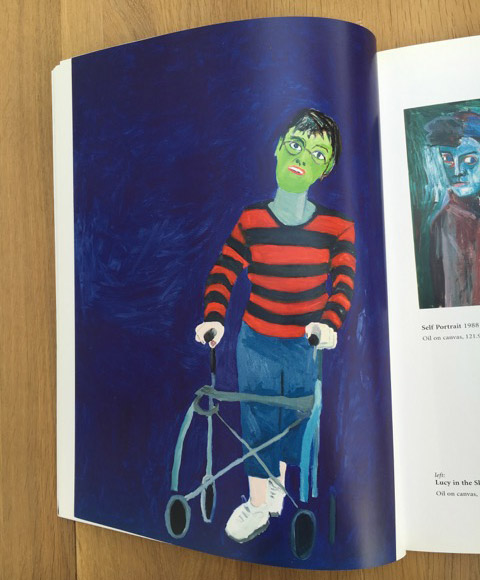
I was reminded of this revelation by a recent exhibition in London of paintings by Lucy Jones  . Jones is a talented, successful artist who happens to also have cerebral palsy. She has painted self-portraits throughout her career and this exhibition includes a self-portrait with her walker.

IMG_1770

An essay about her work describes the context of her self-portraits (which includes feminism in the 1970s), the effect of prolonged study of her own body, the depiction of her disability:

‘In Lucy in the sky 2005 she wanted to say something about being happy, about feeling safe. She is out walking, with her wheelie; she can’t fall over and is free to go anywhere. The painting started with her face, then she added the black and red top, after that the pale blue trousers. Then she had to decide on the background.’ Sue Hubbard, ‘Becoming Lucy Jones’

IMG_1858

Jones’s disability is represented in her paintings and is part of their creation. She talks about how as her confidence grew through her career, she began to paint more of her body, to paint the ‘awkwardness’ of how she looked with CP. These paintings are about how she sees herself, how others see her, and what others project on to her. The paintings describe her coming to accept her walker as being part of who she is, and having the self-confidence to represent it.

The reality of disability is that much is projected on to disabled people and often the problem is with other people’s perceptions rather than the disability itself. The aids and equipment are helping, they’re not a hindrance, and we should treat them as such.

We mustn’t make Ben think he is less because he uses a wheelchair, but rather try to help him have the self-confidence to use it proudly.

References:

Tonia Christle blog: http://www.ellenstumbo.com/growing-up-with-a-disability-the-preschool-years/

Sue Hubbard’s essay ‘Becoming Lucy Jones’ in Lucy Jones: Looking at Self, Momentum Publishing, 2006

Exhibition: Lucy Jones –The Cycle of Life, Flowers Gallery until 21 May http://www.flowersgallery.com/exhibitions/view/lucy-jones

How we learn to talk (part two)

IMG_1051

Recently I complained that Max talks too much. I caught myself saying it twice, to two different people, in one week. Granted, James was away and I was really feeling the intensity of being the primary carer of all three kids, but what was I thinking?

Max is, in the nicest possible way, a chatterbox. Some days he will barely stop talking for hours at a time. It’s a charming mixture of questions, statements and analysis of the varying powers of superheroes.

Max was relatively slow to talk; he just said ‘oh no’ repeatedly for months and as he turned two the health visitor was a bit concerned about his lack of speech. I wasn’t worried. I had spent hours with speech and language therapists with Ben and so knew something of the basics of learning language. I could tell Max knew loads of words and understood what we told him. He made loads of sounds. I had a feeling he was just biding his time until he started talking.

At two-and-a-bit he started saying more words. Within a couple of weeks he was putting words together. And by the end of the month he had three-word sentences. It was like a miracle, like you could see his brain working and his body co-ordinating itself with an ease and fluidity that was beautiful to watch and hear.

Since Ben will probably never talk, I promised myself that I wouldn’t take it for granted. And I haven’t – there have been numerous occasions when we have been so very grateful for Max’s ability to tell us what the matter is when he’s ill or what happened at nursery that day.

Meanwhile there have been many times when we have been so very sad that Ben can’t tell us what the matter is, or what he has done that day. We find ways round it by school telling us each day what he has done, and recording messages on a button that goes to and fro with him, but it’s no substitute for independent communication and it’s a clunky way to converse.

We, and his school, are trying our best to give Ben the means to ‘talk’. We continue to model his PODD book with him (a communication book with lots of symbols to represent vocab), and give him access to his eyegaze computer regularly. When he returned to school after Easter, his carer/nanny printed out photos for him to take to school of all the things he had done over the holiday. I programmed new pages on his computer so he could use his eyes to describe what he had been up to (with photos) for his friends and teachers. (SO proud of myself for managing to navigate the software to do this, with only a couple of exasperating moments when I felt like chucking the computer out the window).

Ben loved all of it – he enjoyed showing people photos of Max squashing him in the park, and telling them about our easter egg hunt.

IMG_1671

But these things are manipulated by us. We choose which photos to include and which anecdotes to tell. Ben can’t tell people what HE wants to about his holiday he can only share one of the moments we chose to include. Who knows whether we have included the bits he most enjoyed? Yesterday we were talking about when we all visited an outdoor exhibition of massive light sculptures and Max’s best, most important memory was of the Smarties Grandpa gave him, rather than any of the sculptures. Kids experience the world differently to adults, and often remember the bits we think are incidental.

Or we (adults) don’t realise what kids want to do. When Max is climbing a tree, Ben will make complaining noises until we ask him if he wants to climb the tree? He then looks at the ‘Yes’ symbol on the arm of his wheelchair, and so we take him out and lift him up into the branches. A year ago he wouldn’t have been able to communicate this clearly something we hadn’t thought of. Or perhaps we weren’t able to interpret what he was trying to tell us.

We continue to hope we can give Ben the means to express what HE wants to say, rather than what we think he wants to say, and he is making progress with the ways he has available.

Each week at school Ben helps create a sentence and they work on the sentence each day, putting the words in the right order. On one of the first days back at school this term, staff in Ben’s classroom navigated him to the Places page of his PODD book. He had to choose the place to complete the sentence ‘I went to the …’ and through careful yes/no answers as he worked his way through the various symbols with an assistant he chose Library: I went to the library.*

School wondered if he really meant library. We hadn’t mentioned going to the library in our various messages to school. Maybe he was confused, or hadn’t really meant library. After all, his communication can be hard to interpret.

But HE HAD GONE TO THE LIBRARY. The day before! So he had told his class something we hadn’t!

Before Max started talking it was all in his head, he just had to work out how to say it all so we would understand. Ben clearly has so much to say, but no reliable way to say it. In some ways this makes me sad. In many ways it makes me anxious – it is our job (with various professionals) to help him find ways to talk to us and I feel the weight of the responsibility.

But mainly I feel hopeful. Ben has started to use the communication systems we are providing and has begun to talk independently. It will take time, but he’s making progress. He went to the library!

How we learn to talk – part one is here

* Note how many symbols there are on this page, which is one of many in the PODD book. Imagine the skill needed to identify which symbol you want on that page and then communicate it to the person you are talking to using only your eyes. Imagine if you got distracted or confused midway through and needed to start again.

Making our own fun

It is the Easter holidays and like thousands of parents around the country, we are in the midst of filling the time with fun, Last week I thought we would try a cycling session at a velodrome.

IMG_1209

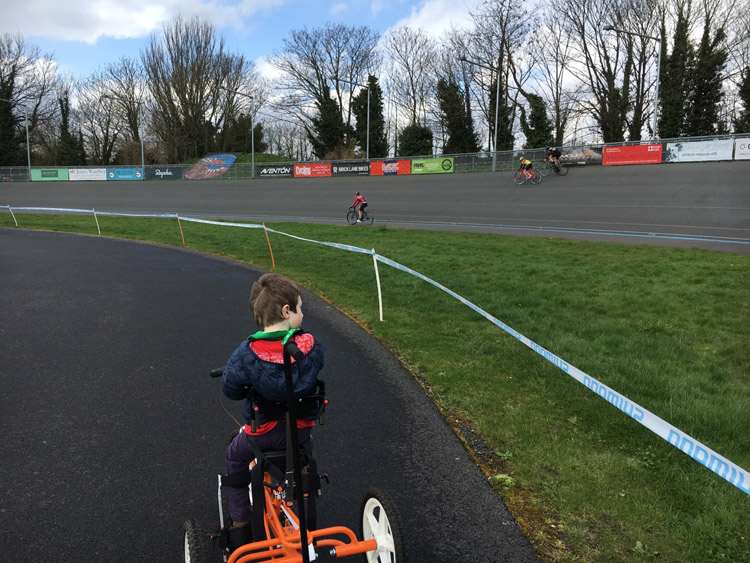
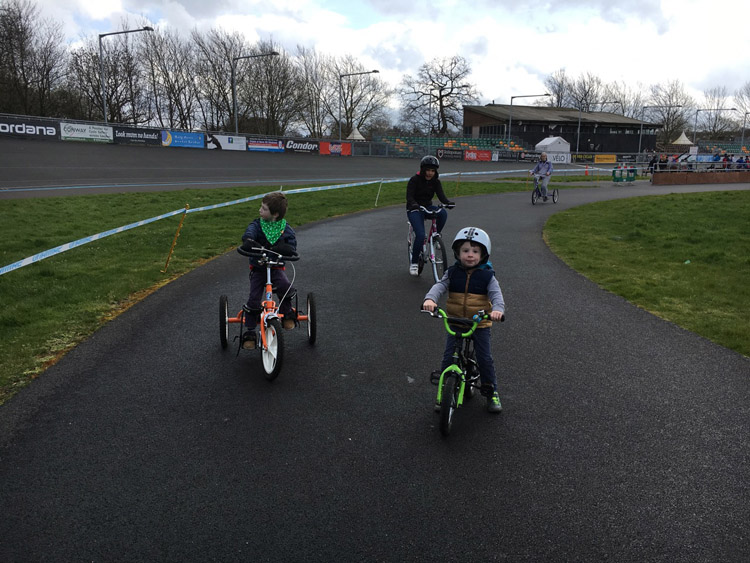
Wheels for Wellbeing run sessions at the Herne Hill Velodrome where they have a variety of adapted bikes and trikes for people to try, though we actually took our own wheels. The velodrome has a professional track with junior cyclists zooming round at high speed, and a flatter track in the centre where children and adults, with various disabilities or none, were cycling around on adapted bikes or trikes – some hand-powered, some with platforms for wheelchairs, some with two seats.

IMG_1206

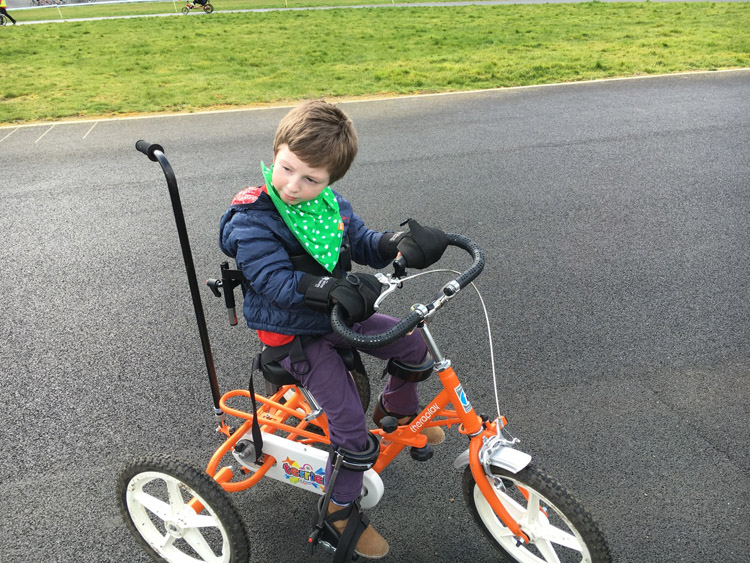
There were very friendly, helpful people around. One of whom suggested we try some mittens to help Ben keep his hands on the handlebars. He went and found and gently fitted Ben’s hands into them, and they worked so well that I have since bought some. Then we bumped into a boy from Ben’s school, and Max, Ben and he did some races round the track. We were there for an hour and it was fun.

IMG_1192

I don’t want to paint too romantic a picture of this outing: because it is actually impossible to co-ordinate the feeding and sleeping routines of three children, Molly was hungry as soon as we arrived so I unpacked Ben’s trike to the sound of her bawling in the car. As the helpful man was fitting Ben’s hands into the mittens, I was breastfeeding Molly under my jumper while walking around and making sure Max wasn’t crashing into anyone. Elegant it was not.

It was raining for a lot of our visit, luckily not too heavily (not least because I’d accidentally left the car sunroof open) but I refused to let it put us off. If I have managed to get all of us to a velodrome with everything we require and no major meltdowns, we are NOT going home just because we’re getting a bit wet! Even if I have negligently put Max in a sleeveless coat.

When I mentioned the idea for this trip to James that morning as he headed off for work he said it was a brilliant idea but noted that it was also so ambitious that I might be nuts to attempt it. He’s right, it’s easier to stay at home where everything is familiar, but more fun to go out. Especially to new places, with welcoming people. And lovely for Ben to see a friend from school. A velodrome! Awesome!

I would love for Ben to do more things like this, where he could meet other local kids and make friends. Maybe even without us. But that appears to be near impossible.

A social worker phoned me in September last year and asked if she could come and visit us. I didn’t know what had brought us to to her attention, but she soon came round one day after school. Since she didn’t seem to need to interact with Ben, he stayed upstairs with a carer and I sat with the social worker in our kitchen for an hour while she asked questions and I answered them.

I had never met her before so I described our day-to-day lives. She agreed that Ben needs were complex. She said she could see our lives were difficult, with the tilted head and sympathetic voice that is so irritating. She asked how we were coping, but offered no practical help because I said we were doing okay.

When she asked what help we needed I said I would like some holiday activities, or weekend clubs, or any kind of extra-curricular activity for Ben that was with other kids and not initiated by us. We can find fun things for Ben to do and fill his days, but we can’t create a peer group for him to do it with, and this is what we need help with.

I said that, as far as I know, there are no holidays clubs in our borough for children like Ben and she agreed. I found one last summer in another borough and she said I should keep looking for things like this, and that when I found them I should contact her team in plenty of time and they would see if they could fund Ben’s place. Which was nice of her, because I definitely have lots of time to be tracking down holiday playschemes, liaising with local authority bureaucracies and checking they understand Ben’s condition.

I had heard of an adventure playground in a neighbouring borough that runs weekend activity sessions for kids like Ben, and asked the social worker if he could be referred to this. She agreed that it might be suitable, but warned me that there was a very long waiting list. That is not surprising, because multiple boroughs like ours don’t provide anything like this. Fine, I said. As far as I was concerned, this was obviously the start of the referral process. She had asked what I wanted, so I had told her. She was taking this forward. Right?

Six months later I hadn’t heard anything. Wow, this is taking a while, I thought. But when I called to check, the social worker denied any recollection of this discussion. She said I hadn’t asked for any referral and so she had not done it. She was more interested in telling me that I was wrong than in actually starting the referral. It turns out we need to be assessed, and the assessment needs to go to a panel, and if they approve funding Ben, only then can Ben be put on the very long waiting list for the playground.

I have since had conversations with other members of the team, and am still waiting for an assessment. So we haven’t even got to step one. Meanwhile, each of these conversations has made me feel really uncomfortable – the only way to get anyone to even think about starting this referral is to ask, repeatedly, for help, something I find hard to do. It seems like I am really putting social services out by asking for assistance and I appear not to have the language to make myself understood or to have a conversation without getting upset. I know we are not in dire need, and plenty of people are worse off, but why is it so difficult to access support which other boroughs (and most reasonable people) recognise is important?

I am asked exactly what I want, which I’m not certain of because I don’t know all or any of the options. The whole thing has to be framed in terms of us ‘needing respite’, because presumably trying to help a six year old boy make friends isn’t sufficiently urgent. We probably do need some respite, but even saying that makes me feel like I’m letting Ben down.

So we will carry on organising our own fun, and lots of fun there is to be had. We’ll go cycling again and try to find other welcoming activity groups. Luckily Ben has an enthusiastic brother, carers with energy and initiative, and an easygoing personality, but it would be really lovely, and a huge relief, if our borough showed some interest in helping disabled kids be children rather than ignoring them.

A space rocket for Ben

In December Max and I went to Ben’s Christmas play at school. It wasn’t what you would call a traditional nativity play – each class did a segment around a theme and Ben’s bit was mainly based on the story of the three pigs and the big bad wolf! This is the second school Christmas play I have been to and they are always a triumph of logistics and imagination.

One of the older classes did a performance based on space, and were dressed as astronauts while singing ‘All About that Space’ to the tune of the Meghan Trainor song. This happens to be one of Max’s favourite songs and he was outraged, ‘It’s All About That BASS, not SPACE!’

Then, as we watched the kids Max said loudly, ‘Astronauts are not disabled.’

‘Um, right, don’t they look great?’ I said.

‘Astronauts cannot be in wheelchairs’, he said.

Luckily for me the next stage of the play involved chocolate coins being tossed in to the audience, so Max was distracted and I didn’t have to deal with the inclusion-disability-space conundrum immediately. But it stayed with me.

Max is as accepting of difference as you could hope a three year old to be. He’s a kid and they deal mainly in black and white and are hugely influenced by what they see around them. So in the same way that they might think women can’t be sea adventurers because there’s only one poxy female Octonaut on the TV programme, they think astronauts can’t be disabled because they haven’t seen one.

And of course they’re sort of right. It’s unlikely there will be a wheelchair-user visiting the International Space Station any time soon. But it’s also pretty unlikely that any of the children we know will grow up to be astronauts despite their aspirations but we don’t therefore tell them it’s impossible. Right now, they can pretend to be whoever they want to be.

The whole point of childhood is to have dreams and imagination, and the role of parents is to make the landscape of their aspirations as wide and ambitious as possible. That’s why we read fictional books. So in the same way that I don’t tell Max that he might not meet the stringent selection criteria for space travel, we also don’t tell Ben that he can’t be an astronaut because he’s disabled. In light of Max’s comments at the play, we spend quite a lot of time talking about how Max AND Ben can be astronauts. And Molly, come to that (depressingly lack of female astronaut portrayal also).

Part of this issue is about representation – kids needs to see disabled people (and girls, and women, and non-white people, etc etc) in their books and on TV, doing the same things that the able-bodied, white boy characters get to do. That’s what the Toy Like Me campaign is all about – calling on the toy industry to better represent disabled kids. There’s a lovely story about their campaign here

While we wait for the rest of the world to catch up with inclusion, I seized the opportunity for action provided by a massive pile of cardboard following delivery of a new sofa from Ikea and…

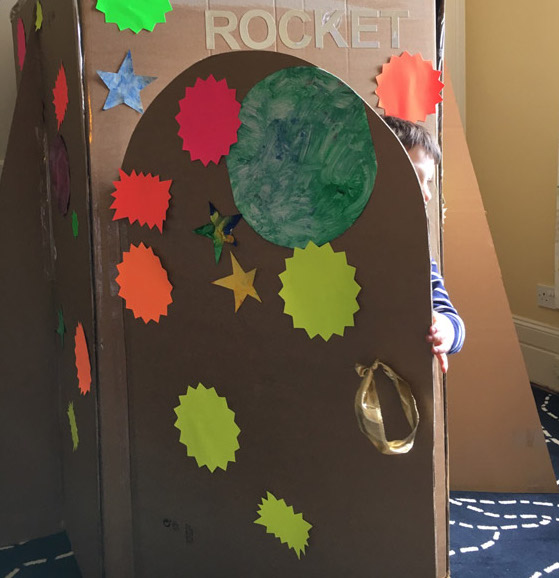
I now present to you: THE WHEELCHAIR-ACCESSIBLE ROCKET!

IMG_0644

My eight years of architectural education have not been wasted. It’s big enough for Ben to get in in his chair and still have room for his brother. Max has decorated it with stars and planets, it has a door to shut out the adults, and interior lighting courtesy of the pound shop. It’s a bit crude, not photogenic and an apostrophe has dropped off but the kids love it.

IMG_0526

IMG_0547

James, Max and Ben have between them created an elaborate bedtime routine which involves turning all the lights off, Max climbing in to Ben’s bed, and then them playing with various light toys. For slightly obscure reasons, this is called a disco (though it involves no music). Therapists would call it Sensory Play.

We recently bought Ben a Buzz Lightyear toy to reward him for all his incredibly hard work using the eyegaze computer and along with the glow-in-the-dark stars and planets and watching clips of Tim Peake in space, the whole thing has become a bit space-themed. Now, the disco often starts with a little trip in to the rocket and a pretend voyage to the moon before the boys get in to bed.

IMG_0655

If the world won’t provide the imaginative horizons my kids need, we’ll have to create them ourselves.

‘To infinity, and beyond!’

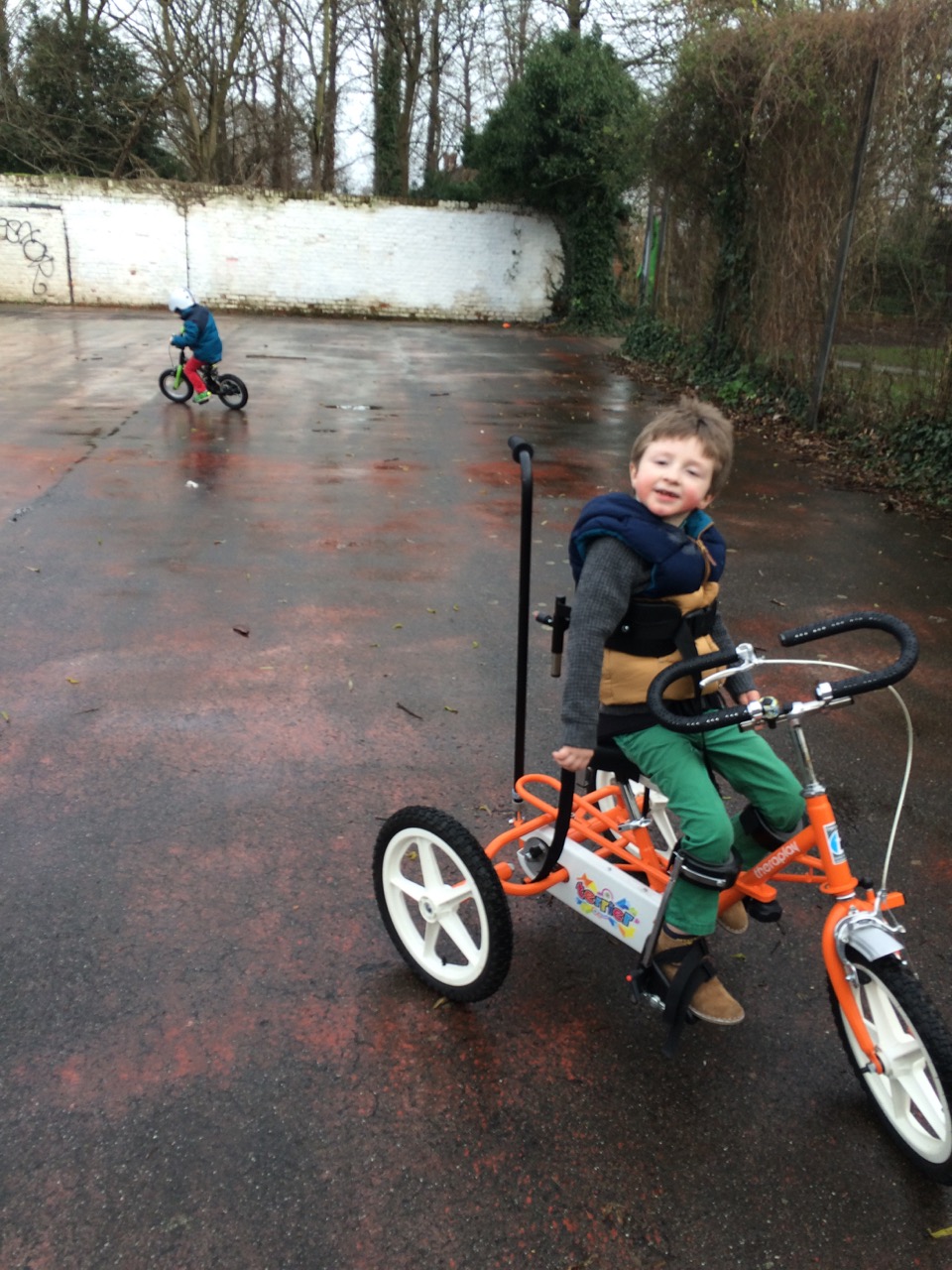
Ben can cycle!

Milestones are a tricky thing for parents and children like us and Ben. Many of the obvious ones from early childhood never materialised and perhaps some never will. If they do, they will be the result of years of hard work on Ben’s part, considerable therapy input and a lot of patience. This is why we start to talk about ‘inchstones’ (as I have done here) which are no less valuable than the typical milestones. Inchstones recognise the scale of greys that we operate in; Ben can’t sit on his own but has worked up from always being held to being able to sit unsupported for two minutes. In our world, this is brilliant progress.

So there we are, pottering along, Ben working really hard on every aspect of his life, accumulating the inchstones. James and I are a bit distracted by the birth of Molly. It’s mid-winter (albeit one of the mildest winters on record) so Ben hasn’t been going out on his trike that much but we have been trying on the weekends when it isn’t raining…

IMG_6243

And then…

He is off! Riding his trike on his own! An unequivocal milestone! Starting with the odd couple of independent cycles with his legs, building up within minutes to confidently pedalling his legs round and round, spinning in circles. I wasn’t there to start with but James sent me jubilant videos by phone and by the time Molly and I got there Ben was happily cycling around the basketball court. We were all so happy it’s tricky to find a video that doesn’t have someone shrieking in it (I’ve muted the sound to save our blushes) but no-one was more excited than Ben himself.

It’s fantastic.

Because cycling is fun.

Because cycling is what six year olds do.

Because it’s Ben being able to move from one place to another entirely under his own steam which he hardly ever does (he can walk in his walker a bit but it takes a lot of effort and is therefore a bit inconsistent).

Because learning to ride a bike is a bona fide milestone (granted Ben can’t yet steer himself but let’s not quibble over technicalities).

Because Max also learnt to ride his bike in the same week and it’s lovely for brothers to do things together.

Because, above all else, Ben was proud of himself and that is a beautiful thing.

IMG_6231

Just in case it’s a while before another milestone comes along, I’m going to dissect a little how this one came about:

Patience and persistence

We have now had the trike for 15 months. We don’t use it every day but most weeks we have pushed Ben in the trike with his legs getting used to going round. I wrote a blog in April last year about Ben starting to cycle himself but it’s not until now that it’s happened reliably. These things take as long as they take. We must be patient and give Ben the chance to learn and develop the skills – it’s no use expecting things to happen quickly and, equally, just because he hasn’t done something (be it cycling, or learning letters, or using an eyegaze computer) within the arbitrary timescale imposed by some adults, doesn’t mean it won’t happen eventually.

Opportunity

As I wrote about here, we bought the trike privately as there is no statutory funding for such equipment and it was really expensive. Ben therefore had the opportunity to learn how to cycle, little and often, over time with no pressure. Kids like Ben have to be given access to equipment and activities even though things like trikes cost over ten times more than a normal child bike.

Enthusiasm

James and I are pretty good at taking Ben out in the trike but probably the thing that tipped the balance in favour of success was his new nanny/carer. She was with James and Ben the day that he nailed it and was coming to it with a level of enthusiasm which we had probably lost over the last 15 months. Ben really likes her and she was encouraging him to pedal on his own having given him a little push, and off he went. Maybe if James and I had been doing the same old pushing we wouldn’t have realised he was ready to do it on his own. It’s perhaps an obvious point but enthusiastic, skilled carers contribute hugely to Ben’s life.

Self-confidence

Because Ben is so dependent on others to help him with every aspect of his life, it is rare that he can do things on his own or that he can take full credit for them. I love that he was so pleased with himself for cycling, and that all of his patience and determination over the last year has been rewarded. When he went to school after the weekend we recorded a message about it on his communication button and sent video links to his teacher so his whole class watched him cycling. His teacher said he was thrilled when they discussed it and the idea of him sharing his huge achievement with his friends with a big smile on his face makes me feel all warm and fuzzy. The boy deserves a bit of self-esteem.

Siblings

Max learnt to really cycle his pedal bike the day before Ben’s achievement – he had been getting close for a while but required a hand on the back of his neck at all times which limited progress somewhat. It may be coincidence that the boys did it together, but probably not. They really keep an eye on each other and the interaction between them is great for them both – Max wants to do what Ben does and learn what he learns, Ben is encouraged to try games and activities that he wouldn’t tolerate at all if Max wasn’t around. This is the latest in a long list of examples of why having siblings is brilliant for them both.

img_8510

Brain surgery

It’s possible that some of this physical progress is down to the stimulators in Ben’s brain. The jury’s out at the moment – let’s wait and see how the rest of the year goes.

So hooray for big orange trikes and small persistent boys.

Sister Molly

Ben and Max’s sister, Molly, is four weeks old. We have survived a month with three children, something which feels like no mean feat.

IMG_0117

That seemed unlikely after our first family outing one week in, when we made it just 100m from our front door before Max broke the rules about how far ahead he was allowed to go on his bike, we shouted, he started crying, Ben started crying because Max was crying, and we all went home. Since then we have managed a family swimming trip and some less eventful local walks. So we might actually be capable of leaving the house as a family of five.

IMG_0103

Both boys have been unbelievably sweet with Molly, and very tolerant of the disruption and imposition involved in having a new-born sister. Through a combination of James having a month off work, numerous carers and family members helping us out, and a baby that sleeps a lot, we have been able to keep things as routine as we can. Ben has shown once again that he can cope with a lot of change and take it in his stride, while Max has been demonstrating his capacity to be both a kind big and little brother. We have all had a lot on, but we’re doing okay

IMG_0082

We do not approach birth lightly. Ben’s disability is because of problems during his birth and we therefore know too much about the risks of things going wrong and having lifelong implications. Max was ill immediately following his birth and had to be admitted to NICU. We sort of assumed that our third baby would end up in NICU, even though a neonatal consultant took the time to explain to us how (very) likely it was that we would have a totally healthy baby.

One of the people who really understood our concerns about the birth of this baby was the obstetrician who we saw throughout this pregnancy and who had previously delivered Max. She is someone we have huge respect for, whose judgement we trust, and who had successfully guided us through my second pregnancy when we were at our most anxious about having another child.

This time we knew in advance that she would not be able to deliver the baby because the elective caesarean was booked during the Christmas period when she would be on holiday. Another obstetrician would do it, it would be fine, we told ourselves. As we prepared on the morning of the birth, getting in to gowns and talking photos of my puffy face, we were calm but nervous. And then she popped her head round the curtain to say hi. Dressed in jeans and tshirt, she was officially on holiday but had come in specifically to do my caesarean section.

That, there, is an emotional moment: the joy of knowing we were in her hands (literally in my case), that our baby had the best possible chance of therefore being fine, that someone so thoroughly understood how difficult this all was for us and had come into work especially.

And then Molly was born, screaming before she was out of my womb, to be immediately declared, with a thumbs up, totally and utterly healthy by the neonatologist we had demanded be on hand to check. No resuscitation, no breathing difficulties, no-one at all worried about anything. She breastfed immediately and, following the facilitation of the obstetrician who knows we spend too much time in hospitals, we were able to go home the following day. You would not believe how uninterested everyone is in a healthy newborn baby – barely any observations, no-one came to check her overnight. If you hadn’t had experiences like ours you would have no idea of the anxiety and stress lurking just across the corridor in the neonatal unit.

IMG_5818

We have now had four weeks of admiring and nurturing little Molly and she is a delight. Third time lucky, we had a baby who didn’t need a canula in their head, or a tube in their nose. She immediately breastfed and sleeps like a champion (just not always at night-time). We take none of this for granted – it is luck of the draw whether you have a baby that does the basics easily or not.

We have not lost and will not lose sight of what a privilege it is to have her here with us, healthy and thriving. Nor what a delight it is to share this baby girl with these boys of mine. We are all lucky.

IMG_0214