Ben can cycle!

Milestones are a tricky thing for parents and children like us and Ben. Many of the obvious ones from early childhood never materialised and perhaps some never will. If they do, they will be the result of years of hard work on Ben’s part, considerable therapy input and a lot of patience. This is why we start to talk about ‘inchstones’ (as I have done here) which are no less valuable than the typical milestones. Inchstones recognise the scale of greys that we operate in; Ben can’t sit on his own but has worked up from always being held to being able to sit unsupported for two minutes. In our world, this is brilliant progress.

So there we are, pottering along, Ben working really hard on every aspect of his life, accumulating the inchstones. James and I are a bit distracted by the birth of Molly. It’s mid-winter (albeit one of the mildest winters on record) so Ben hasn’t been going out on his trike that much but we have been trying on the weekends when it isn’t raining…

IMG_6243

And then…

He is off! Riding his trike on his own! An unequivocal milestone! Starting with the odd couple of independent cycles with his legs, building up within minutes to confidently pedalling his legs round and round, spinning in circles. I wasn’t there to start with but James sent me jubilant videos by phone and by the time Molly and I got there Ben was happily cycling around the basketball court. We were all so happy it’s tricky to find a video that doesn’t have someone shrieking in it (I’ve muted the sound to save our blushes) but no-one was more excited than Ben himself.

It’s fantastic.

Because cycling is fun.

Because cycling is what six year olds do.

Because it’s Ben being able to move from one place to another entirely under his own steam which he hardly ever does (he can walk in his walker a bit but it takes a lot of effort and is therefore a bit inconsistent).

Because learning to ride a bike is a bona fide milestone (granted Ben can’t yet steer himself but let’s not quibble over technicalities).

Because Max also learnt to ride his bike in the same week and it’s lovely for brothers to do things together.

Because, above all else, Ben was proud of himself and that is a beautiful thing.

IMG_6231

Just in case it’s a while before another milestone comes along, I’m going to dissect a little how this one came about:

Patience and persistence

We have now had the trike for 15 months. We don’t use it every day but most weeks we have pushed Ben in the trike with his legs getting used to going round. I wrote a blog in April last year about Ben starting to cycle himself but it’s not until now that it’s happened reliably. These things take as long as they take. We must be patient and give Ben the chance to learn and develop the skills – it’s no use expecting things to happen quickly and, equally, just because he hasn’t done something (be it cycling, or learning letters, or using an eyegaze computer) within the arbitrary timescale imposed by some adults, doesn’t mean it won’t happen eventually.

Opportunity

As I wrote about here, we bought the trike privately as there is no statutory funding for such equipment and it was really expensive. Ben therefore had the opportunity to learn how to cycle, little and often, over time with no pressure. Kids like Ben have to be given access to equipment and activities even though things like trikes cost over ten times more than a normal child bike.

Enthusiasm

James and I are pretty good at taking Ben out in the trike but probably the thing that tipped the balance in favour of success was his new nanny/carer. She was with James and Ben the day that he nailed it and was coming to it with a level of enthusiasm which we had probably lost over the last 15 months. Ben really likes her and she was encouraging him to pedal on his own having given him a little push, and off he went. Maybe if James and I had been doing the same old pushing we wouldn’t have realised he was ready to do it on his own. It’s perhaps an obvious point but enthusiastic, skilled carers contribute hugely to Ben’s life.

Self-confidence

Because Ben is so dependent on others to help him with every aspect of his life, it is rare that he can do things on his own or that he can take full credit for them. I love that he was so pleased with himself for cycling, and that all of his patience and determination over the last year has been rewarded. When he went to school after the weekend we recorded a message about it on his communication button and sent video links to his teacher so his whole class watched him cycling. His teacher said he was thrilled when they discussed it and the idea of him sharing his huge achievement with his friends with a big smile on his face makes me feel all warm and fuzzy. The boy deserves a bit of self-esteem.

Siblings

Max learnt to really cycle his pedal bike the day before Ben’s achievement – he had been getting close for a while but required a hand on the back of his neck at all times which limited progress somewhat. It may be coincidence that the boys did it together, but probably not. They really keep an eye on each other and the interaction between them is great for them both – Max wants to do what Ben does and learn what he learns, Ben is encouraged to try games and activities that he wouldn’t tolerate at all if Max wasn’t around. This is the latest in a long list of examples of why having siblings is brilliant for them both.

img_8510

Brain surgery

It’s possible that some of this physical progress is down to the stimulators in Ben’s brain. The jury’s out at the moment – let’s wait and see how the rest of the year goes.

So hooray for big orange trikes and small persistent boys.

Sister Molly

Ben and Max’s sister, Molly, is four weeks old. We have survived a month with three children, something which feels like no mean feat.

IMG_0117

That seemed unlikely after our first family outing one week in, when we made it just 100m from our front door before Max broke the rules about how far ahead he was allowed to go on his bike, we shouted, he started crying, Ben started crying because Max was crying, and we all went home. Since then we have managed a family swimming trip and some less eventful local walks. So we might actually be capable of leaving the house as a family of five.

IMG_0103

Both boys have been unbelievably sweet with Molly, and very tolerant of the disruption and imposition involved in having a new-born sister. Through a combination of James having a month off work, numerous carers and family members helping us out, and a baby that sleeps a lot, we have been able to keep things as routine as we can. Ben has shown once again that he can cope with a lot of change and take it in his stride, while Max has been demonstrating his capacity to be both a kind big and little brother. We have all had a lot on, but we’re doing okay

IMG_0082

We do not approach birth lightly. Ben’s disability is because of problems during his birth and we therefore know too much about the risks of things going wrong and having lifelong implications. Max was ill immediately following his birth and had to be admitted to NICU. We sort of assumed that our third baby would end up in NICU, even though a neonatal consultant took the time to explain to us how (very) likely it was that we would have a totally healthy baby.

One of the people who really understood our concerns about the birth of this baby was the obstetrician who we saw throughout this pregnancy and who had previously delivered Max. She is someone we have huge respect for, whose judgement we trust, and who had successfully guided us through my second pregnancy when we were at our most anxious about having another child.

This time we knew in advance that she would not be able to deliver the baby because the elective caesarean was booked during the Christmas period when she would be on holiday. Another obstetrician would do it, it would be fine, we told ourselves. As we prepared on the morning of the birth, getting in to gowns and talking photos of my puffy face, we were calm but nervous. And then she popped her head round the curtain to say hi. Dressed in jeans and tshirt, she was officially on holiday but had come in specifically to do my caesarean section.

That, there, is an emotional moment: the joy of knowing we were in her hands (literally in my case), that our baby had the best possible chance of therefore being fine, that someone so thoroughly understood how difficult this all was for us and had come into work especially.

And then Molly was born, screaming before she was out of my womb, to be immediately declared, with a thumbs up, totally and utterly healthy by the neonatologist we had demanded be on hand to check. No resuscitation, no breathing difficulties, no-one at all worried about anything. She breastfed immediately and, following the facilitation of the obstetrician who knows we spend too much time in hospitals, we were able to go home the following day. You would not believe how uninterested everyone is in a healthy newborn baby – barely any observations, no-one came to check her overnight. If you hadn’t had experiences like ours you would have no idea of the anxiety and stress lurking just across the corridor in the neonatal unit.

IMG_5818

We have now had four weeks of admiring and nurturing little Molly and she is a delight. Third time lucky, we had a baby who didn’t need a canula in their head, or a tube in their nose. She immediately breastfed and sleeps like a champion (just not always at night-time). We take none of this for granted – it is luck of the draw whether you have a baby that does the basics easily or not.

We have not lost and will not lose sight of what a privilege it is to have her here with us, healthy and thriving. Nor what a delight it is to share this baby girl with these boys of mine. We are all lucky.

IMG_0214

How we learn to talk

IMG_6819

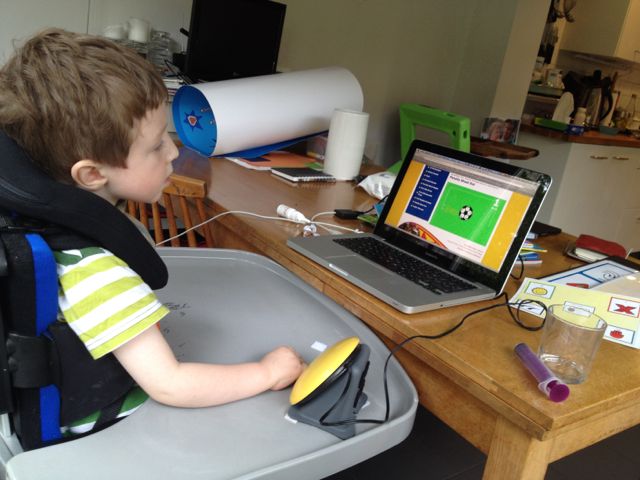
I have just done a two day course on a system that I hope will help Ben communicate with us and everyone else.

Communicating is one of Ben’s biggest challenges. He has a lot to say, but his severe disability hampers all of his efforts to tell us what he thinks or wants: he can’t speak, he can’t point, yet he understands a lot.

He has found highly effective ways to get round this day-to-day. He can smile or frown, laugh, shout or show us his bottom lip (the degree of protrusion of the lip is directly proportional to his sadness, on a spectrum that ends in full-blown sobbing). Whingeing indicates dissatisfaction. Looking expectant means ‘I’m interested’.

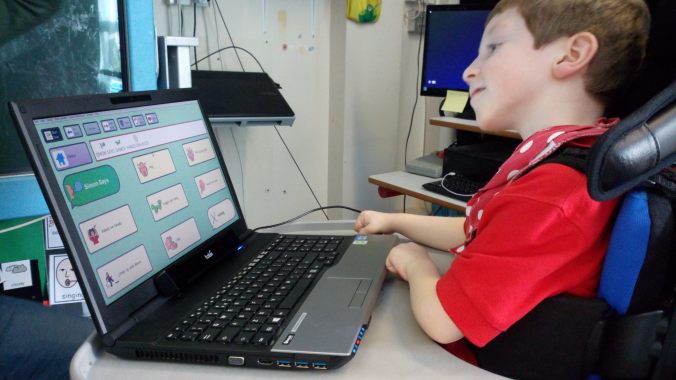
Ben has the intellect to express far more sophisticated ideas and desires than this – but he needs the tools. So we are working with Ben’s school and a number of speech and language therapists to maximise his opportunities, using Assistive and Alternative Communication, or AAC, the term used to capture a whole range of communication systems that don’t rely solely on speech.

Everyone involved in this effort comes together at a termly review meeting. Last week that involved eight professionals sitting around a table for several hours discussing progress. The combined level of expertise is immense.

And partly because of all of this input, Ben is doing brilliantly. In last week’s meeting someone pointed out that (PROUD MUM ALERT) Ben’s spelling is on a level with his non-disabled peers, so it’s important to not push him too hard. He already has to work much harder than a typical kid to spell consonant-vowel-consonant words but he’s doing it – on an eye-gaze computer or by looking at magnetic letters with Granny.

141016-sam-eye-gaze

The major new communication concept we are introducing to Ben is a PODD book, developed by an Australian woman called Gayle Porter, a minor celebrity on the aided language scene.

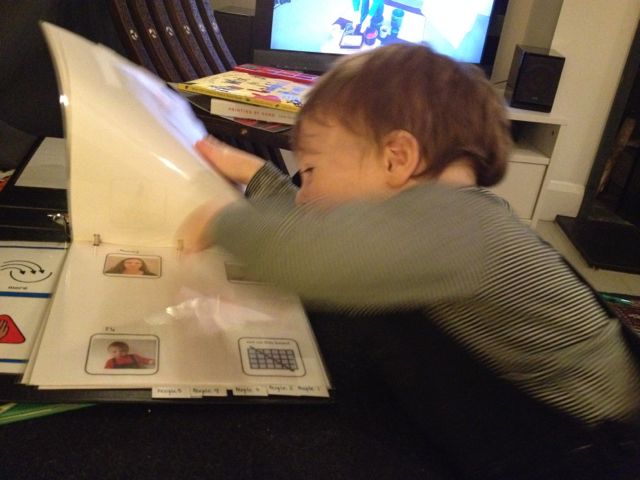
PODD books are full of symbols that you point at to express yourself. The ambition is that Ben will eventually be able to show us which symbols he wants to ‘say’ (video of a child using PODD here).

IMG_9118

The success of using aids like PODD books is totally dependent on the expertise of the people surrounding Ben. The course I was on last week was an attempt to increase my confidence and knowledge.

I came away enthused. This has huge potential for Ben. But at the same time I’m nervous, intimidated even. I took away three main insights from the course that really highlighted how big an endeavour this will be:

1. Do we have the stamina to do this justice?

A typical child hears spoken language for at least 18 months before they start talking (over two years if you’re Ben’s brother Max). It therefore follows that we should be modelling use (otherwise called ‘receptive input’) of the PODD book to Ben for at least a year before we expect him to be using it with us. If we were really to mimic normal acquisition of speech, James and I would use it to talk to each other in front of Ben.

At the course we were shown totally inspirational videos of young children communicating, in ways that just would not happen if they hadn’t been taught to use PODD. But … in some of the videos, their mothers (and they were almost exclusively mothers) had modelled use of the PODD books with their children for over a year before their children started interacting with the book.

The level of skill of these women is impressively high – they can navigate expertly from page to page and find symbols really quickly. But even more important is their level of determination. They have dedicated years of their lives to teaching their kids to use PODD books, even when the kids weren’t apparently engaging with them. It is hugely inspiring, but also massively daunting. What if we’re not committed enough? What if we get bored and demoralised, and that means we fail Ben?

2. You can’t learn a language if you’re placed on mute

If you think of the PODD book as Ben’s way of talking, then you have to have it available to him all the time. Otherwise you are effectively silencing his voice. It is close to the equivalent of gagging a verbal child to stop them talking.

We are already guilty of doing this: we introduced Yes and No symbols on Ben’s chair so he can look at these to answer questions. A few weeks ago, the No got puked on, the sellotape got wet and the symbol fell off. Despite daily good intentions, I still haven’t got round to sticking it back on. And I haven’t got round to putting the Yes and No symbols on his wheelchair.

I introduced an opportunity for him to tell me things and them I took it away. Shit.

3. This needs to be a whole family enterprise

On the course I also saw videos of young children using PODD books really competently with their disabled siblings. Max is really trying to work out the rules around him at the moment and where Ben fits into it: for example, ‘big boys’ walk and babies don’t, but Ben is a big boy and doesn’t walk (cue confused/amazed face). We’ve had discussions about whether Ben can hear Max talking, because normally people talk back when they hear you, but Ben doesn’t talk.

Max already talks to Ben on his terms – he says ‘night night’ to Ben every night and waits for Ben to look at him because he knows that’s Ben way of saying goodnight back. When Max asks Ben a question he says, ‘Ben, can I play with your Peppa toy, YES OR NO’!

IMG_4770

Max could easily pick up the way a communication book works (the photo above shows him at 18 months getting interested in one), but only if he sees us using it. We have to normalise it within our family, even if the wider world insists on only speaking to each other.

I should reiterate that I really am filled with enthusiasm – the PODD system has been thoughtfully developed and children exactly like Ben have learnt to use it proficiently. But, oh my goodness, what a weight of expectation. Remind me of this blog in a year, when my enthusiasm for pointing at symbols might be wavering and I need to remember that we knew we were in it for the long haul.