A Parent Perspective: Interview with Melanie

I spoke to Melanie about being a mother to two children. Her son, Arlo, is seven and has cerebral palsy. Melanie is a journalist and in the last few years has written a book about the early years of being a parent of a disabled child and launched a beautiful magazine about tube feeding, amongst other work.

My son, Ben, is 13 and I knew very little about disabled people or parenting when he was born. My experience of being his mother has been a rapid education in the issues surrounding disability. I find it helpful and interesting to read stories about people with similar lives and I hope you might too!

Tell us a bit about your family.

There’s me and my partner Rowan. I’m a writer and we live in the southern highlands of New South Wales in Australia, south of Sydney. We live with our two kids – Arlo is seven and Odette (Odie) is five. Arlo has quadriplegic cerebral palsy and that’s what brought us into the disability space and got me working and advocating in this area.

Tell us a bit about Arlo. What does he love?

Arlo has loads of hobbies and passions. He’s always been really into music and books. He loves Julia Donaldson, anything that’s rhymey and rhythmical, watching Disney movies and Bluey. He adores music and likes Rowan playing guitar. He’s into people, loves his family, has tons of friends. He’s been in mainstream childcare and school settings his whole life. He’s now at our local school with his sister, where he’s got one-on-one support throughout the day.

He has always made friends easily. He shares in-jokes, laughs a lot. He’s non-speaking but is very expressive. We’re really working on him talking using his eyes with his AAC eye gaze communication device, which is tricky but he can do it. He’s cheeky – he’ll mainly say ‘Play game, play game’. Unless he’s really sick, and sometimes even when he is, he’s pretty happy. He has his moments – he gets a bit shitty with his sister sometimes, though that happens less since she started at his school. She really speaks his language and they like the same movies and music. Arlo has therapies: speech, physio, OT every week after school, so he’s super busy. He takes it all in his stride.

How did you get Arlo’s diagnosis of cerebral palsy?

It was four days past his due date and had been a pretty ordinary pregnancy up to then. His movements felt different so we went in to the hospital, but they said he was fine and sent us home. On our way home I told Rowan to go back because the movements definitely felt different. They put me in a bed and said they’d induce me the next day. We were connected to the fetal heart monitor and all of a sudden Arlo’s heart rate disappeared. It was incredibly lucky that we were in that bed at that time. The emergency button was pressed and they got him out in 10 minutes. We don’t know what happened. It was just a random hypoxic incident – he lost oxygen and that caused damage to his brain.

We only spent one week in NICU and they cooled him for a few days. We couldn’t hold him which was hard. We were in the NICU with all these tiny preemies and you could see there was bad news being delivered all around us. An MRI showed there was bilateral brain damage to the motor section of his brain. We were told on leaving the hospital that “worst case scenario”, this could be cerebral palsy (CP). I didn’t know what that was.

He was always beautifully engaged, smiley and making eye-contact, but as the weeks and months rolled on he didn’t hit a single motor milestone. He never rolled, never sat up. We couldn’t cling to denial past the 3-4 month point. At six months old we got his formal diagnosis of cerebral palsy. Even after that I was googling ‘cerebral palsy misdiagnosis’, thinking this cannot be happening.

He was our first kid. I’d never held a baby really until Arlo. Once we had Odie, I realised that if Arlo wasn’t our oldest child we would have realised early on and would have been freaking out. I love that we had no idea and could be in this bubble. I went to mothers’ groups. I did all the normal stuff. The paediatrician who delivered the diagnosis was really kind. He said CP is so broad and could be very mild, that we just needed the diagnosis to get funds and support. He must have known Arlo’s CP wasn’t mild, but that we didn’t need that information then.

Now we know Arlo’s got a profound physical disability. He’s a wheelchair user, he’s non-speaking, and very bright. We’ve just had equipment trials and spent the day looking at wheelchairs and sleeping systems. We saw our first hoist and it’s confronting. I remember when I first saw a stander I thought it was so ugly, but we got used to it. Same with the hoist- we’ll get it, we’ll put it in the spare room for a year and then we’ll be ready when we need it. We love his wheelchair.

How were the early months and years with Arlo?

By some miracle he was great at breastfeeding, then he was eating purees – although that all stopped when he turned five and got his G-tube. He was in a standard pram for ages, and we had this period where things weren’t that different to his friends. By the time they were, we were okay with it. The only time it’s not okay is when Arlo’s really sick and misses school and his friends, and misses out on fun. That’s awful, and it happens more for him because his health is compromised.

He was such a beautiful baby. There was sadness and fear around his diagnosis but a lot of fellow disability parents I spoke to said try and stay in the moment, and when I’d look at him, he was joy. There’s scary stuff, there are hoists and equipment, and people say crummy things sometimes. But we’re lucky that Arlo is generally happy. We’ve had bad periods, but he’s now sleeping through the night and that’s a massive factor in our mood. I don’t speak for every parent, and I know there are real challenges, but I appreciate what we have.

What do you think enabled you to accommodate something so unexpected?

I think part of it is I wasn’t someone who had the baby shower and big ideas about becoming a mother. I didn’t really have expectations. It has helped having a supportive partner – I think that’s made all the difference. Rowan and I have always both worked flexibly and I think I’d feel very differently if it was all on me. I’ve also had professional success as a result of this. My career went in a completely different direction and my work now feels meaningful. I’m writing about stuff I really care about. I have a passion and I feel like I have a purpose.

How did your book, Special, come about?

We had a social worker come out to us soon after Arlo’s diagnosis and she was very well meaning, but she gave us a children’s book and DVD that were so depressing and bleak. I came up with the idea for a book, which was partly an excuse for me to talk to other parents because I wasn’t ready to go to a support group. I spoke to parents raising kids with all kinds of disabilities and there were common themes: we all try to stay in the moment. We all build community, try and find like-minded parents. We all find joy and a new perspective. It connected me to so many people and really fast tracked me to acceptance. I love that it’s helping other parents do that now, but it comes from a place where I felt so differently.

Tell me more about the tube feeding magazine, The Blend.

When we started tube feeding Arlo it was expected he would be on synthetic formula. He had been eating blended puree so it made no sense that we went from that to six bottles of formula pumped into him throughout the day. He was sick and aspirating. It was terrible. Another parent said I could put the pureed food he used to eat down the tube. We did, and everything changed, but there wasn’t enough information around. The pamphlets were really academic or designed for a child. That’s where the idea for The Blend came from. I wanted to make a cool magazine about tube feeding and for it to be beautiful and make people feel like they were part of a community. We have done two issues so far and I’m bringing out a third. The disability market is huge and there should be beautiful things to cater to that market.

How did you decide to have a second child?

During the emergency caesarean to have Arlo they found a cancerous cyst on my ovary so six weeks later my left ovary and fallopian tube were removed. My gynaecologist said we needed to “complete” our family as soon as possible and, very fortunately, I got pregnant when Arlo was just over a year old. That pregnancy was not fun because we were treated as high risk, which meant a million scans. They would say things like, ‘Her head’s growing a bit fast for her body,’ and it was just trauma and terror. But we had a planned caesarean two weeks before her due date and it was a completely different experience. It was lovely. I was awake when she was put on me. Seeing the typical milestones met, it makes you very unsympathetic to typical parents! Arlo taught us to have zero expectations and Odie has taken her time, she’s got there in her own way. Seeing the way her fingers and tongue move was mind blowing. When I saw her standing in her cot for the first time, I completely freaked out because my brain was not used to seeing children standing. We’ve got this weird training with Arlo that is only for Arlo. It’s been such a wonder to see both ways, to have both paths, to see the things they share and where it isn’t different.

But it’s complicated. The night before we had Odie, I was beside myself because I felt like I was betraying Arlo and that I could never love anyone as much. Of course, I could. Since then, Odie has been interesting and challenging in her own ways. Many days are harder with her than Arlo, who tends to be very sweet. Odie is a whole other bag of challenges. We let her do her own thing but I’m probably not as patient. She’s never allowed to be sick! I need to watch that there isn’t different treatment. I love that she has this world view that I never had. She sees disability is normal. She’s jealous of his wheelchair and his hospital stays. She has a really popular brother who makes her look good a lot of the time!

Are there parts of your life now that feel less unexpected than others?

Everything feels normal eventually. I know that we’d be tired and stressed regardless and I’m normally stressing about work, not Arlo. You think you’ll never get used to it, you’ll never be able to fold the wheelchair that has 26 different parts, but you do. Arlo has so much stuff – several medications, tube feeding – but it feels normal. The only times I’m conscious of it is when I notice other people’s reactions. It pisses me off when people think I have a horrible life or that what’s happened to us is the worst thing ever. I was that person before, but I want everyone to know what I know now, then there wouldn’t be this horrible reaction when you learn that your child has disability.

There’s rarely a moment where I catch myself thinking this is not what I expected. Getting the car modified was difficult – I’ve never been a very confident driver and I didn’t think I’d be driving around in a bus but I’m proud of myself for doing it. You realise you can do anything and that gives you confidence in other areas. I didn’t think I could write a book, or start a magazine, or do a podcast. In the day to day I’m tired, I’m laughing, I’m stressed, and the feelings are the same as they would have been if Arlo wasn’t disabled.

More about Melanie here: https://www.melaniedimmitt.com.au/
Find Melanie on Instagram or Twitter

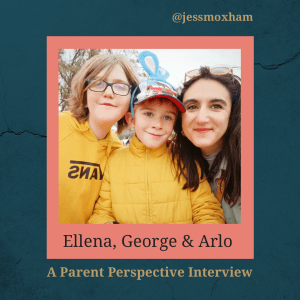
A Parent Perspective: Interview with Ellena          

I spoke to Ellena about being a mother to two sons – George has a rare genetic condition and Arlo is autistic. Ellena also works as a teacher with children who have physical and medical needs so her professional life is entwined with her personal experience.

My son, Ben, is 13 and I knew very little about disabled people or parenting when he was born. My experience of being his mother has been a rapid education in the issues surrounding disability. I find it helpful and interesting to read stories about people with similar lives and I hope you might too.

Jess: Tell us a bit about your family?

Ellena: There’s me and my husband Charlie. We are both secondary school teachers. We live in London with two children. Our oldest son, George, is 12 and has a very rare condition called SEPN1 Muscular Dystrophy. It’s an autosomal recessive condition which is quite different to other muscular dystrophies inherited from one parent. We have a younger son, Arlo, who’s nine and has autism. Our oldest son is in a mainstream secondary school, our younger son is in mainstream primary school. Charlie and I lurch from one thing to the next on a daily basis like most families.

Jess: What do your boys like doing?

Ellena: They’re both real characters. George is a very emotionally mature child. He has spent a lot of time in hospital with medical professionals so gets on very well with adults. He is incredibly sociable and very good at making friends. He’s very interested in art – he likes making things and we have tried to nurture his creativity. There are lots of things he finds physically hard – he can walk but not really run or jump, and going up and down stairs is hard for him. He sometimes uses a wheelchair, but he’s physically ambitious. He’s decided that he’s very into badminton. He really likes going swimming – he can’t actually swim, but he’s fearless. He’ll just jump in.

Arlo is nine and has a specialist interest in trains. He can talk to you a lot about the world of Thomas, and he likes making elaborate train setups with tracks. He loves going to flea markets and finding things that appeal to him, which tend to be Thomas related. He’s found some amazing Hornby things, though it can be hard for him to regulate himself with the uncertainty of whether he’ll find anything.

Jess: What is George and Arlo’s relationship like?

Ellena: They get on quite well together. Arlo’s quite triggered by the sound of people singing and unfortunately George and I like to sing, so we get a lot of telling us to be quiet. He finds certain noises hard, so sometimes they’re a flashpoints. George said to me the other day that he sometimes looks at other siblings and wishes he had a different sibling relationship, because Arlo’s not so sociable and he’s not tactile or demonstrative. He is loving on his own terms. Those relationships are hard, especially when they both have quite different needs. At times, they have both had to yield to the other sibling in terms of time, or our attention, and I worry about that.

Jess: Tell me a bit about the births of your children, and your realisation that Arlo was autistic.

Ellena: Nothing has gone according to the plan that we had. Life as a parent is amazing when your child is hypothetical, and then when you actually have your children you realise nothing is ever how you think it’s going to be. Sometimes that means that your child is born with a really serious condition that is life threatening or life limiting, as was the case with our first child, and sometimes it’s not so high stakes.

We went through the genetic counseling process to have second child. We found out Arlo was a carrier for George’s condition but wouldn’t have it himself. When he was born, I very quickly realised things like laughing, smiling, eye contact were not how I thought they were going to be. Initially, for a very short period of time, I felt a very deep depression at this not being what I expected, or what I wanted. Then that went, because we are very lucky to be well supported as a family. We’ve got really good professional knowledge of children. I stopped thinking about all of the things that my life perhaps could have been and started focusing more on the way it actually was. It’s an incredibly privileged position – not all families are able to do that, and we shouldn’t expect them to. Life is very hard lots of the time, but that doesn’t mean that it can’t also be good a lot of the time as well. It’s about these massive contradictions sitting side by side always. You have to cling on to the things that are going well so you are able to keep going when things are really difficult.

Jess: How do your personal and professional lives influence each other?

Ellena: Before I had George, I was an assistant head in charge of inclusion at a secondary school in Hackney. I love teaching English, but I was also interested in how children learn and how we adapted the curriculum to fit individual needs. When we had George it became clear that he was very unwell. We had loads of different tests and I left teaching for a while, then had my other son not that long after. When I went back to work I became a more specialist teacher, and now I’m an advisory teacher for secondary schools. I support mainstream schools to do the best they can to include children who have physical or medical needs. We have a phenomenal number of children with very complex and quite rare medical needs in the borough and we want to make sure we get it right for them.

So I’m in the world of additional needs at work and at home. I sometimes reflect on that. I read things online about parents that are fighting for things or they’re not sure what’s happening, and it’s overwhelming. If I didn’t know all of the things I know through work, I would find it so much more difficult than I already do.

I think most parents, most of the time, do what they think is best. I have an interesting relationship with health professionals, professionally and personally, where judgements are made about parents. I always gently ask them, ‘Do you think that parent has done what they genuinely thought was right at the time?’ The answer is normally yes.

As a parent of a child with a disability, the number of times you are judged for your choices or your parenting is far more frequent than parents of non-disabled children. When George was little if a healthcare professional said something I found it upsetting or inappropriate I wouldn’t say anything. Increasingly I do say. For example, an Occupational Therapist visited our house recently to look at George using the bath. We live in a typical Victorian terrace, tall, lots of stairs. In an ideal world, I’d live in a huge house with great access, but the world doesn’t work like that. We went into our normal bathroom, and she said, ‘This is a very small bathroom. Have you considered moving?’ I said, ‘Out of interest, would you appraise somebody else’s house like that? Why do you think that it’s okay to say something like that because they are a parent of a disabled child? You have no idea what people’s circumstances are.’

It’s really hard to navigate those situations sometimes, because all parents are just scrambling around trying to work out what to do at any given moment. If your child has some sort of additional need, those challenges are multiplied by hundreds. Lots of experiences – going to a playgroup for the first time, or your child starting school, or going swimming – all of those things are completely different experiences for families like ours.

Jess: Do you have any advice for other parents?

Ellena: Never let go of what you think is right for your child, and for you as a family. If there’s a disconnect between that and what professionals are saying, or there’s a disconnect between that and how professionals are treating you, there’s nothing wrong with advocating for yourself and your child. Say if you don’t think something is appropriate.

All parents of children with additional needs could give you examples of mad things that professionals have said to them. I try so hard to think about that in my professional life.

Jess: What has been your approach to supporting George?

Ellena: Last year George had his PEG feeding tube permanently removed which was a big step for him because it was fitted when he was 2. He’s now waiting for the site to heal into a mark that’s going to be there forever. For him, that’s a symbol of a chapter of his life ending and moving on to the next thing. He’s quite philosophical about things, but he’s also a very good advocate for himself and others. I’m very proud of him.

We’ve never held him back or helicoptered over him. Sometimes I’ve had to keep all of my anxieties to myself, which is really hard, but he’ll give everything a go. But because I’m so immersed in this world, I sometimes forget that our life is quite different to other people. It’s not unusual for young people to have an autistic sibling, but George has a physical disability that is progressive on top of that. He has lots of medical equipment and these things impact him if he wants to do a sleepover or go on a school trip. I think George feels the difference quite keenly.

My husband and I have tried to encourage the boys to say what they feel about something, even if they’re worried it might upset us. It’s probably less obvious what the impact is on Arlo because he can’t always articulate his thoughts in a way that we understand. With George, we’ve always been very upfront and encouraged people to ask questions. When he was very little he wore a helmet because he could walk but he had lots of falls, and splints. We always encouraged George to be proud of those things. Recently, we went to a hospital for a sleep study and the next day he wanted to get back to school. It was hours of waiting for a consultant to see him, for no clinical reason. George wanted to leave and when I pushed for them to discharge us, the doctor asked if we had somewhere else wee needed to be. On the way home, George asked if the doctor was saying that because he has a disability, he shouldn’t expect to have a normal life? That he should expect to give up his days to sit in a hospital?

I’m hoping some of our groundwork will support him when he looks around and sees all of these differences. It doesn’t mean that life’s not going to be challenging in lots of ways. I try to acknowledge the differences and be really matter of fact about them, with George and with the families I work with. Say, ‘Yes, this is what my child does.’ I think the reason George is so keen on raising issues when he thinks somebody’s being discriminated against is because we’ve tried to encourage him to feel confident in himself, and with having a sibling who behaves differently. If we’re on the bus and Arlo’s flapping his hands and somebody says something, I’ll say, ‘Yes, he’s flapping his hands.’ You don’t have to get annoyed with people, just reaffirm what’s happening.

We say to our kids that the world is imperfect and there will always be people who are going to say and do things that they shouldn’t. You just carry on doing the things that you are happy with and that you want to do. You’ve got lots of supportive people around you.

You can find Ellena on Twitter and Instagram

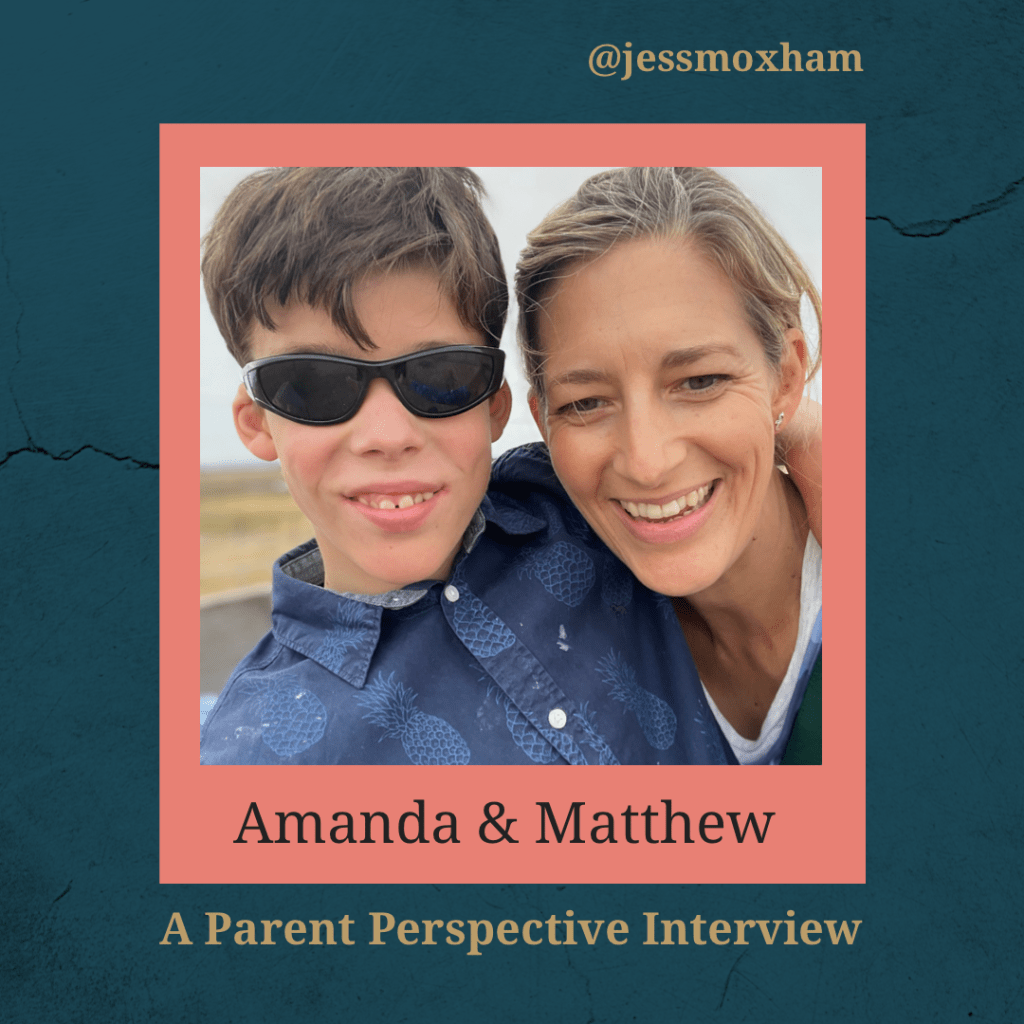
A Parent Perspective: Interview with Amanda

This is my latest interview in an occasional series – A Parent Perspective, I spoke to Amanda about life with her four children. Her son, Matthew, has a rare chromosomal disorder and Amanda has battled to get the support Matthew and her family need. Her tenacity is extraordinary but working against the systems that are meant to support has been difficult for all of them.

My son, Ben, is 12 and I knew very little about disabled people or parenting when he was born. My experience of being his mother has been a rapid education in the issues surrounding disability. I find it helpful and interesting to read stories about other people with similar experiences and I hope you might too.

Could you describe your family?

My husband and I have four children who are all quite close together. They are 16,14, 12 and 10. Our 12 year old, Matthew, was born with a chromosomal disorder called 47,XYY which means he has an extra male chromosome.  He is non-verbal with complex learning difficulties and autism. Matthew‘s siblings are great with him and I think it’s taught them so much. There’s so much to consider with Matthew just to keep him safe, and I constantly worry if I’m there enough for the others. 

How would you describe Matthew, and what are his particular challenges?

Matthew loves music and being outdoors. He has a wide taste in music, everything from heavy rock to salsa to Gangnam Style. So there is always music playing when Matthew is around, although he likes nothing more than to press repeat over and over again on a particular track so we never get past the intro!

Matthew is cheeky and inquisitive and has a great sense of humour.  What makes life hard for him is his sensory processing challenges and difficulty with communicating – he’s nonverbal but can be very noisy! We all do some signing and he has a talker on his iPad that he’s learning to communicate with. It’s difficult for him in the wider world because other people don’t know signing.

The lack of communication leads to a lot of frustration. Sometimes he’ll be doing a sign that I haven’t seen before and he’ll look me in the eyes, coming up really close, like he’s trying to say, ‘Why can’t you understand what I’m trying to tell you?’ He has no sense of danger. He’s always on the go, doesn’t sit still, and doesn’t have a sense of social norms or personal space.

How you get the diagnosis of Matthew’s genetic condition?

When he was born it was suggested that he might have Down syndrome because of some physical features.  After a week of waiting and wondering, we were then told everything was normal. About a week later, the consultant phoned to say the blood tests had shown something in Matthew’s chromosomal pattern. At a hospital appointment we were given a Wikipedia print out to explain that Matthew had an extra male chromosome, but we were told it wasn’t much to worry about – he might need a bit of extra help at school.

Matthew was slow to roll over, then crawled when he was about a year old. He started to walk when he was about three but he wouldn’t tolerate wearing shoes – he would scream and kick. I was thinking about autism because he would look up into the distance, and liked to be on his hands and knees and spin a lot. A paediatric nurse agreed there were enough traits to say it looked like a ASD diagnosis. I thought we might get some help as a result but didn’t.

What has Matthew’s school experience been like?

I had come across ABA (Applied Behavioural Analysis – a particular way of teaching children with autism) when Matthew was in preschool and I was very sceptical, but we did an hour a week and saw a change in him. It was all about play at that age, but we started to introduce some learning goals and it went really well. I found out you can run an ABA programme in a mainstream school, where trained tutors support the pupil alongside the class teacher, but once we said we’d like to do so the local authority said Matthew should go to a special needs school. We had to fight and went to tribunal with an advocate and reports to show why he needed it. It was an awful experience to go through, having to argue our case and be cross examined by an aggressive barrister who referred to our son as a ‘drain on the state’. After that stressful experience we won and Matthew started in reception.

Running an ABA programme in a mainstream school brought its challenges. We were responsible for employing the tutors and I felt like an HR and payroll service. If a tutor was sick, Matthew couldn’t go into school. There were lots of challenges trying to get speech and language therapy from the local authority – nobody saw him for two years. When it came to his secondary transfer, the local authority were suddenly interested and wanted to assess the effectiveness of the programme, despite having shown little to no interest over the years. We said he needed to go to an ABA secondary school because that was the only style of learning he was used to and had made excellent progress. The local authority refused, insisting it go to tribunal, although they didn’t have a leg to stand on. Again we went through the expensive process of employing an advocate and getting our own reports from independent professionals. At this hearing the local authority brought witnesses that had never met Matthew and the judge dismissed them in the first 10 minutes and agreed to everything we were asking for. The whole process was unnecessary and made me wonder what happens to the children of parents who don’t have the knowledge of the system or the financial means to fight it. 

Matthew started at an ABA special needs secondary school last November and it’s going really well. He spends a lot of time exploring the school and they’re gradually easing him into more academic tasks. I feel like finally we’ve got him what he should have always had – regular speech and language, OT and physio input. He’s learning how to interact with others and life skills, which is really what I want for him. I’ve found him being at a special school quite hard to deal with as a parent – not that I was in denial about his needs, but coming to terms with the realisation that he’s always going to need someone to keep him safe.

How much support are you getting out of school?

It’s been an ongoing struggle over the years to get any help.  A few years before lockdown, after many years of refusing, the local authority agreed for Matthew to go to a respite home locally. We built up to three weekends a month and some nights during the school holidays. It was incredibly hard because we missed him so much but it allowed us some breathing space. When Covid happened, the home shut immediately which was tough but we just got on with it because everyone was in the same boat. Sadly it then closed permanently.

Since then I’ve lost count of the number of emails I’ve written (often ignored) and phone calls made (and not returned) pleading for support.  We have jumped through so many hoops and a huge amount of intrusion and judgement to then be met with responses such as “Senior management have not agreed to your request” or “Matthew is not at risk of harm so the best place for him is the family home”.  It felt like we were stuck in this Catch 22 situation where you only get help if you fall apart. 

The irony of all this is that whether it’s social care or education, when you have a child with special needs so much time and energy is spent fighting the system when you are already exhausted. 

Recently we have managed to secure a new respite placement for our son which was not easy. The system of processes and procedures is not set up to help parents of disabled children. I have so many feelings of grief and guilt, of not being a good enough parent, of not being able to cope. Deciding to place our child in regular overnight respite has been one of the hardest things I’ve ever done.  Each time he goes I feel my heart breaking a little more. 

Having a disabled child has opened my eyes to how parents are left to get on with it on their own. I would have assumed that if you need help – such as speech and language therapy for a child who doesn’t speak, or respite so you can recharge your batteries to look after your child – you’d be given that help, but that’s not the case. I’m angry about this and wonder if I’ll ever get to the day where I’m not battling? I have a dream of building a respite home for disabled children because I don’t want anyone else to go through these struggles.

You are a Pilates teacher. Is there a link between being a carer and doing Pilates?

Pilates has been my saviour, in giving me an identity other than mum or carer but also in keeping me strong physically and mentally. Sometimes it’s difficult to fit in my own practice, but without it I would have gone mad by now. It’s a chance to forget everything else and just move. Movement is a kind of meditation. When I’m teaching, I’m totally in the zone, and I have great clients. You build up a relationship and help people make positive changes which is very satisfying.  I also teach in a forest so being outside in the fresh air is another bonus.

Some names have been changed.

Amanda is on Instagram at @kemp_pilates

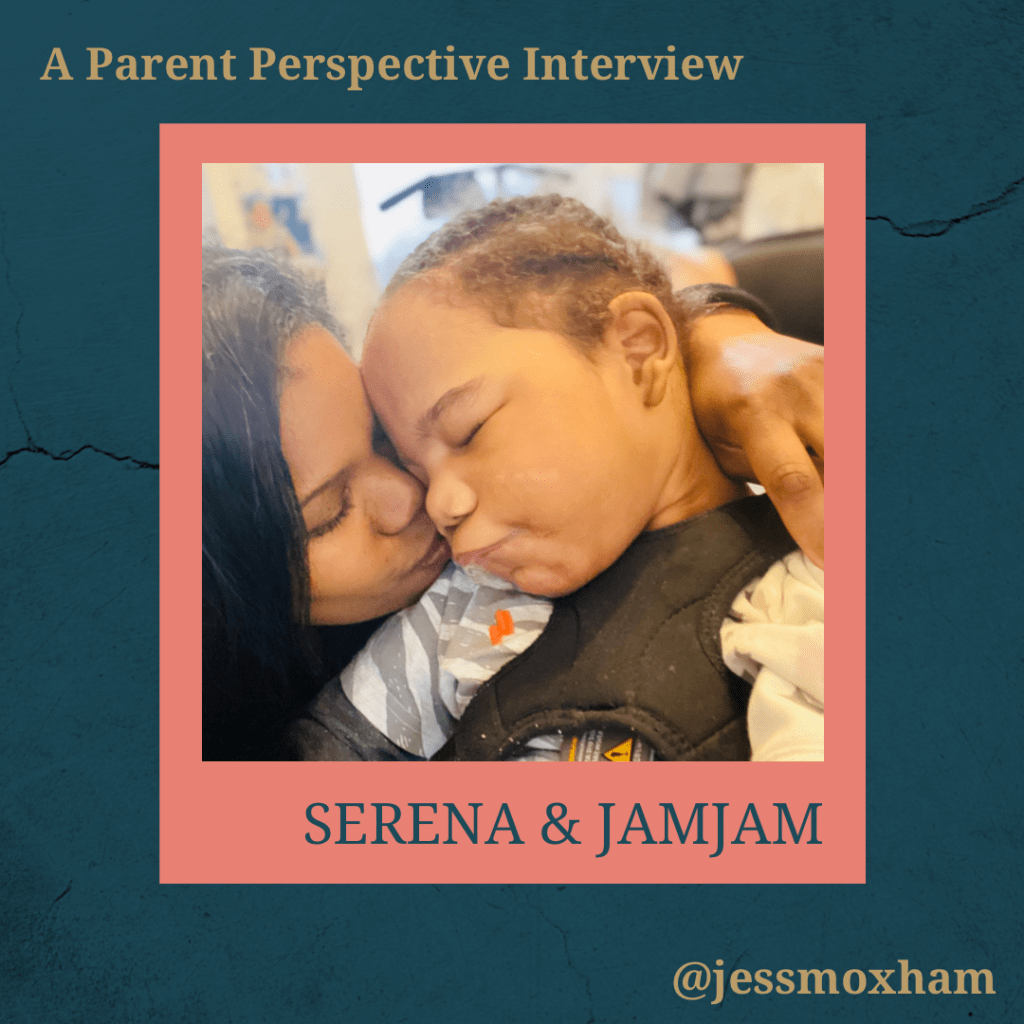
A Parent Perspective: Interview with Serena

This is my latest interview in an occasional series – A Parent Perspective. I spoke to Serena about her experience raising her son JamJam, who has a rare genetic condition. JamJam has defied the odds but keeping him healthy is complex and Serena is often fighting for him. I hugely admire Serena and I loved hearing how she approaches life with JamJam within her big family.

My son, Ben, is 12 and I knew very little about disability when he was born. My experience of being his mother has been a rapid education in the issues surrounding raising a disabled child. I find it helpful and interesting to read stories about other people with similar experiences and I hope you might too.

How would you describe your family?

We have a big family. Between my husband and I we have eight children – four older girls in their 20s, a son who’s 16, a daughter who’s 13, a five year old son, and JamJam who is four.

I love having a big family. I love for us to be around the table together, hearing about their days. Sometimes I take a step back and listen to the laughter and think, that’s me. I’m the mum to you guys!

Tell us about JamJam.

He is the most chilled of all my children. He lights up the room, laughs and smiles a lot. The minute he hears the beat to some music, he’s dancing. As soon as he hears your voice he’s moving his head. He does trampolining at school and he really enjoys that. He’s happy outside with fresh air on his face. He’s an amazing boy and we love him.

He goes to a fantastic school. It was a battle to get him there because it is out of borough, but we are so happy with everything that they do for him. Because JamJam is blind, he doesn’t have the cues from light and dark perception and his sleeping habits are really erratic. Since being at school his sleep is much improved. He’ll sleep for five hours in a stretch now which is a big difference for us.

Patau syndrome is the official name of his condition, but it’s commonly known as Trisomy 13 – he has three copies of chromosome 13. The prognosis is typically quite bleak – if children survive the pregnancy, they tend to live seven to 10 days. 90% of children die before their first birthday. It was a complete shock when we found out. We had seven healthy children and I come from a really big family where there are no disabilities. I wasn’t worried when I did the amniocentesis. We got the results on 16 August 2017 at 9:35am. It was my son’s 12th birthday so there were lots of his friends in the house up bright and early, wanting breakfast. We were expecting the call and my husband and I went into the kitchen when the phone rang. The geneticist said, ‘I’m really sorry, he’s positive for trisomy 13’. We were stunned. Neither of us said anything for what seemed like ages. We hugged then I went into the toilet and I cried and cried. Then I had to wipe my tears and get on with the party. Our lives changed in that moment.

And then how as the rest of your pregnancy?

We had options. Because this condition is seen as incompatible with life, you have the option to terminate at any point in the pregnancy. They explained that after 22 weeks, they would inject through my abdomen into the baby’s heart to stop it, then contractions would start and I’d give birth. The thought of it was horrendous, like I’d be murdering my child. We were in turmoil and only had weeks to decide what to do because we knew 22 weeks was going to be the cutoff point for us. Also we found out I was pregnant nine months after having a baby, and during the previous delivery I was really unwell and was in theatre for over nine hours as they tried to control a bleed.

What made the difference for me was our faith, because we’re Christians, and then also reaching out to the Trisomy 13 community. Our geneticist and consultant told us things based on the knowledge they had, but we entered a whole new world when we joined the trisomy 13 community and saw that children do live. There are children who are 4, 6, 30 years old with the same condition, and that gave us some hope that our child could be in the 10% that survive beyond their first birthday. We decided to let him write his own story – to give him the chance and deal with whatever life throws at us.

How were you both when he was born?

I was absolutely fine. JamJam had been put under palliative care during my pregnancy and offered comfort care only. We had to battle to have that decision overturned and for him to receive medical intervention. Fortunately we were successful because he wasn’t breathing when he was born and he was resuscitated. He had lots of issues maintaining his blood sugars and needing platelet transfusions. When he was three days old, an ophthalmologist examined him and said he had been born without eyes. Shortly after that we were told he was deaf. He was only in hospital for two weeks and when we got home we did more hearing tests. On the third test, they said that he did have muffled hearing. We prayed about everything. I know his hearing isn’t muffled – the minute you walk into a room, he hears it.

When he was eight months old, I was praying for another miracle for his eyes and 15 minutes after he opened one eye for the first time in his life and there was an eye there. Very small, but it was there. Later that day, he opened the second one – another eye there. No one’s been able to give us an explanation, but he has them. He is our miracle boy, he continues to defy the odds. Of course, it’s tough – he has epilepsy and apnoeas which are fairly frequent. He could be playing and then you notice that he’s quiet, and he’s completely blue and stiff. Then we need to grab the oxygen, try and stimulate him.

He’s completely nil by mouth and PEG-fed. We’ve been meticulous about what we feed him – he has a vegan ketogenic blended diet with lots of fresh, organic vegetables, fruits, seeds and nuts. We were told he would fail to thrive but he’s putting on weight, although making his food is very time consuming. We weigh everything and cook lots of batches of food, cool it down, label it, freeze it, and then it goes so quickly and you’re back to doing it again. I’ll never pretend that I enjoy doing a lot of the things that we have to do, but we do it because we want the best for him.

Do you have any help?

We are very fortunate to have a very good care package with seven nights and four days of support, which is needed. Also he has all his brothers and sisters – even my five year old can recognize what’s happening. He’ll say, ‘Mum, Jam Jam’s having a seizure,’ which is great in one sense, but it’s also quite deflating in another. In emergencies everybody knows what to do. One grabs the oxygen, one’s calling the paramedics, another one’s taking the younger children out the way.

I’m really proud of our children – they’re very compassionate, loving, and tolerant. They’re also very vocal – they’re advocates for JamJam and they speak about issues in society. My children love to debate, expressing their opinions, and it’s amazing. Having JamJam as a brother means they’ve got a level of maturity that otherwise they probably wouldn’t have had.

I guess you’ve unfortunately become really familiar with hospitals.

We’re even familiar with paramedics. Some of them arrive, turn to their colleagues and say, ‘I know JamJam. His mum doesn’t like any shoes on the mat!’ We know the protocols – if JamJam is really unwell he’s going straight to Resus 8 and we’re going to be there for a while, and then we’ll go to intensive care or HDU. Everybody knows him.

The doctors will say, ‘What do you think Serena? You know him best. Has anyone in your group experienced this before? Obviously they are trained, they are the professionals. JamJam is all we have experienced, but it’s good to have a relationship and exchange experiences.

Are there ways that you have changed since having JamJam that you are grateful for, even though it’s been very difficult?

Time is so precious and things that may have seemed really important before have less value now. I’ve learned to really value being around the children. I also try and have one to one time with each of the children. Before, the children would be talking to me and I’d be getting on with something. But now, I’ll pause and actually look and listen, giving them all of me, even if it’s just five minutes. I want all of my children to feel that they are important, to know that their needs, desires, the things they want to do are being supported. I often hear myself saying, ‘One minute, please, I’m just doing this for JamJam.’

My children are all so different. I’ve got one who is incredibly studious with so much drive and ambition. My 13 year old is an actress and I want to ensure she’s able to do the things she wants to. She had an audition when she was eight and we were running late. I had to take JamJam out the car, get him in his chair, he had his NG tube and I was syringe feeding him, rushing with my other son. Her agent called me and screamed down the phone at me and I burst into tears. When I got to the audition they said they were running behind anyway, but all I could do was cry. I felt like I’d let my daughter down. Thankfully she got the job but it was so stressful. You just want to be the best mum you can to every single one of them and meet all of their needs, but it’s really tough.

I think particularly coming from a Caribbean background, a lot of Caribbean women have got to be seen as strong, holding it together and able to cope. But if I’m not managing, I’m going to say. If I feel like crying, I’m going to cry. If I want to take a holiday and leave my children for a while so I can recuperate, that’s what I’m going to do, and I do it all unapologetically.

What are the things which frustrate you, that you feel need to change?

The disparity that I see between families. We go to hospital, and see families who have their nurses or carers there with them, supporting their child. We can’t have that and I find it so frustrating. We see families who have so little. I saw a lady recently who I’ve met in hospital and she’s carrying a 16 year old up and down the stairs in temporary accommodation. It grieves me, it’s so unfair. Not everybody has the support we have. There are parents that need so much more and they’re not getting it. It also makes me very grateful.

I think it makes a huge difference to know that you’re not alone.  There are many people in different situations, but there’s so much that we have in common. When I realised there was a whole Facebook group of people with me, I realized we were not alone. We’ve met so many wonderful people and people we’d never have had the opportunity to speak to.

You can find Serena on Instagram @mum.of.faith

Her book for kids, JamJam Can!, is available to order here

A Parent Perspective: Interview with Emma

This is my latest interview in an occasional series – A Parent Perspective – with Emma. I first met Emma when her son, Ted, was very small and we lived near each other. Baby Ted reminded me so much of baby Ben. Since then she has moved out of London, had another child, Ted has blossomed and our families have become friends.

My son, Ben, is 12 and I knew very little about disabled people when he was born. My experience of being his mother has been a rapid education in the issues surrounding disability. I find it helpful and interesting to read stories about other people with similar experiences and I hope you might too.

Could you describe your family?

There are four of us: my husband, Rik, and me. Ted is my oldest child who is nine now, and my daughter Dilly is six. We often have a carer with us too. We live on the Wiltshire-Somerset border but we’ll be moving to Somerset once we adapt a house there.

How would you describe Ted and what does Ted love doing?

Ted is a very happy, smiley boy. He loves being around people and in the thick of it. His favourite place to go is a supermarket – he literally whoops with joy when he realises that we’re going there. He also loves slapstick comedy, silly games, fart noises, all of that kind of thing.

He has cerebral palsy from a catastrophic brain injury at birth, which affects his whole body. He requires a lot of support with everything in his life so we have a lot of help from carers.

Ted goes to a brilliant school in Bath. He used to really hate goodbyes and would wail as we waved him off on the school bus in the morning. They’d always text 10 minutes later to say he was fine, but it was awful. Then we had this gruff, Scottish driver who’d joke with Ted and now he gets really excited when the bus comes.

Did you know from the moment Ted was born that his brain injury was going to going to have affected him?

He was in a very poor state when he was born and he was whisked off into NICU. That night the consultant mentioned the words cerebral palsy. We were taking each day, each hour, each minute at a time. Once he moved from NICU into Special Care, I think the naive part of me was hoping for a miracle – one of these people whose life support was almost turned off but now they’re six foot and play rugby. There were lots of signs that wasn’t going to happen – feeding difficulties, physios saying he was very stiff, nurses giving us a knowing look with a slight tilted head. We had a diagnosis of cerebral palsy at about three months. Ted cried all the time in those early days.

There were some forums that I joined that I quickly stepped back from because it was just terrifying to me at that point – people’s children were passing away or having terrible seizure disorders. Life seemed very medical and very difficult. At that point, Ted needing a wheelchair was the worst thing I could think of. Now I know that Ted not walking is the least of our worries. I was asking myself if Ted was going to be constantly unwell? Was I going to be in and out of hospital wondering if he was going to make it through the night? At the beginning you don’t know what is going on, you feel like you’re upside down half the time. It’s a lot to deal with.

What was helpful in that early period?

Realising I could say no. There was a physio playgroup at 9am on a Tuesday and I found it stressful getting out of the house that early to get the bus. When I got there, I don’t know what I was supposed to be doing. Everyone else seemed to have a programme to follow or children that could play. The day that I said, ‘I don’t want to go to that, I’m not finding it useful,’ felt really big because I felt like my baby belonged to a system. He wasn’t really mine. He belonged to the hospital, social care, and health care systems, so it was good to take back some control.

I felt very different to other mums and like Ted was very different to other babies when he was tiny. But actually I realised that he didn’t really look any different to anyone else. One of the people I’d met in antenatal classes was persistent in inviting me out for a coffee and we went to baby massage, and that was really helpful. A little normality was what I needed. I learned to accept help from friends. I tried not to hide away and to do some fun things. They were all quite tinged with sadness though, because it was a traumatic time and the antithesis of what I expected having a newborn to be like.

How did you make decisions about having another child?

We always wanted more than one child but there was fear and anxiety. I knew it was very unlikely for the same brain injury to happen again but once you spend some time within those Facebook forums you hear awful stories. I didn’t know if I could do that again, but I knew that we did desperately want another child. I wanted to experience what it might be like to have a neurotypical child and have a non-traumatic birth. Ted was three when Dilly was born and was having a bit of time at nursery. He still had his moments, but he was generally happier about things, a bit more comfortable in his body. We’d resolved some of the feeding issues (he still wasn’t tube fed at that point). It felt like a good time, and it was brilliant.

Dilly’s birth was super easy in a birthing pool but feeding was not smooth. I decided I was going to make breastfeeding work, but it was four months of absolute agony before we found our groove. It was difficult deciding whether to keep going or move to formula because I’d had to do that with Ted. I’m glad I persevered – I fed her for four and a half years in the end and it gave us an incredible bond. Having Dilly made me really appreciate what it’s like to raise a neurotypical child, but also understand everything that Ted had struggled with.

They are completely different children, and you have to accept them for the child they are rather than the child you want them to be, or that you think they are. Regardless of disability. I realised that I had to fully accept Ted as he is. I had to embrace every aspect of him – feeding difficulties, missed milestones, a body that didn’t work as it should – as much as I accepted that he had brown hair and brown eyes.

How have you approached therapies with Ted?

I definitely went through a stage of thinking if I just found the right combination of therapies, I could make Ted do these things that he was clearly never going to do. We settled on ABR therapy which we’ve done since he was six months old. When we first went he was very tight and angry, and I don’t think it’s necessarily given him much more functionality but it’s brought him a lot of comfort within his own body. I focus on the physical therapy, and could probably do more in terms of communication. Ted’s very bright, sociable and clearly understands a lot, but we don’t know where his cognition level is and we haven’t found a good system of communication beyond eye pointing and smiling.

How do you think having Ted changed the kind of parent you are?

I think I appreciate every little milestone of Dilly’s in a way I probably wouldn’t have done if I’d had a typical first child. I think it’s been a real blessing having Ted because he suits who I am as a parent – low key! I don’t feel pressure to make sure that Dilly is attending Mandarin classes or whatever. We prioritise experiences and family time over formal learning.

Before you have children all you know about is sleepless nights and ‘terrible twos’. You don’t feel the love, or see how angelic your children look when they sleep, or know what it’s like when they write you cards saying, ‘I love you’. From the outside you just see the difficulties, but you can’t know the amazing feeling when I make Ted laugh.

How have you found having carers to help Ted, and how have you made it work for your whole family?

I’m extremely grateful for the help that we have. It ebbs and flows but I have a good life and if we had to do all of the 24/7 care, would I be as resilient and upbeat about it? We’ve had carers since about 2016, including some nightcare, and it’s strange sharing your house with other people. For the first time recently, Rik and I were bickering in front of the carers because our house is not particularly big. I think it was making them feel quite uncomfortable, but I can’t wait until 8pm on Friday to schedule an argument with my husband. Having carers in the house is really helpful but there’s not a lot of privacy. It does mean that I can do the fun things with Ted and pass off the boring tasks. I can focus more on Dilly and I’m able to work and do some things for myself, which is incredibly important. It comes with a fair amount of guilt for people that don’t have what we have.

What helped change your thoughts about Ted’s disability, since the period after his birth?

Having talking therapy and processing the emotions was helpful to a degree. Meeting you was really helpful – someone who was a little bit further down the road than you are, modelling that it’s okay. Reading Andrew Solomon’s book, Far From The Tree. Listening to podcasts. Listening to disabled people, partly on social media, and unpicking internalised ableism.

Realising that we’re all different, and different doesn’t have to mean bad. Our life is never going to be how it is in our head. We’re never the mothers that we think we’re going to be because our children come along and are their own people. That’s irrespective of challenges. I looked at what I want from life and how I could go about getting that, and none of that involved taking away Ted’s disability. Before I had Ted, I definitely had times where I felt like there had to be a bit more to life. I wanted a life with more meaning, and that’s exactly what I’ve got. Going through difficult times makes you appreciate the better times.

When Ted was born someone from work sent me a card which said (I think it’s a John Lennon quote) that everything will be okay in the end, and if it’s not okay it’s not the end. It’s really hard to see that in the beginning, when I thought ‘okay’ was a miracle recovery. That’s not what happened and it’s more than okay. You can come out the other side of the difficult times and it can be brilliant.

You can find Emma on Instagram here, and on Twitter here

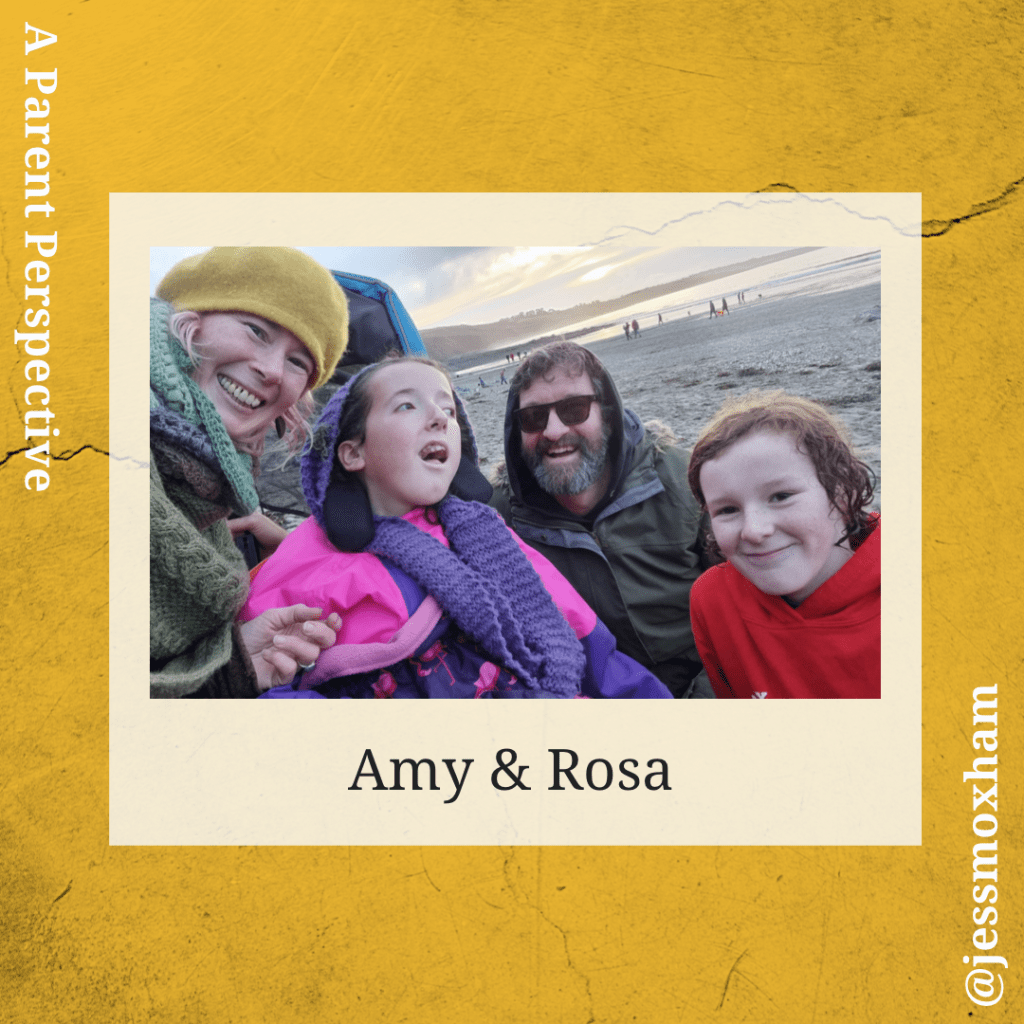
A Parent Perspective: Interview with Amy

This is my latest interview in an occasional series – A Parent Perspective – with Amy. Amy lives with her family in Cornwall, working as an artist and making beautiful pots. Her daughter, Rosa, has a rare genetic disorder and I really enjoyed talking to Amy about how she has trusted her instincts as they have navigated their lives with Rosa’s life-limiting condition.

My son, Ben, is 12 and I knew very little about disabled people when he was born. My experience of being his mother has been a rapid education in the issues surrounding disability. I find it helpful and interesting to read stories about other people with similar experiences and I hope you might too.

Could you describe your family?

There’s four of us – me and my husband, Gareth (we’ve been together for our entire lives), our daughter Rosa who is 13, and our son Ithan who is 11. Rosa has Canavan disease which is a rare genetic brain disorder and means she needs a lot of help. We live in a lovely, tiny cottage on a river in south Cornwall.

What are Rosa’s favourite things to do?

She likes anything that is a bit shocking, that makes you jump, and things that you build up to. We play lots of games, Kerplunk and board games. She enjoys body noise humour. She likes interaction, being in a group of people and being with other kids, which is important and has been lacking so much over the last couple of years. It’s been really difficult to facilitate because she is very vulnerable and we have had to be horribly cautious for ages.

What impact does her disability have on her day-to-day life?

It affects every aspect of her life. She’s nonverbal, in a wheelchair and doesn’t have very much movement. Rosa’s communication is largely through facial expression. She does things brilliantly at school, but at home she just expects us to know, which is cheeky but fair enough. She’s got a computer at school that she operates with a switch but at home she’d rather we just entertain her, not have to press a button to make it happen. She looks up and smiles for yes, and looks down and doesn’t smile for no. Her condition is progressive and we feel things are getting harder for her and she’s in a fog more often. She’s had more seizures over the last few years which means constant managing, trying to make her as comfortable, involved and happy as possible without overwhelming her.

When did you find out Rosa had this condition?

We had a completely blissful first couple of months of just being in love with our new baby and I felt really good. I started to wonder when she was about three months, but we didn’t talk to anybody until she was seven months old, when it was probably quite obvious to everybody else. I don’t think I wanted to know, and as soon as we talked to professionals it was like the floodgates opened. Everybody wanted to do tests and Rosa was in and out of hospital. You’re in such unfamiliar territory, it’s like being in the midst of a hurricane, just trying to make sense of it. We got her diagnosis very quickly – it was only three months after we’d first talked to our health visitor, and we were lucky because it’s a really rare condition.

We’d always wanted more than one child – we were initially quite frightened to go ahead with another pregnancy but were able to have a CVS test at 11 weeks of pregnancy to rule out Canavans. Ithan is the polar opposite of Rosa. He was feisty from the moment he was conceived, and then he arrived and held his head up, like, ‘Here I am.’ He did everything really early so there was no chance to worry. With Rosa our whole life landscape changed, so to then have this little miracle of normality come along was (both) wonderful and sad.

How has your approach to appointments and professionals changed over the years?

We’ve been quite good at that from the start. We sacked our first paediatrician because we didn’t like his attitude. We felt like he didn’t like children and he never addressed Rosa. His initial examination of her destroyed me. I felt he was so cold and moved her around like she was a thing.

Initially we did all the appointments that came and we were more compliant, but we’ve always resisted medicalising Rosa’s life as much as possible. Some people look the condition up in the book and say we’re going to do this and this without assessing if that’s necessary and weighing up the pros and cons for Rosa. Gareth comes from quite a scientific family and I come from a hippy, intuitive family which makes a good combination. When we first got the diagnosis I was really frightened to know the facts whereas Gareth was doing massive amounts of research. He could then drip feed me the information when I wanted it which worked really well.

It sounds like you had such strong instincts about the kind of parent you were going to be and that advocacy bit of it came naturally.

Yes, I think so. There are experimental treatments going on in the States and we looked into all of that but we felt that if Rosa’s life is going to be short then we want it to be as fun as possible. We don’t want her to spend it in hospital, recovering from surgery which probably won’t make that much difference. We decided at the beginning it was about her quality of life and we’ve got more strict about that. Unless we can see how an appointment is going to benefit Rosa, we try not to do them.

Do you think there’s things about the uniqueness of Rosa that has then affected the way that you’ve been a parent to Ithan?

I know that having Rosa as a sister has hugely affected the way Ithan is compared to his peers. There are so many times when we’re going to do something and then we can’t because of Rosa. He’s so good about it and adaptable. He’s very tolerant of Rosa needing a lot of care and attention. Gareth and I work in our business together, at home, so one or both of us is always around and I hope Ithan feels there’s enough attention for him. We try to make the most of good days and seeing the relationship between Rosa and Ithan is precious.

The last few years we’ve started intentionally doing more things separately with the kids. We take turns taking Ithan camping, because Rosa loves camping but our camper van has got too small for us all. It’s important that Ithan can have some undivided attention. For years we took Rosa’s chair across the moor but now she’s big and it’s bumpy. Sometimes you have to recognise there are limits to what you can do, and Rosa would enjoy juggling at home more than dancing across the moor in the weather.

Does Rosa enjoy school?

It’s been really patchy how much Rosa’s been at school because of Covid, and we’re also in the middle of a massive hellish battle with the council about transport. It’s so frustrating and emotionally exhausting because it should be simple. Rosa’s had a taxi to school for years. It’s a brilliant school which she’s been going to since she was three, and she loves it. She had a scary medical event in July when she stopped breathing and had a cardiac arrest out of the blue. She is now fine but transport stopped because they said the driver and assistant weren’t qualified to do it. I’m arranging the training for them but the council keep moving the goalposts.

A school day is very short anyway, in terms of getting work done. We’re both self employed and driving Rosa to school, or her not going to school, has an impact on the wellbeing of our family. Ithan’s school is in the opposite direction and we’ve only got one vehicle, so it’s all juggling while trying to run a business.

Do you have help from carers?

Not enough. We have one carer who brings toys and plays with Rosa for a few hours after school. It’s okay if one of us is here with her, and it’s better than having nobody, but it’s not a great help.

We had more help when Rosa was little. My brother used to work with Rosa and that was great. We had Homecare for some years which was mostly helpful although it was awkward to make changes, and you didn’t always know who was coming. Then there were cuts, and they decided that Rosa wasn’t disabled enough and we lost 30 hours a month of help, which made a big difference. Now Rosa is so big, it feels difficult to get anybody in who can be properly helpful because we don’t have any hoisting or any way of getting her upstairs apart from carrying her.

How has Rosa’s feeding has changed over time?

For the first few days she had trouble feeding, and then she was brilliant at breastfeeding and didn’t want to stop. She was feeding constantly until she was nearly two, and she used to love eating. They were telling us she needed to have a gastrostomy* and we were saying she doesn’t. She was gorgeous and chubby. It started to get more difficult when she was about six. She was aspirating more and it got harder to keep her hydrated when she was poorly. Gradually she was enjoying eating less, finding it more difficult and taking longer. She had a nasogastric tube for a bit, after she’d been ill, and that’s when we started supplementing with formula. We decided it was time to get a gastrostomy, which was a surprisingly hard decision but it felt like Rosa had said, ‘I don’t want to do this anymore, it’s too hard.’ She was eight when she had a gastrostomy and afterwards she didn’t want to eat anymore. Even birthday cake and ice cream.

We started doing blended food* almost as soon as she had her gastrostomy. Our previous paediatrician had told us about it. Rosa’s got a really tiny tummy capacity so we have continued to use formula as well. I blend a lot of her food with formula and when she’s at school they feed her formula, because it’s straightforward. Now she also has a pump feed at night. It was another thing that I was resistant to, because I feel like your tummy should be able to rest when you’re sleeping, but there’s always a bit of give and take – a tug of what your instincts say and what your child needs. Sometimes she just has water in the pump because milk is just too much, and sometimes anything is too much. She has gained weight, which is brilliant for her, but a nightmare for us because we’re still carrying her around the cottage. She’s still really slight and nowhere near the size of a typical 13 year old girl, but at least she now has some reserve.

Terms: *Gastrostomy – feeding tube through abdomen into the stomach

*Blended food/diet – liquidised food put through a feeding tube

You can find Amy on Instagram, Facebook and her blog is here.

A Parent Perspective: Interview with Fiona H

My son, Ben, is 11 and my approach to his disability has changed a lot since he was little. I knew very little about disabled people when he was born and my experience of being his mother has been a rapid education in the issues surrounding disability. If I had known then what I know now, I would have done things differently and I would have found it helpful to have read stories of other people with similar experiences.

This is my latest interview in an occasional series – A Parent Perspective – with Fiona who has three sons. Her youngest son, Joel, has just turned 18 and is autistic. I really enjoyed hearing Fiona talk about the dynamics in her family now her children are adults.

Could you describe your family?

I have three sons: Samuel is 24 and he is very close to Joel, my youngest, who just turned 18. My middle son, Ethan, is 20 Ethan is also extremely close to Joel and they have a unique relationship. Joel was originally a twin but I lost the other baby during the pregnancy.

Joel didn’t sleep for the first six years of his life and didn’t meet milestones. He didn’t walk until he was about two and he had very little speech. Because I had two older children I knew there was something going on with him and I took him for an assessment when he was 18 months old. A professor in Glasgow said he thought what happened in the womb had something to do with Joel’s delayed development and he thought there might have been some brain damage.

Joel went to a fantastic special education nursery in Glasgow when he was two and a half, and then to a special ed school because his development was very delayed. His diagnosis was Global Developmental Delay, which is a massive umbrella term that they say when they don’t know what’s wrong.  When we moved up to Dundee, he changed school where he was assessed and eventually given a diagnosis of Autism Spectrum Disorder and Sensory Processing Disorder when he was 13. I didn’t have much support – my family don’t live here and my ex-husband and I split up, so I looked after the boys on my own.

Can you tell us a bit about Joel and what he enjoys?

Joel’s never really played with toys. His favourite thing when he was younger was a taking leaves and branches off trees and bringing them home to demolish, bit by bit, until they were gone. He’s six foot two and very skinny. He was a picky eater but his school have been encouraging him to eat everything. He has a very sweet tooth and he would eat chocolate all day if I let him. He loves music – there’s always music on in every room of the house and the car – and watching films. He’ll watch the same film for months on end and know every line.

His speech is coming along – he can say short sentences now, what he wants or he doesn’t want. He very rarely gets upset, though he bites his fingers when he’s frustrated. He’s good fun. The school describe him as being very gentle. He’s a really sweet boy who is affectionate in his own way.

Is Joel at school or college now?

A few years ago Dundee social services were pushing me towards employing support for Joel directly which I really didn’t want to do. They could offer me all sorts of things in theory, but in reality the funding is not there and I couldn’t bear the thought of Joel having to live with me for the rest of his life.

I wanted Joel to go a Camphill School, which is based on the Steiner method of education, because there was almost nothing for him in Dundee and they do a lot of learning outdoors which he loves. I had three friends help me with the application which took about six months, and we got him in. Dundee fund the place and it’s actually cheaper for Joel to be there than it is for them to offer the services they said they could at home.

The school has seven acres of land and they grow a lot of their own food which the kids are all involved in. Before Joel was going to school and coming home, not seeing any friends out of school. At Camphill he lives in the same house as five other boys, house parents and co workers. He eats almost anything now, which he never did before. He’s learned to ride a bike. The whole ethos of the school is to push the kids to the best of their ability. He has a great life there and is so happy.

How did you explain how Joel was different when the boys were younger?

There’s 21 months between Ethan and Joel. Luckily, Ethan was a very self contained and easy toddler because Joel took up almost all of my time. Samuel was six when Joel was born and he was very helpful. I used to say to the boys that Joel has a different brain to everyone else’s but it’s a very special brain, and they thought that was quite cool. We kind of knew that he was autistic, but we didn’t want to use the word until we knew for sure.

We dealt with things on a day-to-day basis. Every day was different. For the first four months of his life, Joel screamed the house down every time I bathed him. I was googling and it came up with loads of scary stuff, so I just went with my instincts and persevered. I instinctively knew he needed repetition and eventually he loved baths and now he loves swimming.

How quickly did you come to terms with Joel being different?

In my heart of hearts, I knew he was different. I didn’t say anything to anybody, not even my husband at the time, but I just knew from the moment he was born, when he cried for a few seconds and then lay in my arms and looked at me as if to say help. I think I wanted to hide it, keep it to myself, process it, before I could vocalise it to anybody. I’ve heard a lot of parents talk about the grief that they feel for the life they won’t have with their child. Mine wasn’t grief, it was feeling that I needed to prepare myself, pick myself up, dust myself off, then think this is going to be different. I was then able to get him assessed and tell other people.

I accepted it quite quickly. I’m very pragmatic and I thought I am going to deal with this head on. There were so many times that me and the boys would go out somewhere and have to leave early because Joel was having a meltdown. I used to get really embarrassed and upset. By this time, he was nine and tall so I’d have to physically lift him over my shoulder and sometimes people would stare at Joel. I felt like asking them, ‘What is your problem?’ But then there would always be someone who would come over and say, ‘Can I help you?’ There wasn’t much they could do, but the offer was so lovely. It was difficult for me to get the point where I could think I’m not going to make any apologies for Joel. This is my son. I’m taking him out of here for his own safety, not yours and I don’t care what you think.

How have you and Joel adapted to his needs over the years?

When Joel was younger I didn’t look too far ahead to the future. One day at a time. There were some hilarious things, but there were also some really tense and anxious moments. Now it’s just a joy to be with him and it’s not hard work anymore. I still have to monitor him, there’s still a lot of things that need to be done, and I couldn’t leave him on his own. But he’s so much easier. Joel has surprised me every step of the way, so I’ve been fortunate.

Now we can do almost anything as a family with Joel but it’s taken years of repetition. I first met my new partner about eight years ago and he’s a very outdoor person who loves going walking in the hills but Joel used to run off. We almost had a helicopter out once to find him because he went missing. But we kept doing what we were doing until he learned not to go too far ahead and always to wait. Now we’ve climbed three Munros with Joel. He’s so fit and healthy and he’s in his element on walks. His love of the outdoors has reflected on the other two boys.

We can go out for a meal now too, albeit we tend to go to the same sort of places. If we go somewhere new, I’ll prepare him and he’ll always ask for a burger. Until recently, he’d get very upset if there was a baby crying but his school house parents had a baby last year and now just blanks it out. I think I subconsciously decided I wasn’t going to stop doing the things that I like, but try to expose Joel to things slowly. I wouldn’t put him through stress, but we just kept persevering with all sorts of things in a very slow but repetitive way. Now I can take him into almost any situation and he’ll soon tell me if he isn’t happy.

I persevered because I decided that Joel was going to have a really full and interesting life, and I wanted him to experience things. It’s the same at his school now. He learned to ride a bike last year at school and I went cycling with him for the first time this summer through a forest and it was such a lovely experience.

Are there things that you would have done differently?

I don’t think there’s anything I would have done differently with Joel. I didn’t read books about autism, it was all instinct. You feel like you should be doing all these things with your child, but actually you have to go at their pace. I learned that I couldn’t push Joel because he would very soon tell me that he wasn’t happy. I think the only thing I would do differently would be to have spent more time with the other two boys. When we would have to leave a party early I always felt their disappointment really deeply. They never complained, but I still feel guilty about that.

What has having Joel as a brother meant to your other two sons?

All kids are resilient but I think siblings of children with disabilities are even more so. Samuel has this inbuilt sense of responsibility. When he went to university, he phoned me every day for about two months asking how Joel was. I had to tell him that Joel is my responsibility not his. They’re so protective of their sibling.

I think my two other boys are very different to their contemporaries because of Joel. They’re very caring, very compassionate, and very protective of him. I have a really good relationship with the boys and we are very close. I think Joel has enabled that even more so than if he wasn’t there. My two have been through loads of stuff with Joel and they’re both very well rounded boys. We can’t imagine our lives without Joel. He’s enriched our lives in a way that has been amazing, and we wouldn’t change it.

You can find Fiona on Instagram here, and on Twitter here

A Parent Perspective: Interview with Caro

My son, Ben, is 11 and my approach to his disability has changed a lot since he was little. I knew very little about disabled people when he was born and my experience of being his mother has been a rapid education in the issues surrounding disability. If I had known then what I know now, I would have done things differently and I would have found it helpful to have read stories of other parents with similar experiences.

This is my latest interview with a parent who is raising a child who is not typical. This week it is with Caro, who is one of the friendliest people I’ve met on the internet.


Can you describe your family?

There is me, my husband, and our children: a boy of 17, a daughter of 15, and my youngest son is 11. My daughter is autistic and has Pathological Demand Avoidance (PDA).

If you met her, depending on what your benchmark of neurotypical is, you might notice she’s different but she’s quite hard to spot. Behind that facade is an absolute ocean of anxiety. My daughter also has Obsessive Compulsive Condition (OCC, or OCD – whichever is your preference) which is part of the pathological demand avoidance. So whilst her brain is telling her, ‘You’ve got to be in control, you can’t do what this person is asking you to do’, the OCC kicks in and she will say, ‘I’m going to do it, but I’m going to do it my way’. They just fight each other all time and it makes life very debilitating.

Women and autism don’t have the greatest history. For every female diagnosed as autistic there are three males which means that a lot of women are being missed. Women present very differently and the current questionnaire, the system of how we diagnose autism, is based on male research.

Lack of understanding means that when I explain even to the most learned of healthcare professionals my daughter is autistic and has PDA, I’ll get a little head bob, and ‘I’m so sorry’. It really annoys me because that’s not helping anyone – her or the path that lies ahead for others. We need to change that whole conversation.

Was there a moment when you noticed your daughter was doing things differently to your older child?

She didn’t walk until quite late but I wasn’t overly worried. She was doing this thing as a toddler where she would turn my face to speak to her. I had previously looked after a little boy who’s deaf so I thought she had hearing difficulties. We took her to see a doctor and he said she has really bad glue ear but it will clear. When she started at nursery she was speaking and walking but she wasn’t socialising the way my son had. I went to see another paediatrician who wasn’t that worried and at the bottom of the note that he sent to my GP, it said ‘Mother worried’.

I’ve got a lot of ‘Mother concerned’ notes and it wasn’t until she was in year two that somebody started to take it seriously. By then she was on her third school. We had a terrible situation where she was being treated terribly by one of the members of staff in a verbally abusive way. My daughter had been told she was stupid, he would rip work up in front of her. He sent her down from year one to reception class. We removed her straightaway but I think that had lasting effects on her.

She was diagnosed with audio processing issues when she was seven but we started seeing more people privately because the waiting lists to get a further diagnosis were years long. When she was nearly nine she got the diagnosis of autism, and a year later, a diagnosis of pathological demand avoidance. By then her issues with executive function were obvious. She was still in a mainstream school and masking a lot, so a lot of what we were being told wasn’t really fitting with her behaviour at home.

At one stage as a family we didn’t go out socially for about a year, not because we were embarrassed about her behaviour, but because it was so upsetting and difficult for her. We would parent the children almost separately, so my husband would sometimes take the boys and I would take my daughter. I think that was an error – I think siblings should be exposed to it all – but at the time we felt it was a lot for us and for them. My husband played sport for a living and therefore he worked at weekends so I was on my own a lot with all three.

How do you approach language around autism?

I listen to autistic people saying, ‘This is how I want to be addressed,’ and I use that language in my family. I’ve always felt that communication is the key. Where you don’t have information there is a void, and people can fill it with anything they want. There is no embarrassment to any of my daughter’s diagnoses.

How do you judge how much to share about your daughter?

I don’t want to give too much of her away, because I think she deserves her own social media footprint. I think we want to make sure that we maintain a level of respect for the person that we’re raising, because I would hate for my daughter to read or see something upsetting. But I felt very lonely for a very long time, because there were no other parents at her original schools that were in a similar position, and it felt very isolating to me. When I started sharing on social media, people said, ‘Me too’, and it felt less lonely. It’s a difficult line and I often sit back and take a break, but there are phenomenal support groups on social media.

I realised, probably a bit late, that I was putting her face up and then rethought. I definitely was guilty of saying, ‘Oh, woe is me,’ a few years ago. What I didn’t do enough was sit and listen, because my daughter isn’t the first autistic person to be born and she won’t be the last. I’m listening to autistic people because I can talk about my learned experience as a parent or carer, but I can’t speak about what it’s like to be autistic. Most of the information that we have has been from healthcare professionals that are neither autistic nor raising those that are.

How has your approach to your daughter’s autism, or parenting, changed over the years?

My daughter had a lot of behavioural issues when we were out when she was younger (which makes perfect sense now) and my eldest son found that exceptionally challenging. I was saying, ‘You go and play with your friends, everything is fine.’ I didn’t really know what I was dealing with and didn’t feel supported, even though I’d read every available book and seen countless doctors. Actually what I was lacking was self-confidence. When I read your book, I saw you got your confidence early and I envy that.

Anyone that’s ever been into a meeting with their Local Authority will know it’s probably one of the most terrifying things you’ll ever do. I remember sitting in a meeting about her, listening, and when I walked out I said to my husband, ‘They’re all completely wrong about her. I’m never going to go into another meeting so ill prepared again.’ The next year I spent weeks preparing for the meeting and handed a booklet of papers out to everyone. I said, ‘I’m really uncomfortable with the language that you’re using.’ I corrected things that were wrong. It’s not about dismissing what professionals are telling you, it’s that not everything will apply to you and it’s about getting the confidence to pick and choose what will help your child and your family. I think that starts with looking on social media or reading a book or finding people in similar situations.

My husband, Will, is the most incredible support. I’m the primary carer and I struggled with not earning money for a long time. I didn’t want to be a burden but I undervalued what I was doing because caring isn’t valued by society. When I’ve sat through those hideous meetings thinking I can’t do this, he’s there saying, ‘You absolutely can.’

My husband and I are very different. I am over communicative, he under communicates. We are polar opposites in lots of ways, but our life goals and the way we raise children has been in sync. I do think there is luck involved. My family are really important support to us – especially my mum.

I get messages from people saying their family members have criticised how they parent their autistic child, how they should be firmer. How can people not see how unhelpful and damaging that can be? I remember someone very early on into our daughter’s diagnosis a friend sending me a link to an article about how to cure autism. It’s what’s called ‘soles of your feet’ behaviours – things that you can’t see that you do, that you forget are there, but they’re part of you. If people that love my daughter will say or send things like that, then heavens only knows how we’re ever going to make the path less challenging for her and people like her.

No child comes with a book of instructions. I spent far too long looking back and thinking we should have done things differently. I think that would be the advice I would give myself now: you’re doing the best you can at the time. I think we made terrible errors with my daughter when we didn’t know what was going on, where I was telling her off for doing something she had no control over. I didn’t know what else to do at the time.

Do you think there are things that you’ve learnt through parenting your daughter that have changed the way you are with your other children?

Yes, definitely. There are loads of things that my daughter has taught me that has made me a better mum. I’m much more patient. I now always listen first, there is absolutely nothing off limits. I think I would have been far more staid had it not been for her and the way that she is. I have seen now that behaviour is communication so rather than reacting straightaway, I’ll ask, ‘What’s going on?’ My daughter taught me that trying to fix things is no good when the situation is full of anxiety, noise and stress.

How has parenting changed you over the time that you’ve been doing it?

I think I am a much better person. I used to look back and regret a lot. This is not how I thought my life would be – not being negative, it just isn’t what I expected. I am now more than okay with that. It’s absolutely wonderful.

I think as carers we sit on a tightrope between our children and people that aren’t like our children, and we want society to meet a little bit in the middle. I want people to understand that it can be difficult, like any parenting, but there are so many incredible parts. I’m trying to listen to autistic people whilst caring for someone that is autistic, whilst not being autistic myself.

I wouldn’t change my child, not for me, but I’d take away some of her anxiety and her challenges if I could. My daughter has changed us all and she is glorious and brilliant (with splashes of, ‘How are we going to deal with this?!’) My boys are better humans because of their sister. My husband is entirely different to the man that I met 25 years ago. I absolutely wouldn’t change a single tiny hair on my daughter’s head. I am so glad that I am her mum.

You can find Caro on Instagram @spikey and Twitter @CaroTasker

Time Travel

Almost two years ago Ben went on a school trip. He left on Monday morning and returned on Friday afternoon, and we got some messages inbetween but we were otherwise largely oblivious to what he was doing. We knew he would be okay – we trust the school staff, and his usual night carers travelled with him to be there if he woke – but it was still strange. Not because we were away from him – we have often left him with family or carers. But because he was away from us, which is unusual.

There is an expectation of linearity in childhood. Babies are expected to reach developmental milestones and then continue to tick life stages off the list: walking, talking, starting school, being left at other people’s houses, riding a bike, sleepovers, school trips… Through these stages there’s a distancing of the child from their parent – probably not entirely smoothly (my children often pull away from me for a bit and then return close for a while, before pulling away again) but there is a broad direction of travel. They become more independent both physically (Max no longer needs me to tie his shoelaces) and mentally (Molly will take what her teacher has told her to be true over anything I say). If children have siblings there is an expectation that they are like a little chronological train – the first child makes their way along the track and others chug along behind.

For Ben the path is less linear – in some ways he is right on that track, wanting to watch 12 Certificate Marvel movies rather than the more gentle films I encourage, preferring to listen in on adult conversations than be at the bottom of the garden with his brother and sister, and learning from and communicating with teachers, carers and TV programs as much he does as with me and James. But in other ways, particularly physical, Max overtook him a long time ago and there are ways in which Ben will always be dependent on me and James (or other adults) to help him.

Time, and our family’s passage through it, is not progressive in the way that I had expected. I entered into parenting expecting linear development of my children but it won’t be like that. Ben entering his teens will have no effect on his ability to walk away from me, and yet he is becoming more mature and bursting out of his unadjusted wheelchair. The ways in which I am his mother are in some ways completely different to when he was little, and in some ways (feeding, dressing) exactly the same, so being his mother concertinas time in a way that feels, as Ellen Samuels has said, like time travel.

Ellen Samuel’s essay, Six Ways of Looking at Crip Time, talks about the ways in which time shifts or stretches when you are disabled. It’s a brilliant essay that I would recommend reading – an eloquent insight into how disability affects so many aspects of life beyond the solely physical.

From the essay: ‘Crip time is time travel… Some of us contend with the impairments of old age while still young; some of us are treated like children no matter how old we get. The medical language of illness tries to reimpose the linear, speaking in terms of the chronic, the progressive, and the terminal, of relapses and stages. But we who occupy the bodies of crip time know that we are never linear, and we rage silently – or not so silently – at the calm straightforwardness of those who live in the sheltered space of normative time.’

This made me think about the ways that being Ben’s mother doesn’t conform to the linear path I had been told to expect, because he is disabled. Being Ben’s mother is a process of undoing assumptions, and it’s near-constant work because the world tells us that the right way is chronological and cumulative, and that these things indicate progress. At the beginning, having a child who didn’t do things in the order others did was disorientating. It’s not any more.

Ben will lead the way for Max in some ways (he already has a smartphone, as Max reminds me near daily), and in others he won’t. He will go on school trips, but people will still ask us if he goes to school. He will continue to grow and need ever larger clothes, yet sometimes people will speak to him as if he is a baby. The issue isn’t with Ben, it’s with the ways some people struggle to compute his difference. I can get my head around it, and have, but we are continually butting up against other people who are confused by Ben’s developmental time travel, and express it. I can’t know what that feels like for Ben, but it is annoying as his parent.

Reference: Six Ways of Looking at Crip Time by Ellen Samuels, in Disability Visibility: First Person Stories From the Twenty-First Century edited by Alice Wong.

Link to buy from Bookshop.org here

A Parent Perspective: Interview with Emma

My son, Ben, is 11 and my approach to his disability has changed a lot since he was little. I knew very little about disabled people when he was born and my experience of being his mother has been a rapid education in the issues surrounding disability. If I had known then what I know now, I would have done things differently and I would have found it helpful to have read stories of other parents with similar experiences. I am interviewing parents who are raising children who are not typical to discuss their thoughts and lives. This week it is with Emma Gardner.

Could you describe your family?

I have one child – Dotty. She is seven and she is disabled. Her dad and I are divorced although we’re great friends and still very much a team for her. I have a new partner, Adam and he has two children from his previous marriage.

What does Dotty love?

Since she was a baby her favourite thing has been eating. She is so motivated by food. She loves music, and responds to one to one play, in close proximity. She loves thumbing through books. She can’t read but she just loves turning pages and holding books.

How would you describe Dotty to people who don’t know her?

I describe her as disabled. I used to blurt that out nervously when she was younger and people would look at her adaptive pram. But now I confidently use it. I want her to feel proudly disabled and as a wheelchair user it’s more obvious now. Also her condition is complicated – it’s a rare, genetic condition that is fairly tough to explain.

When did you first realise that Dotty might not be a typical baby or child?

She was a very unhappy baby and we were in and out of hospital for the first few months. From around 18 months, we knew she wasn’t hitting the “typical milestones” but we thought she was probably chilling out after such a difficult start. We went to see a neurologist who had wanted to keep an eye on her following her early hospital stays, and we started to realise that she wasn’t doing a lot of things that were “expected”. She was diagnosed with her condition when she was two and a half after lots of tests. We kind of knew there was something going on, but when you get, ‘Here it is, this is exactly what it is, now off you go,’ you’re like, ‘Wow, what actually just happened?!’

The diagnosis wasn’t very clear about what it would mean for Dotty. There’s no pack explaining things. We were just told to speak to our health visitor, continue with the physio, do what we were doing and see how it went. At the time the internet was definitely not helpful, not least because genetic code and neurology are really tough to understand!

Some of the groups I found online took me to some dark places because I couldn’t see what the condition meant long term. I realise that the pre-conditioned views a lot of us have grown up with around disability clouded this period of time and it was easy to get stuck in a negative loop, focussed on what was wrong. But I knew I didn’t want to do that – I just wanted to move forward.

And now that she’s a bit older, how does Dotty’s disability impact her day to day life?

She needs one to one care. She goes to a specialist school and she has the most incredible team there – her teachers, assistants, physios. I love that it’s all now in one place now. Dotty needs help to do most things but she’s a determined soul. She’s really socially engaged and this past year she’s really developed her connection skills and emotional responses which has been wonderful, especially for me to see having spent so much time with her, working from home.

Are there things that you have been struck by being particularly different to what you expected of motherhood?

Motherhood was such a change, but also a magnifier on everything that was going on with me – my mental health, my lifestyle, my relationships, my career. My marriage broke down, I got divorced and everything changed. When it happened I was really worried that Dotty would be seen as the reason for that, or her disability would. But it wasn’t – there was stuff going on there with me before she came along. Having Dotty shone this intense light into a lot of that stuff that I needed to figure out which was pretty tough to manage but I’m thankful now. I’m happier, the people around Dotty are happier and I think ultimately that’s made her happier. I don’t know what I imagined motherhood to be like, but probably nothing like it is. I didn’t imagine unravelling and rebuilding myself for example. I wasn’t prepared for that.

I genuinely thought I was giving birth into a spreadsheet. I was that person, who made lists and assumed I had it all sorted. Arrogantly so.

I know some people get on brilliantly and becoming a mother doesn’t change anything for them, but for me it was hard and it changed everything. It’s still hard at times. But it’s also the best thing that’s ever happened to me, and I wouldn’t change how it’s played out at all. Otherwise I wouldn’t have Dotty or be the person I am now.

Do you think things could have been easier if the people or processes around you had been different?

Definitely. I think that’s still true, although people around you get more used to it. In the beginning, there’s a perception that it’s the worst thing that’s happened to you. So even when you’re getting on, trying to live your life, you’ve still got the pity of other people to manage. Nothing’s easy when you become a parent anyway, but navigating the medical model of disability I found so frustrating, because you’re questioned, it’s hard and there are so many barriers to getting help. I’m lucky enough to have had some incredible support and brilliant people around Dotty since she was a baby. But why isn’t it easier, particularly for people that need more help to access the support they have a right to?

Access (or lack thereof) to places and products can change where we go on a weekend and where we can hang out, particularly now that Dotty’s older. That frustrates me because it’s not really anything to do with Dotty or her needs. It’s the fact that there often isn’t any accommodation or thought for people like Dotty. Those are the things I try to challenge myself, but that can be exhausting and I have to pick my battles.

What do you wish you had to spend less time explaining or that people knew about your family?

I suppose it’s that we’re not sad. We really do believe that this is okay. When I say I wouldn’t change Dotty, I mean it. I’m not just saying it because I can’t. That can be a very polarising view, depending on who you are. For me, yes, things are different, but she’s ultimately the greatest kid. I don’t really want people to look at us as sad or even inspiring but instead as a great example of living with disability, living a happy, colourful life. I’ve found a huge passion in trying to find ways to help people see that, to try and find ways to showcase that to parents particularly…and anyone really.

What do you think helped you come to that view?

When Dotty was younger, I buried myself in work. My ex-husband stayed home with Dotty and I was quite detached. But I was processing by bringing disability into conversations in my workplace. Through that process I read a lot and met and made friends with disabled people, and that naturally changed my mind and educated me. I met disabled people who were unapologetically themselves, talented, wickedly funny, creative and innovative. That really helped me to understand that negativity comes from society’s view of disability which often isn’t the reality. Like the rest of us, disabled people are all different, and a lot of the time just trying to get on with their lives. I’m hyper aware that Dotty can’t tell me her views yet and may not be able to. As her mother and carer, I know her and we communicate in our own way. Outside of that, I take in as much information and perspectives as possible to make the best decisions for her. But, just because I know what the social model of disability is, doesn’t mean I’m done. You’ve always got to keep learning.

Did having a disabled child change your view of the world?

Yes, definitely. It’s been transformational for me. It has broadened my perspective and everything we’ve been through has made me so much more confident.

Now, I want things to be better for Dotty and people like her and I understand how to make that happen. it’s ignited something in me. I feel like I can talk about it and help people, particularly parents, get there more quickly. I just feel so different, and that’s because my whole life has changed in the last couple of years and having a disabled child has been an integral part of that.

I still have my moments. I’m nonstop, don’t sleep enough and I struggle with anxiety, but none of those things are because of Dotty’s disability. They’re more likely to be related to other people’s views of it or of us. Or not related at all and just part of the way I’m wired.

How have you found being a working parent with a disabled child?

When I had Dotty, I was on the board of the agency and had worked there a long time so, for the most part, I was able to carve out the flexibility I needed. Looking back, I was definitely in ‘work comes first’ mode for a long time, which was happening because I was unhappy and hadn’t worked through a lot of the things I have now.

Now I’ve set up my own business and have total control over how that works for Dotty & I. I think the pandemic made me realise that I don’t want to go back to the amount of time I was spending in an office, my priorities changed again and I’ve developed much stronger boundaries.

I would say that working is really tough, depending on the level of care you’ve got, pandemic or not. But I’ve always been somebody that likes to work and I’m excited about what I’m doing again. I think that’s ultimately how I’m going to make it work. It feels like Dotty’s part of it, if that makes sense?

I think there can be a lot of pressure on mothers of disabled child that they should be giving everything to their children. Have you felt the pressure to not work?

It’s something I struggled with a lot before I started my own business and I felt guilty about not giving up work to care full time for Dotty. But ultimately, I know myself. I know that I’ll be no good to Dotty if I don’t also do the things that I need to make me happy. That took me, is still taking me, some time to be at peace with. But I stand by it, and that guilt feeds the attitude that assumes the disabled child, and disability, are tragic and something to pity, and that the mum has to be there by the kid’s side 24/7. Actually Dotty loves school. I love her going to school. I need her to go to school. There’s a place for all of it – people do what they need to do for their situation. I’m privileged that I was able to start my own business and managing both is working for us right now. Everyone’s situation is very individual and that’s ok.

If you’d like to know more about the Medical and Social Models of Disability that Emma refers to there is more information here.

Emma is on Instagram: @ms_emma_gardner and Twitter: @ms_emma_gardner