A Parent Perspective: Interview with Janette

I spoke to Janette about being a mother to her son Gregory, who is 35 and supremely sociable. I really appreciated speaking to Janette who is a parent to an adult child, and navigating being a carer for much longer than most would expect to be.

My son, Ben, is 13 and I knew very little about disabled people or being a parent when he was born. Being his mother has been a rapid education in the issues surrounding disability. I find it helpful and interesting to read stories about people with similar lives and I hope you might too!

Jess: Can you tell us a bit about you and your family?

Janette: My son Gregory is 35, and I have a younger son Edmund who is now 31. Gregory’s a very sociable person. He loves being with people, going to people’s houses. We’re active members of a lively church and we’ve got lots of good friends there. He loves live music and musicians. He’s very affectionate. He can read more than most people think. He can walk with walking sticks around our bungalow and with a walking frame for short distances. He likes things in a very particular order. He’ll notice when tiny things in our house aren’t in the place that they’re supposed to be. He loves picture books and coloring books.

He goes shopping once a week and loves using the hand scanner at Tesco. He’s very motivated by anything that’s got a button or a switch. We’ve gone through a lot of televisions and DVD players because he breaks the buttons by pressing them so hard. He likes going swimming, when we can find a support worker who is able to go with him. He loves being out and about and going on walks. He goes to a day center once a week. He loves doing cooking. He’s got a great sense of humor. He loves going to see his dad. We split up when Gregory was about nine. My ex-husband is a lot more patient than I am.

Gregory can speak well sometimes. He’ll tend to use the main words in a sentence. He’s very good at remembering people’s names and what socks they wear! He’s surprising to me and I know him really well.

Jess: At what point did you receive Gregory’s diagnosis?

Janette: He was my first child so to me it was a normal birth, but he had a small head and a low Apgar score. He was with me for an hour, then he was taken up to special care. They kept him in for a week while they monitored everything. I had to keep taking him for head measurements after he was born. Feeding was difficult. His legs were stiff and rigid. I was part of the National Childbirth Trust and one of my friends there was a GP. She said to me, ‘I think you need to go and get him checked out a bit more’. Leading up to being one year old, they did start doing a few more investigations. He wasn’t crawling, he wasn’t sitting very well. He had a big day’s assessment and at the end the paediatrician told me that he had special needs. She wasn’t very specific but just said he would be disabled all his life. I don’t remember her saying cerebral palsy. He then started having lots of physiotherapy and eventually they used the word cerebral palsy. He was such a smiley baby. He always wanted to engage with other people. I’m so thankful for the speech therapists in his life. Gregory started speaking when he was four.

Jess: How were Gregory’s school years?

Janette: He went to a mainstream playgroup until he was five, and then to a special school, mainly for children with physical disabilities. He had amazing physio and speech and language therapy (SLT). We asked for him to go two days a week to the mainstream primary and three days a week to the special school, encouraged by his SLT. We weren’t popular with Exeter council – it was like they’d never heard of that before – but it worked for Gregory. I felt he needed to be surrounded by ordinary chatter. It was a challenge, particularly communication between the two schools. As he was coming to the end of the first school the local authority wanted him to go to a special school full-time. The SLT suggested we see the schools in Taunton, where there was a massive push towards inclusion. We decided to move here because of that. We moved when Gregory was eight and it was like a dream. Our other son could go to the same school and there were other children there with similar disability to Gregory. The knock on effect of him being in a mainstream school is that wherever we go there’s bound to be somebody that recognizes Gregory. The first two years of secondary school were ok. The last three years were very rocky. He got suspended for a week for throwing a glass test tube across the chemistry lesson. They said they had to treat everyone the same, but a lot of it depended on the quality of the one-to-one teaching assistants and some weren’t very good.

It was very hard to know if I made the right decision. When he was 14 I went to see a residential special school because things were not good at school. They had communication devices, physio, hydrotherapy. I thought I might be able to go back to work, and then the school decided they wouldn’t have him. I was gutted. I think they felt his learning disability was the more dominant thing in his life than his physical disability but I see them all as part of him. Then he went to college at 16 and it was a breath of fresh air. They were all very embracing. He was at college for five years. He did gardening, pet care, cooking. They went on trips. He doesn’t do as much now as he did at college.

Jess: How do you think things have changed over the course of Gregory’s life?

Janette: I’ve come across a shift in attitude, particularly in social work departments. Social workers and other professionals working with children with disabilities occasionally have an attitude of, ‘You get a break when they’re at school.’ But all children are entitled to an education. They’re not called respite centres, or holiday camps. they’re called schools. If your child has a medical appointment, an orthotics appointment they’re continually missing bits of school. The pressure on services and funding is having a profound impact. I can look back 15-20 years ago and see that things weren’t as squeezed as they are now.

Jess: What support do you and Greg have?

Janette: I fought really hard. One social worker helped me a lot when Gregory was transitioning to adult services. I wanted to go back to college and do some studying. They awarded us 75 hours a week, and I went to college. The 75 hours is still in place, but it hasn’t happened since March 2020. There was absolutely nothing in the early days of March, April and May 2020 and even now the care company are finding it really hard to recruit because they don’t pay enough money, because the government doesn’t give enough money to local authorities to pay for these things. The care company can’t provide the support that they’re contracted to. This is one of the worst things. I might receive a rota on a Wednesday for the following week. Sometimes I only get two days notice until it starts. I can’t plan anything. I have not been able to work for 35 years, and I do feel quite resentful. I had to stop studying for my degree. When a carer goes off sick, there’s nobody to cover them. Often he should have a carer all day, but the care company can only get someone for 5 hours, or not at all.

I’m often having to pivot as the circumstances change and I’ve got to not fall over. I’ve found it less stressful to think I’m not letting an employer down, but I’m 60 now and I want to go to work.

It’s stressful having new carers in the house. Our bungalow’s quite small. People adjusting to you and you adjusting to them. We’ve had some amazing carers, people that you don’t want to ever leave you because they’re so good and they enhance all of our lives. But we’ve also had some shocking carers. Somebody decided that they were going to borrow some of Gregory’s money. Another drove Gregory 30 miles away because he needed a new tyre on his personal car and didn’t tell me. He didn’t know you have to put child locks on the door because Gregory will open the door as you’re driving along.

The relationship between support workers and our children is so important. Are they really interested in making their lives fun and interesting as well as safe and healthy? Does Gregory laugh? Does he go out and do interesting things with them? Are they sitting there at my dining room table on their phone for an hour while Gregory’s in his bedroom reading a book? Good people are intuitive as support workers. They know what Gregory is about.

Jess: How did you find the transition from children to adult services?

Janette: It’s like dropping off the edge of a cliff. The lack of physiotherapy as he gets older is quite worrying when all the physiotherapists I’ve met have said prevention is better than cure. We try to keep the stretches up, make sure he’s active, that he goes swimming and horse riding. They are not just activities, there are health benefits as well.

They closed the day center that the local authority was running. They outsourced to different private companies who do daycare. But if you’re an adult with a learning disability and a physical disability, then you become a minority of a minority. The setting that he goes to on a Friday said he couldn’t go on a trip because there wasn’t enough room for the bags and his wheelchair. I have learned that I can come across quite critical sometimes, but you would have thought an organisation that was supporting disabled people would have thought about it. I’m in the process of applying for deputyship from the court of protection. I haven’t had any problems since Gregory turned 18 about anything medical. Nobody’s ever questioned that I’m acting in his best interests.

Jess: How has being Gregory’s mother made you think differently about politics?

Janette: Care is the most important thing. There isn’t proper recognition of the hard work that carers do and they’re ignored by society. We need a career structure for carers in social care. The system is broken. Our MP is uninterested to the point of it being rude. I protested a year ago at the local elections and I got hounded by the Conservative councillors. I held up a big placard that said, ‘Don’t Vote Conservative’. A councillor came right up to my face and said, ‘You are a stupid woman’. We got into conversation and I was telling him about my son, and he said, ‘So what did you do to cause your son’s disability?’ I said nothing, and justice was served because he got voted out. I’ve never done anything like that before, but I just felt a wave of bravery come over me.

Jess: What would your advice to parents of younger disabled children be?

Janette: I remember never thinking about it when Gregory was growing up, but I wish I’d thought about the future. I think it’s important to think about what you would like Ben’s future to look like, and more importantly what he would like. Talk to your social worker about what older disabled people do, where they live.

Sometimes I think that nobody else can look after Gregory as well as I can. It’s not true, because I’ve seen other support workers be brilliant. My vision is for Gregory to live in a shared house with support workers. Greg thrives in a more social environment, not on his own. Social workers have told me the hurdle is housing, because the amount of suitable housing is negligible. The local authority here have become reliant on parents looking after their adult children because it’s so much cheaper for them. Most authorities don’t have a plan for people with complex disabilities, their health, their housing and their wellbeing. I want carers that we can really rely on, housing that’s suitable, and for Greg to not to be too far away. I want to be able to visit him and then come away secure in the knowledge that he is happy, that he’s safe, that he’s doing interesting things, that his needs are being met. Wanting your child to have a life of their own, outside of their parents, is a normal thing.

A Parent Perspective: Interview with Melanie

I spoke to Melanie about being a mother to two children. Her son, Arlo, is seven and has cerebral palsy. Melanie is a journalist and in the last few years has written a book about the early years of being a parent of a disabled child and launched a beautiful magazine about tube feeding, amongst other work.

My son, Ben, is 13 and I knew very little about disabled people or parenting when he was born. My experience of being his mother has been a rapid education in the issues surrounding disability. I find it helpful and interesting to read stories about people with similar lives and I hope you might too!

Tell us a bit about your family.

There’s me and my partner Rowan. I’m a writer and we live in the southern highlands of New South Wales in Australia, south of Sydney. We live with our two kids – Arlo is seven and Odette (Odie) is five. Arlo has quadriplegic cerebral palsy and that’s what brought us into the disability space and got me working and advocating in this area.

Tell us a bit about Arlo. What does he love?

Arlo has loads of hobbies and passions. He’s always been really into music and books. He loves Julia Donaldson, anything that’s rhymey and rhythmical, watching Disney movies and Bluey. He adores music and likes Rowan playing guitar. He’s into people, loves his family, has tons of friends. He’s been in mainstream childcare and school settings his whole life. He’s now at our local school with his sister, where he’s got one-on-one support throughout the day.

He has always made friends easily. He shares in-jokes, laughs a lot. He’s non-speaking but is very expressive. We’re really working on him talking using his eyes with his AAC eye gaze communication device, which is tricky but he can do it. He’s cheeky – he’ll mainly say ‘Play game, play game’. Unless he’s really sick, and sometimes even when he is, he’s pretty happy. He has his moments – he gets a bit shitty with his sister sometimes, though that happens less since she started at his school. She really speaks his language and they like the same movies and music. Arlo has therapies: speech, physio, OT every week after school, so he’s super busy. He takes it all in his stride.

How did you get Arlo’s diagnosis of cerebral palsy?

It was four days past his due date and had been a pretty ordinary pregnancy up to then. His movements felt different so we went in to the hospital, but they said he was fine and sent us home. On our way home I told Rowan to go back because the movements definitely felt different. They put me in a bed and said they’d induce me the next day. We were connected to the fetal heart monitor and all of a sudden Arlo’s heart rate disappeared. It was incredibly lucky that we were in that bed at that time. The emergency button was pressed and they got him out in 10 minutes. We don’t know what happened. It was just a random hypoxic incident – he lost oxygen and that caused damage to his brain.

We only spent one week in NICU and they cooled him for a few days. We couldn’t hold him which was hard. We were in the NICU with all these tiny preemies and you could see there was bad news being delivered all around us. An MRI showed there was bilateral brain damage to the motor section of his brain. We were told on leaving the hospital that “worst case scenario”, this could be cerebral palsy (CP). I didn’t know what that was.

He was always beautifully engaged, smiley and making eye-contact, but as the weeks and months rolled on he didn’t hit a single motor milestone. He never rolled, never sat up. We couldn’t cling to denial past the 3-4 month point. At six months old we got his formal diagnosis of cerebral palsy. Even after that I was googling ‘cerebral palsy misdiagnosis’, thinking this cannot be happening.

He was our first kid. I’d never held a baby really until Arlo. Once we had Odie, I realised that if Arlo wasn’t our oldest child we would have realised early on and would have been freaking out. I love that we had no idea and could be in this bubble. I went to mothers’ groups. I did all the normal stuff. The paediatrician who delivered the diagnosis was really kind. He said CP is so broad and could be very mild, that we just needed the diagnosis to get funds and support. He must have known Arlo’s CP wasn’t mild, but that we didn’t need that information then.

Now we know Arlo’s got a profound physical disability. He’s a wheelchair user, he’s non-speaking, and very bright. We’ve just had equipment trials and spent the day looking at wheelchairs and sleeping systems. We saw our first hoist and it’s confronting. I remember when I first saw a stander I thought it was so ugly, but we got used to it. Same with the hoist- we’ll get it, we’ll put it in the spare room for a year and then we’ll be ready when we need it. We love his wheelchair.

How were the early months and years with Arlo?

By some miracle he was great at breastfeeding, then he was eating purees – although that all stopped when he turned five and got his G-tube. He was in a standard pram for ages, and we had this period where things weren’t that different to his friends. By the time they were, we were okay with it. The only time it’s not okay is when Arlo’s really sick and misses school and his friends, and misses out on fun. That’s awful, and it happens more for him because his health is compromised.

He was such a beautiful baby. There was sadness and fear around his diagnosis but a lot of fellow disability parents I spoke to said try and stay in the moment, and when I’d look at him, he was joy. There’s scary stuff, there are hoists and equipment, and people say crummy things sometimes. But we’re lucky that Arlo is generally happy. We’ve had bad periods, but he’s now sleeping through the night and that’s a massive factor in our mood. I don’t speak for every parent, and I know there are real challenges, but I appreciate what we have.

What do you think enabled you to accommodate something so unexpected?

I think part of it is I wasn’t someone who had the baby shower and big ideas about becoming a mother. I didn’t really have expectations. It has helped having a supportive partner – I think that’s made all the difference. Rowan and I have always both worked flexibly and I think I’d feel very differently if it was all on me. I’ve also had professional success as a result of this. My career went in a completely different direction and my work now feels meaningful. I’m writing about stuff I really care about. I have a passion and I feel like I have a purpose.

How did your book, Special, come about?

We had a social worker come out to us soon after Arlo’s diagnosis and she was very well meaning, but she gave us a children’s book and DVD that were so depressing and bleak. I came up with the idea for a book, which was partly an excuse for me to talk to other parents because I wasn’t ready to go to a support group. I spoke to parents raising kids with all kinds of disabilities and there were common themes: we all try to stay in the moment. We all build community, try and find like-minded parents. We all find joy and a new perspective. It connected me to so many people and really fast tracked me to acceptance. I love that it’s helping other parents do that now, but it comes from a place where I felt so differently.

Tell me more about the tube feeding magazine, The Blend.

When we started tube feeding Arlo it was expected he would be on synthetic formula. He had been eating blended puree so it made no sense that we went from that to six bottles of formula pumped into him throughout the day. He was sick and aspirating. It was terrible. Another parent said I could put the pureed food he used to eat down the tube. We did, and everything changed, but there wasn’t enough information around. The pamphlets were really academic or designed for a child. That’s where the idea for The Blend came from. I wanted to make a cool magazine about tube feeding and for it to be beautiful and make people feel like they were part of a community. We have done two issues so far and I’m bringing out a third. The disability market is huge and there should be beautiful things to cater to that market.

How did you decide to have a second child?

During the emergency caesarean to have Arlo they found a cancerous cyst on my ovary so six weeks later my left ovary and fallopian tube were removed. My gynaecologist said we needed to “complete” our family as soon as possible and, very fortunately, I got pregnant when Arlo was just over a year old. That pregnancy was not fun because we were treated as high risk, which meant a million scans. They would say things like, ‘Her head’s growing a bit fast for her body,’ and it was just trauma and terror. But we had a planned caesarean two weeks before her due date and it was a completely different experience. It was lovely. I was awake when she was put on me. Seeing the typical milestones met, it makes you very unsympathetic to typical parents! Arlo taught us to have zero expectations and Odie has taken her time, she’s got there in her own way. Seeing the way her fingers and tongue move was mind blowing. When I saw her standing in her cot for the first time, I completely freaked out because my brain was not used to seeing children standing. We’ve got this weird training with Arlo that is only for Arlo. It’s been such a wonder to see both ways, to have both paths, to see the things they share and where it isn’t different.

But it’s complicated. The night before we had Odie, I was beside myself because I felt like I was betraying Arlo and that I could never love anyone as much. Of course, I could. Since then, Odie has been interesting and challenging in her own ways. Many days are harder with her than Arlo, who tends to be very sweet. Odie is a whole other bag of challenges. We let her do her own thing but I’m probably not as patient. She’s never allowed to be sick! I need to watch that there isn’t different treatment. I love that she has this world view that I never had. She sees disability is normal. She’s jealous of his wheelchair and his hospital stays. She has a really popular brother who makes her look good a lot of the time!

Are there parts of your life now that feel less unexpected than others?

Everything feels normal eventually. I know that we’d be tired and stressed regardless and I’m normally stressing about work, not Arlo. You think you’ll never get used to it, you’ll never be able to fold the wheelchair that has 26 different parts, but you do. Arlo has so much stuff – several medications, tube feeding – but it feels normal. The only times I’m conscious of it is when I notice other people’s reactions. It pisses me off when people think I have a horrible life or that what’s happened to us is the worst thing ever. I was that person before, but I want everyone to know what I know now, then there wouldn’t be this horrible reaction when you learn that your child has disability.

There’s rarely a moment where I catch myself thinking this is not what I expected. Getting the car modified was difficult – I’ve never been a very confident driver and I didn’t think I’d be driving around in a bus but I’m proud of myself for doing it. You realise you can do anything and that gives you confidence in other areas. I didn’t think I could write a book, or start a magazine, or do a podcast. In the day to day I’m tired, I’m laughing, I’m stressed, and the feelings are the same as they would have been if Arlo wasn’t disabled.

More about Melanie here: https://www.melaniedimmitt.com.au/

Find Melanie on Instagram or Twitter

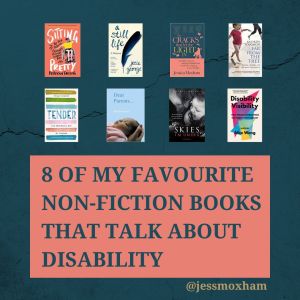
8 Of My Favourite Non-Fiction Books That Talk About Disability

These books have all given me valuable insight into the experience of being disabled or caring for someone who is. Some are confronting (which is necessary), others are beautiful and insightful. All are worth your time and will widen your understanding of people and the world.

I have included my own memoir (in a reluctant flash of self-promotion) because I’m proud of it. Together they are a mixture of own voice accounts by disabled people, memoirs by parent carers, and well-researched non-fiction.

Most are available to buy from my Bookshop.org list here.

1 Sitting Pretty: The View From My Ordinary Resilient Body – Rebekah Taussig

This is one of my favourite books. It does exactly what I want a book to do – speak truthfully and lyrically about complex issues that are personal and also universal. It really digs into the ways that disabled people are made to feel like the difficulties they face are individual, when actually they’re societal, and how it feels to be a woman. It’s funny and powerful.

2. A Still Life – Josie George

George’s memoir is about her life being made physically still and small by her illness and pain, yet full and rich in her mind. She writes so evocatively about all the challenges and triumphs of her day-to-day experience, and helps us reimagine what is valuable.

3. The Cracks That Let the Light In: A mother’s story of raising her disabled son and the life-changing power of books – Jessica Moxham

My memoir about my son Ben and what he’s taught me. A lot about the challenges and triumphs of parenting, his love of books and my hatred of people pitying us.

4. Far From the Tree – Andrew Solomon

This is a huge book that covers the stories of hundreds of parents whose children with very different identities from their own – from autism, to deafness, to complex physical disability. It would be impossible to read in one go – I’ve read a chapter at a time – Solomon’s writing is accessible and represents diverse views while being true to lived experience.

5. Tender: The Imperfect Art of Caring – Penny Wincer

Part memoir, part interviews, part manifesto. Penny covers all of the realities and emotions of being an unpaid carer – the highs and lows, and how it can still be possible to live a good life.

6. Dear Parents – Micheline Mason

I was lucky to see Micheline Mason speak when my son was younger, but this book is a good alternative to hearing her in person. Micheline is disabled and a parent of a disabled child and her insights can feel challenging, but are undoubtedly necessary.

7. The Skies I’m Under – Rachel Wright

Rachel writes movingly about how her life is turned upside down when she realises her son will be disabled. Despite her being a nurse and her husband being a doctor, this is a different way of engaging with health services and makes Rachel re-evaluate her life, her faith and her responsibilities.

8. Disability Visibility: First-Person Stories from the Twenty-First Century – edited by Alice Wong

This is a collection of writing by disabled people with diverse impairments and there is something for everyone. The range of topics and styles make it a powerful anthology, representing views and insights that I haven’t read elsewhere.

A Parent Perspective: Interview with Emma

This is my latest interview in an occasional series – A Parent Perspective – with Emma. I first met Emma when her son, Ted, was very small and we lived near each other. Baby Ted reminded me so much of baby Ben. Since then she has moved out of London, had another child, Ted has blossomed and our families have become friends.

My son, Ben, is 12 and I knew very little about disabled people when he was born. My experience of being his mother has been a rapid education in the issues surrounding disability. I find it helpful and interesting to read stories about other people with similar experiences and I hope you might too.

Could you describe your family?

There are four of us: my husband, Rik, and me. Ted is my oldest child who is nine now, and my daughter Dilly is six. We often have a carer with us too. We live on the Wiltshire-Somerset border but we’ll be moving to Somerset once we adapt a house there.

How would you describe Ted and what does Ted love doing?

Ted is a very happy, smiley boy. He loves being around people and in the thick of it. His favourite place to go is a supermarket – he literally whoops with joy when he realises that we’re going there. He also loves slapstick comedy, silly games, fart noises, all of that kind of thing.

He has cerebral palsy from a catastrophic brain injury at birth, which affects his whole body. He requires a lot of support with everything in his life so we have a lot of help from carers.

Ted goes to a brilliant school in Bath. He used to really hate goodbyes and would wail as we waved him off on the school bus in the morning. They’d always text 10 minutes later to say he was fine, but it was awful. Then we had this gruff, Scottish driver who’d joke with Ted and now he gets really excited when the bus comes.

Did you know from the moment Ted was born that his brain injury was going to going to have affected him?

He was in a very poor state when he was born and he was whisked off into NICU. That night the consultant mentioned the words cerebral palsy. We were taking each day, each hour, each minute at a time. Once he moved from NICU into Special Care, I think the naive part of me was hoping for a miracle – one of these people whose life support was almost turned off but now they’re six foot and play rugby. There were lots of signs that wasn’t going to happen – feeding difficulties, physios saying he was very stiff, nurses giving us a knowing look with a slight tilted head. We had a diagnosis of cerebral palsy at about three months. Ted cried all the time in those early days.

There were some forums that I joined that I quickly stepped back from because it was just terrifying to me at that point – people’s children were passing away or having terrible seizure disorders. Life seemed very medical and very difficult. At that point, Ted needing a wheelchair was the worst thing I could think of. Now I know that Ted not walking is the least of our worries. I was asking myself if Ted was going to be constantly unwell? Was I going to be in and out of hospital wondering if he was going to make it through the night? At the beginning you don’t know what is going on, you feel like you’re upside down half the time. It’s a lot to deal with.

What was helpful in that early period?

Realising I could say no. There was a physio playgroup at 9am on a Tuesday and I found it stressful getting out of the house that early to get the bus. When I got there, I don’t know what I was supposed to be doing. Everyone else seemed to have a programme to follow or children that could play. The day that I said, ‘I don’t want to go to that, I’m not finding it useful,’ felt really big because I felt like my baby belonged to a system. He wasn’t really mine. He belonged to the hospital, social care, and health care systems, so it was good to take back some control.

I felt very different to other mums and like Ted was very different to other babies when he was tiny. But actually I realised that he didn’t really look any different to anyone else. One of the people I’d met in antenatal classes was persistent in inviting me out for a coffee and we went to baby massage, and that was really helpful. A little normality was what I needed. I learned to accept help from friends. I tried not to hide away and to do some fun things. They were all quite tinged with sadness though, because it was a traumatic time and the antithesis of what I expected having a newborn to be like.

How did you make decisions about having another child?

We always wanted more than one child but there was fear and anxiety. I knew it was very unlikely for the same brain injury to happen again but once you spend some time within those Facebook forums you hear awful stories. I didn’t know if I could do that again, but I knew that we did desperately want another child. I wanted to experience what it might be like to have a neurotypical child and have a non-traumatic birth. Ted was three when Dilly was born and was having a bit of time at nursery. He still had his moments, but he was generally happier about things, a bit more comfortable in his body. We’d resolved some of the feeding issues (he still wasn’t tube fed at that point). It felt like a good time, and it was brilliant.

Dilly’s birth was super easy in a birthing pool but feeding was not smooth. I decided I was going to make breastfeeding work, but it was four months of absolute agony before we found our groove. It was difficult deciding whether to keep going or move to formula because I’d had to do that with Ted. I’m glad I persevered – I fed her for four and a half years in the end and it gave us an incredible bond. Having Dilly made me really appreciate what it’s like to raise a neurotypical child, but also understand everything that Ted had struggled with.

They are completely different children, and you have to accept them for the child they are rather than the child you want them to be, or that you think they are. Regardless of disability. I realised that I had to fully accept Ted as he is. I had to embrace every aspect of him – feeding difficulties, missed milestones, a body that didn’t work as it should – as much as I accepted that he had brown hair and brown eyes.

How have you approached therapies with Ted?

I definitely went through a stage of thinking if I just found the right combination of therapies, I could make Ted do these things that he was clearly never going to do. We settled on ABR therapy which we’ve done since he was six months old. When we first went he was very tight and angry, and I don’t think it’s necessarily given him much more functionality but it’s brought him a lot of comfort within his own body. I focus on the physical therapy, and could probably do more in terms of communication. Ted’s very bright, sociable and clearly understands a lot, but we don’t know where his cognition level is and we haven’t found a good system of communication beyond eye pointing and smiling.

How do you think having Ted changed the kind of parent you are?

I think I appreciate every little milestone of Dilly’s in a way I probably wouldn’t have done if I’d had a typical first child. I think it’s been a real blessing having Ted because he suits who I am as a parent – low key! I don’t feel pressure to make sure that Dilly is attending Mandarin classes or whatever. We prioritise experiences and family time over formal learning.

Before you have children all you know about is sleepless nights and ‘terrible twos’. You don’t feel the love, or see how angelic your children look when they sleep, or know what it’s like when they write you cards saying, ‘I love you’. From the outside you just see the difficulties, but you can’t know the amazing feeling when I make Ted laugh.

How have you found having carers to help Ted, and how have you made it work for your whole family?

I’m extremely grateful for the help that we have. It ebbs and flows but I have a good life and if we had to do all of the 24/7 care, would I be as resilient and upbeat about it? We’ve had carers since about 2016, including some nightcare, and it’s strange sharing your house with other people. For the first time recently, Rik and I were bickering in front of the carers because our house is not particularly big. I think it was making them feel quite uncomfortable, but I can’t wait until 8pm on Friday to schedule an argument with my husband. Having carers in the house is really helpful but there’s not a lot of privacy. It does mean that I can do the fun things with Ted and pass off the boring tasks. I can focus more on Dilly and I’m able to work and do some things for myself, which is incredibly important. It comes with a fair amount of guilt for people that don’t have what we have.

What helped change your thoughts about Ted’s disability, since the period after his birth?

Having talking therapy and processing the emotions was helpful to a degree. Meeting you was really helpful – someone who was a little bit further down the road than you are, modelling that it’s okay. Reading Andrew Solomon’s book, Far From The Tree. Listening to podcasts. Listening to disabled people, partly on social media, and unpicking internalised ableism.

Realising that we’re all different, and different doesn’t have to mean bad. Our life is never going to be how it is in our head. We’re never the mothers that we think we’re going to be because our children come along and are their own people. That’s irrespective of challenges. I looked at what I want from life and how I could go about getting that, and none of that involved taking away Ted’s disability. Before I had Ted, I definitely had times where I felt like there had to be a bit more to life. I wanted a life with more meaning, and that’s exactly what I’ve got. Going through difficult times makes you appreciate the better times.

When Ted was born someone from work sent me a card which said (I think it’s a John Lennon quote) that everything will be okay in the end, and if it’s not okay it’s not the end. It’s really hard to see that in the beginning, when I thought ‘okay’ was a miracle recovery. That’s not what happened and it’s more than okay. You can come out the other side of the difficult times and it can be brilliant.

You can find Emma on Instagram here, and on Twitter here

A Parent Perspective: Interview with Jo

My son, Ben, is 12 and I knew very little about disabled people when he was born. My experience of being his mother has been a rapid education in the issues surrounding disability. I find it helpful and interesting to read stories about other people with similar experiences.

This is my latest interview in an occasional series – A Parent Perspective – with Jo. Jo’s eldest son is disabled and her personal experience motivated her to look at the wellbeing of parent carers in her professional work as a psychologist and writer. I loved talking to Jo about how she’s balanced working and caring over the years, which I think is a familiar challenge to so many of us, and how she’s making sure her research is useful to parent carers.

Could you describe your family?

I live with my husband and three sons. My eldest is 14, and then I have a 13 year old and a nearly 10 year old, and we live in north London. I often describe our family as quirky which I’ve come to embrace.

My eldest son is disabled – he has cerebral palsy, learning disability and autism. He’s in a good place at the moment. His sense of humour has come out – he’s discovered some swear words that he’ll suddenly shout out at tea time and I find very funny (and he knows he’s being cheeky). I don’t want to undermine how difficult it has been to get this good place, so I appreciate and enjoy it, but it can feel precarious.

What are your son’s favourite things?

He is happy and really settled in a special school. He loves pizza and chocolate cake, and transport. Once a year I take him away on a train and we went to York in the summer which was special. He sits on the train and shouts ‘All aboard!’ which makes me chuckle. He loves being out and about, for coffee and a cake, to sit on the bus.

In the house, and during the school holidays, it’s quite difficult to entertain him other than TV, iPad, iPod. He likes the trampoline, pacing around. He used to be absolutely terrified of dogs and it was getting to the point we couldn’t go to our local park because he’d scream or run into the road when he saw a dog. But we got a dog three years ago and she’s been incredible, and then we’ve just got a new puppy who we hope will be more playful and interactive. My son loves throwing a ball or a stick for the dogs, and they have now become a big part of his everyday life. He gives them fresh water, puts their food out. He’s in charge of letting them in and out of the garden and they have cured him of his phobia.

How does his disability affect his day-to-day life?

He is very mobile and walks and runs around. His memory is not great so we break things down for him with lots of repetition. That can be quite hard when you’re very tired. His speech is quite affected. Something I found really hard to get my head around with brain injury is that some days it’s like he’s firing on all cylinders – he’s funny and fast, tells my husband he’s going to put custard in his slippers – and it feels like this is him. Then another day he won’t respond – he’ll be staring out the window and it’s like the neurons just aren’t connecting in the same way. I think some of it is tiredness or when he’s coming down with illness. I’ve learned over many years that when he’s getting ill he has a couple of weeks of feeling grotty but it doesn’t show, so I wonder why he’s being so irritable and then it all comes out and he’s lying on the sofa and needing me.

It was interesting during lockdown that he was so well and his behaviour was amazing. It was only when I went to a training session a few years ago that I heard someone say that people with learning disabilities can be more prone to illness, and illness can really affect behaviour. I sometimes feel guilty for not realising these things sooner. You need to know these things to empower yourself, and also to know that some changes are temporary which makes difficult periods more bearable.

Your two eldest sons are quite close together in age. What were their early years like?

After my eldest son was born we were so delighted he had survived following a traumatic birth and we didn’t fully have an idea of what his diagnosis meant for him. Then when my second son was born it was really tough because it was when some of my eldest son’s difficulties became more apparent, when he was 18 months old. I was full of hormones, and I couldn’t recover from the birth with two kids under two. I had some difficulties trusting other people to look after my eldest son, which may have been the case anyway but was exacerbated by his difficult birth, and childcare was expensive so I didn’t get enough support. I remember I had to put my second son on a chair on the sofa, with a footstool in front, to stop my eldest son getting to him and scratching his face. I’d found a way that kept everyone safe, but the health visitor came round and said I couldn’t put a baby in a chair up on a raised surface. It’s difficult when people come into your house and make comments without having an alternative solution. You are quite exposed when you have a baby anyway, but when you have a disabled child that is magnified – the number of people coming, looking, commenting, telling, advising. It can be quite disheartening as a parent. You’re having to prioritise what’s the most important thing at the moment. That’s why parent carers have such amazing skills.

How did having your eldest child affect your career?

I was a psychologist in primary care in the NHS before I had children. After my eldest son was born it was just about manageable, but then his appointments really increased and I had my second son. My eldest was getting ill a lot and there was a lack of flexibility from my employers and it became too difficult. It was a really hard decision to leave my job because I’d worked really hard for it. I know lots of other parent carers have this difficult decision to make – you like your work and it gives you purpose and meaning, but then it adds to the stress so much that it becomes untenable.

I gave up work for a bit, and then I started working in counselling for a charity supporting male survivors of sexual abuse. The team that I worked with and the work I did there was incredible, but I kept coming back to emotional wellbeing in parent carers and wondering why no one was talking about it. It felt like a hidden thing that wasn’t acknowledged because everything is about the child. I was mulling this over for a long time before I decided to go back to do a Doctorate and research that topic. I started my Doctorate when my eldest son was 10 and it took me for four years.

Before that I had set up my website Affinity Hub (www.affinityhub.uk) to signpost to emotional support because I was hearing anecdotes about general counsellors not really getting what parent carers needed and I thought there must be some people with expertise in this area. I wrote a few articles for journals in therapy and counselling and found counsellors that were often parent carers as well, or had worked in the field for a long time and really got it. I also did a brief survey on my website because I was curious about how parent carers were feeling. The response I got to that drove my desire to do the doctoral research, which then fed into my book Day by Day: Emotional Wellbeing in Parents of Disabled Children which was published earlier this year.

What did you find in your research?

To feel well, you want to feel like you have some control over your life and that came through really strongly in my research. The importance of connecting with positive other people as well and how for some people their family or friends could be such a strong support and for others those were the very people that had really let them down. The importance of finding other parent carers, which was not surprising but so strong. Also the importance of the connection, the love and strength of feeling that parent carers have towards their child. I think a lot of parent carers develop an awareness that we don’t have control over life, and it can be difficult at times. There is a kind of a wisdom – you see what’s really important, and that things are fragile and precious.

it was so important to me that something practical came out of my research because having felt quite alone in some of my difficult feelings in the early years, I was shocked at how many studies were out there about risks to mental health for parent carers. I’d never read about these studies and I was a professional in the mental health field. When I found that research I thought I’m not alone. I’m not a failure. It was so powerful, but also made me really angry that it’s not better known. It’s important to me that research gets to the people that need it and I worked not only on my book, but training for professionals and the NHS about how they can better support parent carers.

Has your research made you think you would have done some things differently?

A common theme was guilt, and giving yourself a hard time for things that you could have done differently. I’m reading a lot about self-compassion at the moment and I think it’s so important for parent carers. You’re only human, you can’t know everything, you made the best of things at that time. There are things that I would have done differently, but I try to not give myself a hard time about it now. There are certainly things that I would want to have been different with the support around me, and the support around all parent carers. My big bugbear is acknowledging the emotional impact, which I think is still rare or done very insensitively.

Have you done any research into siblings of disabled children?

A lot of parent carers I spoke to felt that there could be a tendency to overcompensate for siblings. To give them amazing days out and let them get away with things, being desperate to give siblings amazing memories.
I felt guilty for a long time about my middle son because he was born so close to my eldest. I tried to protect him as much as possible but I’m sure it was stressful for him because of some of the behaviours of my eldest son. Now I look back and I don’t know what more I could have done. It was the nature of the experience.

It’s interesting with siblings because they go through phases of getting on. Initially, my eldest and middle were quite close, then my eldest and youngest, and then my youngest and my middle sons. I think you have to remind yourself that those dynamics would be there anyway, disability just adds an extra thing.

When they were all younger and my eldest son disturbed a game, for example, I would say ‘It’s not his fault, he doesn’t understand.’ I was hoping that they would get an understanding of their big brother’s needs. Then I went on a Sibs training course, and one of the things that adult siblings of disabled people reported as hating hearing the most is, ‘Don’t give your brother/sister a hard time because they can’t help it.’ Or ‘it’s not their fault’. So I’ve stopped saying that but it’s an ongoing learning process!  Being a parent is hard, managing all these dynamics, and you never know if you’re making the right decisions at the time. I think it’s important to keep hold of the idea of ‘good enough’ parenting rather than expect perfection. There’s no such thing as a perfect parent, you just try and do your best.

You can find Jo @affinityhub.uk on Instagram, Twitter and Facebook

Jo’s website is here: www.affinityhub.uk

You can order her book Day by Day: Emotional Wellbeing in Parents of Disabled Children here

Confidence Trick (in a good way)

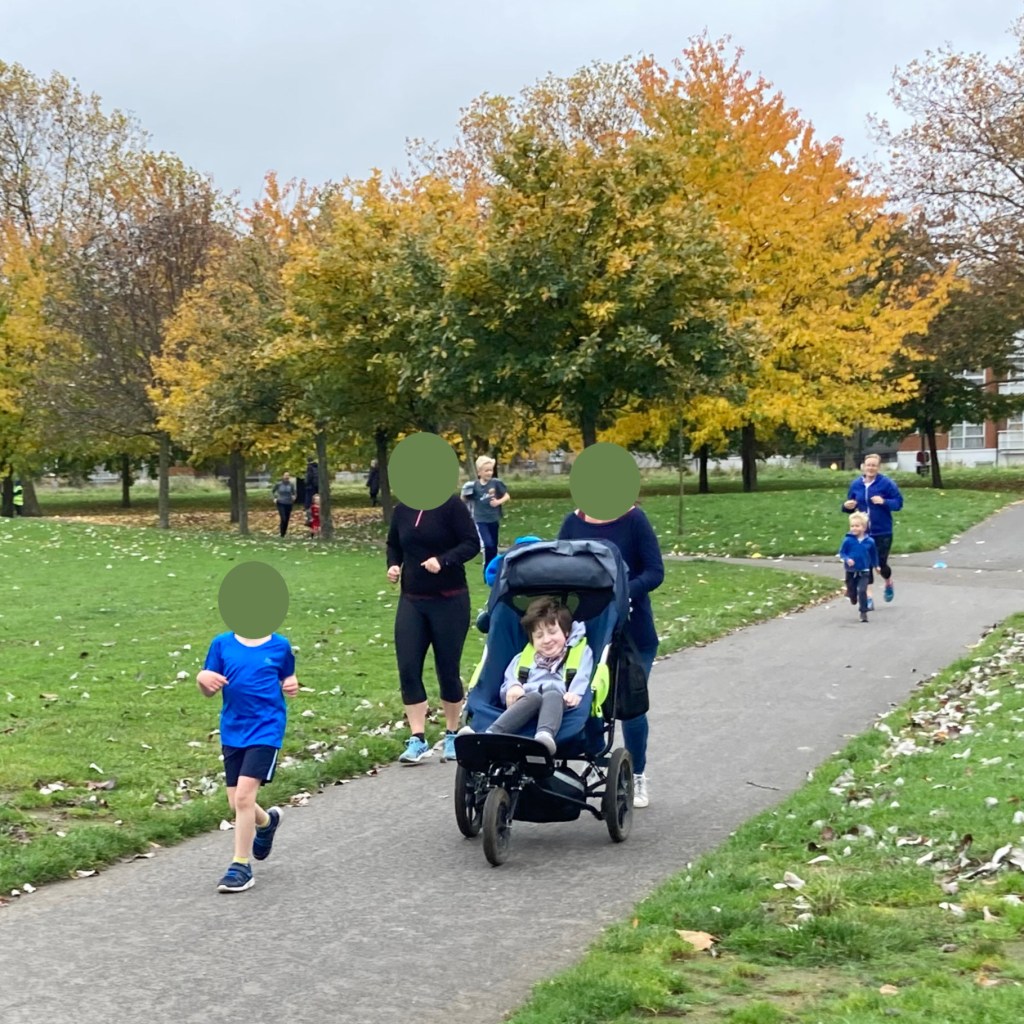
It’s two years since we went to Junior Parkrun and after the 2km run the organisers refused to give Ben a token because he had been pushed though the finish line, which meant he didn’t officially take part. They later admitted that they should have included him, since being pushed in a wheelchair (or all-terrain buggy) was different to a baby being pushed by their parent, but by then it was too late.

We took all the kids back to Junior Parkrun last weekend where they all ran 2km with some friends (not me – still working on my ankle rehabilitation). Ben got his fastest ever time thanks to his particularly athletic carer, F, pushing him. Molly ran for the first time and pipped Max to the finish line because he was incapacitated by a stitch, apparently.

James and I had agreed beforehand that we wouldn’t talk to anyone about Ben taking part. They would all run, and then push Ben though the finish line and assume they would all be given a token. If it wasn’t offered to Ben, we would ask for it. We did this – actually Ben’s carer pushed him through – and a token was freely given. Ben really enjoyed it, as did Molly and Max once they’d got their breath back and eaten some Mini Cheddars. It was fun! And made us feel like Very Good and Active Parents.

I realised that we have changed our approach to some situations. My instinct used to be to try and let everyone know that we were there, talk them through what Ben would need in an effort to alert them to our situation and smooth the way. Sometimes this worked.  But sometimes it created an impression that I was asking for favours and thought what I was asking for was at their discretion. Like I knew what Ben needed was tricky, but since I was asking nicely please could they possibly be able to accommodate us? So sorry, thank you so much.

Now, I wonder if it’s better to go into encounters acting like what Ben requires is going to be offered. With an aura of certainty that someone will give us what we need, because to do otherwise would be unacceptable. Perhaps then the onus is on them to refuse, rather than us to beg. Because what we’re asking for is never too much.

It’s a work in progress for me, but I think it links to a confidence that I try to radiate. Ben deserves his place in the world and for people to accommodate the way he moves and presents. I am not apologetic about his disability, and I think projecting that allows other people to believe it too (or at least might interrupt their instinct to pity or say something completely freaking ridiculous).

I think Parkrun learned from their 2019 mistakes, but to bring it back to chilly mornings in a south London park, if you act like someone should give you the token, are they more likely to give you the token? Let’s try it.

A Parent Perspective: Interview with Fiona H

My son, Ben, is 11 and my approach to his disability has changed a lot since he was little. I knew very little about disabled people when he was born and my experience of being his mother has been a rapid education in the issues surrounding disability. If I had known then what I know now, I would have done things differently and I would have found it helpful to have read stories of other people with similar experiences.

This is my latest interview in an occasional series – A Parent Perspective – with Fiona who has three sons. Her youngest son, Joel, has just turned 18 and is autistic. I really enjoyed hearing Fiona talk about the dynamics in her family now her children are adults.

Could you describe your family?

I have three sons: Samuel is 24 and he is very close to Joel, my youngest, who just turned 18. My middle son, Ethan, is 20 Ethan is also extremely close to Joel and they have a unique relationship. Joel was originally a twin but I lost the other baby during the pregnancy.

Joel didn’t sleep for the first six years of his life and didn’t meet milestones. He didn’t walk until he was about two and he had very little speech. Because I had two older children I knew there was something going on with him and I took him for an assessment when he was 18 months old. A professor in Glasgow said he thought what happened in the womb had something to do with Joel’s delayed development and he thought there might have been some brain damage.

Joel went to a fantastic special education nursery in Glasgow when he was two and a half, and then to a special ed school because his development was very delayed. His diagnosis was Global Developmental Delay, which is a massive umbrella term that they say when they don’t know what’s wrong.  When we moved up to Dundee, he changed school where he was assessed and eventually given a diagnosis of Autism Spectrum Disorder and Sensory Processing Disorder when he was 13. I didn’t have much support – my family don’t live here and my ex-husband and I split up, so I looked after the boys on my own.

Can you tell us a bit about Joel and what he enjoys?

Joel’s never really played with toys. His favourite thing when he was younger was a taking leaves and branches off trees and bringing them home to demolish, bit by bit, until they were gone. He’s six foot two and very skinny. He was a picky eater but his school have been encouraging him to eat everything. He has a very sweet tooth and he would eat chocolate all day if I let him. He loves music – there’s always music on in every room of the house and the car – and watching films. He’ll watch the same film for months on end and know every line.

His speech is coming along – he can say short sentences now, what he wants or he doesn’t want. He very rarely gets upset, though he bites his fingers when he’s frustrated. He’s good fun. The school describe him as being very gentle. He’s a really sweet boy who is affectionate in his own way.

Is Joel at school or college now?

A few years ago Dundee social services were pushing me towards employing support for Joel directly which I really didn’t want to do. They could offer me all sorts of things in theory, but in reality the funding is not there and I couldn’t bear the thought of Joel having to live with me for the rest of his life.

I wanted Joel to go a Camphill School, which is based on the Steiner method of education, because there was almost nothing for him in Dundee and they do a lot of learning outdoors which he loves. I had three friends help me with the application which took about six months, and we got him in. Dundee fund the place and it’s actually cheaper for Joel to be there than it is for them to offer the services they said they could at home.

The school has seven acres of land and they grow a lot of their own food which the kids are all involved in. Before Joel was going to school and coming home, not seeing any friends out of school. At Camphill he lives in the same house as five other boys, house parents and co workers. He eats almost anything now, which he never did before. He’s learned to ride a bike. The whole ethos of the school is to push the kids to the best of their ability. He has a great life there and is so happy.

How did you explain how Joel was different when the boys were younger?

There’s 21 months between Ethan and Joel. Luckily, Ethan was a very self contained and easy toddler because Joel took up almost all of my time. Samuel was six when Joel was born and he was very helpful. I used to say to the boys that Joel has a different brain to everyone else’s but it’s a very special brain, and they thought that was quite cool. We kind of knew that he was autistic, but we didn’t want to use the word until we knew for sure.

We dealt with things on a day-to-day basis. Every day was different. For the first four months of his life, Joel screamed the house down every time I bathed him. I was googling and it came up with loads of scary stuff, so I just went with my instincts and persevered. I instinctively knew he needed repetition and eventually he loved baths and now he loves swimming.

How quickly did you come to terms with Joel being different?

In my heart of hearts, I knew he was different. I didn’t say anything to anybody, not even my husband at the time, but I just knew from the moment he was born, when he cried for a few seconds and then lay in my arms and looked at me as if to say help. I think I wanted to hide it, keep it to myself, process it, before I could vocalise it to anybody. I’ve heard a lot of parents talk about the grief that they feel for the life they won’t have with their child. Mine wasn’t grief, it was feeling that I needed to prepare myself, pick myself up, dust myself off, then think this is going to be different. I was then able to get him assessed and tell other people.

I accepted it quite quickly. I’m very pragmatic and I thought I am going to deal with this head on. There were so many times that me and the boys would go out somewhere and have to leave early because Joel was having a meltdown. I used to get really embarrassed and upset. By this time, he was nine and tall so I’d have to physically lift him over my shoulder and sometimes people would stare at Joel. I felt like asking them, ‘What is your problem?’ But then there would always be someone who would come over and say, ‘Can I help you?’ There wasn’t much they could do, but the offer was so lovely. It was difficult for me to get the point where I could think I’m not going to make any apologies for Joel. This is my son. I’m taking him out of here for his own safety, not yours and I don’t care what you think.

How have you and Joel adapted to his needs over the years?

When Joel was younger I didn’t look too far ahead to the future. One day at a time. There were some hilarious things, but there were also some really tense and anxious moments. Now it’s just a joy to be with him and it’s not hard work anymore. I still have to monitor him, there’s still a lot of things that need to be done, and I couldn’t leave him on his own. But he’s so much easier. Joel has surprised me every step of the way, so I’ve been fortunate.

Now we can do almost anything as a family with Joel but it’s taken years of repetition. I first met my new partner about eight years ago and he’s a very outdoor person who loves going walking in the hills but Joel used to run off. We almost had a helicopter out once to find him because he went missing. But we kept doing what we were doing until he learned not to go too far ahead and always to wait. Now we’ve climbed three Munros with Joel. He’s so fit and healthy and he’s in his element on walks. His love of the outdoors has reflected on the other two boys.

We can go out for a meal now too, albeit we tend to go to the same sort of places. If we go somewhere new, I’ll prepare him and he’ll always ask for a burger. Until recently, he’d get very upset if there was a baby crying but his school house parents had a baby last year and now just blanks it out. I think I subconsciously decided I wasn’t going to stop doing the things that I like, but try to expose Joel to things slowly. I wouldn’t put him through stress, but we just kept persevering with all sorts of things in a very slow but repetitive way. Now I can take him into almost any situation and he’ll soon tell me if he isn’t happy.

I persevered because I decided that Joel was going to have a really full and interesting life, and I wanted him to experience things. It’s the same at his school now. He learned to ride a bike last year at school and I went cycling with him for the first time this summer through a forest and it was such a lovely experience.

Are there things that you would have done differently?

I don’t think there’s anything I would have done differently with Joel. I didn’t read books about autism, it was all instinct. You feel like you should be doing all these things with your child, but actually you have to go at their pace. I learned that I couldn’t push Joel because he would very soon tell me that he wasn’t happy. I think the only thing I would do differently would be to have spent more time with the other two boys. When we would have to leave a party early I always felt their disappointment really deeply. They never complained, but I still feel guilty about that.

What has having Joel as a brother meant to your other two sons?

All kids are resilient but I think siblings of children with disabilities are even more so. Samuel has this inbuilt sense of responsibility. When he went to university, he phoned me every day for about two months asking how Joel was. I had to tell him that Joel is my responsibility not his. They’re so protective of their sibling.

I think my two other boys are very different to their contemporaries because of Joel. They’re very caring, very compassionate, and very protective of him. I have a really good relationship with the boys and we are very close. I think Joel has enabled that even more so than if he wasn’t there. My two have been through loads of stuff with Joel and they’re both very well rounded boys. We can’t imagine our lives without Joel. He’s enriched our lives in a way that has been amazing, and we wouldn’t change it.

You can find Fiona on Instagram here, and on Twitter here

A Sibling Perspective: Interview with Fiona

My son, Ben, is 11 and my approach to his disability has changed a lot since he was little. I knew very little about disabled people when he was born and my experience of being his mother has been a rapid education in the issues surrounding disability. If I had known then what I know now, I would have done things differently and I would have found it helpful to have read stories of other people with similar experiences.

This is my latest interview in an occasional series – usually A Parent Perspective, but this time A Sibling Perspective – with Fiona, who lives with her disabled brother, Ewan. I found it so interesting to hear her thoughts about growing up with her brother.


Could you describe your family?

My mum and dad have three children – I’m the oldest, then my sister, Kirsty, then Ewan who is three years younger than me and is disabled. We grew up in Sussex and then moved to Scotland when Ewan left school to a house that is designed around Ewan’s needs. Ewan and I have always been incredibly close. My parents were Ewan’s carers but they’re not getting any younger and I wanted to be involved so now I am his main carer. My parents, Ewan, my husband Dom and I all live together which means there’s a lot of bickering because we all have strong opinions! But it works well for Ewan because he has me and my husband around and we can go out and do things very naturally. We do have paid carers as well.

Could describe Ewan and what he likes doing?

Ewan’s very cheeky. He loves to entertain us by doing something daft or mischievous. We both work at a candle shop, which is a social enterprise designed for people with disabilities. He and I are joint workshop leaders which I think Ewan really enjoys. We’re lucky to have met a nice group of friends, both with and without disabilities, and we go out – evenings at the pub, lunches, an art class. Ewan’s quite social and loves spending time with my husband, Dom.

Ewan is 36. We describe him as being disabled – having a learning disability. He needs a lot of support though he can do lots himself. He uses a wheelchair and doesn’t speak but he has fantastic communication. Ewan uses Makaton sign language, or at least his version of it! He also has some vocalisations – he’ll make sounds for yes, no, and some names that we recognise. He can get anxious in some situations and find them challenging.

How does Ewan’s disability affect his day to day life? What are the things that you, as a family, plan around?

At home he’s just Ewan. If we’re planning a day out sometimes it can be difficult to know what we’ll be able to do, what he’ll find interesting, whether we’ll be able to get in the building, whether there will be a Changing Place. From his point of view, his anxiety affects him. If Ewan’s worried or excited about something he has a lot of spasms in his arm, and that can cause pain.

Do you remember as a child realising that Ewan was different to you and your sister?

We didn’t know when Ewan born that he was disabled. Because he’s the youngest I think my mum realised that he wasn’t doing things that my sister and I had done. I remember being told that Ewan was blind and ‘handicapped’ (as it was in those days), and then he didn’t learn to walk and talk. He was obviously different but I don’t remember it really being much of an issue. I’ve always been very close to Ewan and I’m very proud of him, so people would get told about him all the time! I’ve never experienced anything negative about him being my brother.

To say that my parents weren’t fazed by it sounds ridiculous, but that’s the way it came across. Obviously he needed different things, different care, but it was always more of a practical thing, and mum and dad were very aware of trying to treat us all the same.

Did you choose to be Ewan’s carer?

Yes, I chose it because I feel that it works. It doesn’t really feel like I’m his carer except for the obvious things where we help him physically. It’s just our relationship and it’s fun. The hardest thing for me is stepping back and entrusting somebody else with the role because it can be difficult for other people to know how much independence to give Ewan, for example, and they can be tempted to make a choice for on his behalf or perhaps take over an activity.

Was there a natural progression over time as you took over from your parents?

When my husband and I moved to Scotland we allocated which days each of us would do Ewan’s care and I always wanted more days so we could go and do fun things. Now I support Ewan Monday to Friday and my parents do it at the weekends, though since we live with each other there’s overlap.

My parents know a lot more than I do about Ewan’s medical history and so they are more involved with that side of his care. Ewan used to have more health worries but thankfully since his epilepsy has been under control he’s been better. I am starting to take him to important hospital appointments on my own.

As a familywe bicker a lot, but not over Ewan’s care. I say I don’t want other people worrying about us because of Ewan, but I was worried about my parents and whether they were coping with all the care that they were doing before we moved up here. And now, they worry about me. I think that’s what families do!

What has worked particularly well for Ewan at particular stages of his life?

From the age of six he went to a brilliant school in Sussex. The whole school was geared towards their students, all of whom had very complex disabilities. They did everything, like scout camp for example. Ewan had the opportunity to do so many things, learned loads, and he enjoyed it. He’s not really had the same opportunities since he left school because not everywhere has the facilities.

When we moved to Scotland there were a few disabled children just leaving the high school and there was nothing here aimed at people with disabilities, which is why things like the candle shop came about. I’m talking on Ewan’s behalf here, but I think we’ve been really lucky. It feels like we’ve been in the right place at the right time.

Are there things that have been particularly challenging either for him, or for you as a family?

Ewan does always seem to be quite happy and he doesn’t seem to worry if he can’t do something. I think we lived in a bit of a false sense of security for a long time, thinking that he had everything he needed at home. It’s only since finding the first Changing Places toilet that the penny dropped for me, and I wondered why we were only just discovering them. Noticing how inaccessible places are makes me angry and frustrated. I think we’ve been incredibly lucky compared to many other people, in terms of support and services. We have been in the right place at the right time.

I think that no one talks about the benefits of having a disabled sibling…

I agree, or they do but it’s that ‘inspiring’ thing. I guess it’s hard to appreciate unless it is your experience. I know friends who have had harder times that us – we’re very lucky that Ewan’s health is good. If he didn’t sleep or needed a lot of medical attention our experiences would be different. I feel like we’re very lucky. Sometimes I don’t understand how other people don’t get it and don’t see the world like I do, and then I remember that they’re not all as fortunate as I am.

Do you have any advice for other siblings or for parents of disabled children or adults?

I’m not really in a position to give advice, but perhaps it would be: don’t compare. I’m not a parent but I think we’re all individuals. We’re all going to be the people that we’re meant to be, irrespective of disability. You can’t possibly compare one person to another, or the speed at which they’re doing something. I think my parents knew Ewan was going to be different so didn’t compare or worry about milestones.

I’ve spoken to my mum about it and she was upset when she first heard Ewan’s diagnosis but that’s the only sad thing I’ve ever heard. I sometimes feel like families are beating themselves up for not doing enough therapy with their children, that they think they’re not doing the best by their child, and that’s quite hard to watch. I think what will be will be.

You can find Fiona on Instagram @ewieandfi and on Twitter @fmmchiarini

A Parent Perspective: Interview with Fay

My son, Ben, is 11 and my approach to his disability has changed a lot since he was little. I knew very little about disabled people when he was born and my experience of being his mother has been a rapid education in the issues surrounding disability. If I had known then what I know now, I would have done things differently and I would have found it helpful to have read stories of other parents with similar experiences.

This is my latest interview with a parent who is raising a child who is not typical. This week it is with Fay. We became friends when Ben and Caleb were small, and Fay and I were trying to work out how to be parents.

Note: includes a description of pre-term birth.


Can you describe your family?

We’re a family of 3, plus a grandparent. I’m a single parent who works part time with a 5 year old, Sarai, and an 11 year old, Caleb.
 
How would you describe Caleb?

Handsome! He’s so affectionate, nothing phases him. For example, he can usually use his iPad but today his arms are a bit all over the place so he can’t, and he’s getting us to work it for him. That’s what I admire about him, no matter what he’s been through, he just continues to smile.  

He loves YouTube, reading, lying in bed listening to the radio – only Capital radio! Thankfully he was born in this generation where there’s all this technology, otherwise I don’t know what I’d do!
 
Caleb’s not able to walk, sit unaided, feed himself or get himself dressed, but he gets by. He’s got people who will get him dressed, feed him, help him look good. He uses a wheelchair.
 
When did you first realise that Caleb was going to be disabled, or have special needs?

I went into labour at 21 weeks. When they examined me they said I was miscarrying and I burst into tears. I asked when it was going to happen. They said it wouldn’t be too long and put me on bedrest. A consultant in pre-term labour came to see me after a scan and said, ‘I’m really sorry you are miscarrying, but you’re young, you can always try again’. I was just waiting, worrying, and nothing happened.
 
Then the bleeding changed and I felt Caleb move for the first time. There was nothing I could do. I went into labour one night, and Caleb came at 23 weeks exactly. I thought he was dead because I couldn’t work out what was going on. I just saw this red ball and I didn’t want to look, then they took him away. They said he was alive.
 
But that’s when the problems started because he was in NICU and really unwell. Other children came in after him but then left hospital and we were still there. I became a mini-nurse, watching all the screens. We were discharged in October after seven months. In January we had a community paediatrician check-up and the doctor said, ‘Have you heard of cerebral palsy?’ and I just cried. I started looking at him differently. I had been thinking he wasn’t sitting up yet because he was premature. Then all these healthcare professionals started coming in and out of our lives and I started noticing a bit more.
 
For Caleb cerebral palsy was just the fact that he couldn’t sit, walk, he couldn’t really talk. Every time he went into hospital it was always to do with oxygen, because he had chronic lung disease. He was actually doing alright – he was rolling. You’d wonder where he was and have to follow the oxygen tube round the house, find him under the table! That threw me when he was later in hospital after hip surgery because that wasn’t to do with his chest. I’m used to him being ventilated, but that time it was different and unfamiliar.
 
In what ways is your life now how you expected it to be, and how is it different?

I didn’t really have expectations. I got pregnant at 22, had Caleb when I was 23. Life now with Caleb is great. Once you start having a better understanding of disability, how to manage it, have a relationship with your child – it’s kind of like having super-powers. If I was to do Mastermind in Caleb I’d ace it! It’s just one foot in front of the other, learning to be content with what we’ve got, being proud of ourselves for what we’ve endured. I think acceptance takes a while. I think the acceptance is 99.9% there for me and things have fitted into place. I’ve learnt how to manage, how to adapt.
 
There are highs and lows. Caleb’s always happy, and it’s me who goes through the emotions. There are days when I feel like I’ve got this – I know what I’m doing with meds, baths, feeding. And then there are days where I just don’t want to do it. I can plan like everyone else but things don’t always go to plan, illnesses come on all of a sudden. Sometimes I get a bit of anxiety. I try not to think long term. I get on with it but I’m thinking I don’t think I’ll be able to lift him in a year’s time. I’m being an advocate all the time.
 
How do you think raising Caleb has changed you?

He’s changed me for the better. When I was growing up I was quite insecure but having Caleb has given me confidence. I don’t take any crap because I’m fighting a battle every day. It’s made me a stronger person, as well as more emotional. People used to say ‘When Caleb goes to school you won’t be able to be there to fight his battles’, but I’ll still be there, fighting all his battles. I didn’t think I had it in me.
 
How much of what is difficult in your lives is to do with people not helping in the way they could, rather than Caleb’s disability?

The lack of understanding, even from family members, is difficult. Sometimes Caleb says something and they ask me, ‘What did he say?’ I’m thinking he’s sitting right next to you and understands you. Why can’t you say, ‘Caleb, why don’t you say that a bit slowly because I didn’t hear you’ If I’m there I will intervene and Sarai will say, ‘He said this…’.
 
In my culture there’s a thing of ‘God will help, God will see it through’. So if I say we need to do something, people say, ‘No, you’re being defeatist here. Where’s your faith?’ I have faith, but you have to help yourself. Caleb has glasses and people say he doesn’t want to wear them so don’t put them on, but I’m his parent and he needs glasses. I know my kid better than anyone. Maybe because I don’t have a partner, it’s like they still don’t see me as an adult. It frustrates me because I am the adult – I’ve got two kids.
 
There are some professionals that are really clued up and there are some that aren’t. We’re fortunate that we’ve got good relationships with our health professionals, really good ones that I can have a proper conversation with. I think sometimes if you’re really difficult they put you at arms’ length and you don’t get the support you need. You’ve got to be open with people and tell them how you’re feeling. I find with healthcare if you don’t ask, you’re not going to get.

How much do you think your age affected the way people treated you as a mother? Do you think people underestimated you?

Sometimes I’d be at an appointment with my mum and they would talk to her, not me, and she can barely speak English! I think people underestimated me, sometimes in a patronising way, where they were like ‘Don’t worry, in time you will get it.’ As if when I’m 40 I’ll suddenly get it.
 
With doctors there’s a spectrum. You get some that are bubbly, keen, really engaging with the kids. And then you some who have minimal words, no social skills, who look more uncomfortable than me. You get the really nice nurses who ask you how you do things, and ones who aren’t like that at all. You meet so many different types of healthcare professionals. I’ve learnt to ask the questions I need to ask.
 
When Caleb started school aged four the headteacher asked, ‘Does Caleb need all of this?’ waving her arm at his equipment. And I said, ‘Yes he does. Every single one. Do you want me to tell what it’s for?’ She said, ‘Oh no, it’s fine, it’s just a lot of space’. I said that’s not my problem and from then she didn’t like me. When Caleb got a specialist buggy she said we couldn’t leave the buggy outside the classroom. I said, ‘You know Caleb can’t walk so how do you expect him to get home?’ People think you’re being difficult, but actually it’s them not thinking before they speak.
 
What do you wish other people knew?

I was the first in my group to have a baby and no one understood the severity of what I was going through. People say, ‘Fay you’re always smiling, you just get on with it’, and yes I do but it’s really hard. I have to make appointments, chase up test results or a new piece of equipment, or something is broken and I need to get it fixed. There’s so much to organise.

People haven’t offered support – even just to come over and hang out. Some people are intimidated by his feeding tube but it’s not complicated. Caleb isn’t fragile, he’s like any other kid. Please just treat him like a normal child. I’ve been at people’s mercy a lot which I don’t like.
 
I also wish people thought more about emotional wellbeing. I wasn’t put in touch with other parents of disabled kids. I was lucky to meet other parents at a conductive education charity. I struggled with not having a support network. Once you’re in your own four walls, no matter what you’re going through, you always feel like you’re the only one going through it.
 
I wish Caleb had more social life and friends. With Sarai, Caleb has come out of his shell a bit more. He mimics her, they wind each other up and it’s so nice to see that. Sarai’s never known any different. If Caleb and I go to pick Sarai up from school, she runs up to him. Sometimes she does notice when people stare and ask about Caleb, but if her friends ask a question she’ll just answer it: ‘That’s his wheelchair.’ I’ve explained to her he’s disabled and she used to say ‘be-abled’. She wants Caleb included. I think that’s why they’re so homely because the love they get at home is enough for them.

Time Travel

Almost two years ago Ben went on a school trip. He left on Monday morning and returned on Friday afternoon, and we got some messages inbetween but we were otherwise largely oblivious to what he was doing. We knew he would be okay – we trust the school staff, and his usual night carers travelled with him to be there if he woke – but it was still strange. Not because we were away from him – we have often left him with family or carers. But because he was away from us, which is unusual.

There is an expectation of linearity in childhood. Babies are expected to reach developmental milestones and then continue to tick life stages off the list: walking, talking, starting school, being left at other people’s houses, riding a bike, sleepovers, school trips… Through these stages there’s a distancing of the child from their parent – probably not entirely smoothly (my children often pull away from me for a bit and then return close for a while, before pulling away again) but there is a broad direction of travel. They become more independent both physically (Max no longer needs me to tie his shoelaces) and mentally (Molly will take what her teacher has told her to be true over anything I say). If children have siblings there is an expectation that they are like a little chronological train – the first child makes their way along the track and others chug along behind.

For Ben the path is less linear – in some ways he is right on that track, wanting to watch 12 Certificate Marvel movies rather than the more gentle films I encourage, preferring to listen in on adult conversations than be at the bottom of the garden with his brother and sister, and learning from and communicating with teachers, carers and TV programs as much he does as with me and James. But in other ways, particularly physical, Max overtook him a long time ago and there are ways in which Ben will always be dependent on me and James (or other adults) to help him.

Time, and our family’s passage through it, is not progressive in the way that I had expected. I entered into parenting expecting linear development of my children but it won’t be like that. Ben entering his teens will have no effect on his ability to walk away from me, and yet he is becoming more mature and bursting out of his unadjusted wheelchair. The ways in which I am his mother are in some ways completely different to when he was little, and in some ways (feeding, dressing) exactly the same, so being his mother concertinas time in a way that feels, as Ellen Samuels has said, like time travel.

Ellen Samuel’s essay, Six Ways of Looking at Crip Time, talks about the ways in which time shifts or stretches when you are disabled. It’s a brilliant essay that I would recommend reading – an eloquent insight into how disability affects so many aspects of life beyond the solely physical.

From the essay: ‘Crip time is time travel… Some of us contend with the impairments of old age while still young; some of us are treated like children no matter how old we get. The medical language of illness tries to reimpose the linear, speaking in terms of the chronic, the progressive, and the terminal, of relapses and stages. But we who occupy the bodies of crip time know that we are never linear, and we rage silently – or not so silently – at the calm straightforwardness of those who live in the sheltered space of normative time.’

This made me think about the ways that being Ben’s mother doesn’t conform to the linear path I had been told to expect, because he is disabled. Being Ben’s mother is a process of undoing assumptions, and it’s near-constant work because the world tells us that the right way is chronological and cumulative, and that these things indicate progress. At the beginning, having a child who didn’t do things in the order others did was disorientating. It’s not any more.

Ben will lead the way for Max in some ways (he already has a smartphone, as Max reminds me near daily), and in others he won’t. He will go on school trips, but people will still ask us if he goes to school. He will continue to grow and need ever larger clothes, yet sometimes people will speak to him as if he is a baby. The issue isn’t with Ben, it’s with the ways some people struggle to compute his difference. I can get my head around it, and have, but we are continually butting up against other people who are confused by Ben’s developmental time travel, and express it. I can’t know what that feels like for Ben, but it is annoying as his parent.

Reference: Six Ways of Looking at Crip Time by Ellen Samuels, in Disability Visibility: First Person Stories From the Twenty-First Century edited by Alice Wong.

Link to buy from Bookshop.org here