The world of the Wheelchair Accessible Vehicle

IMG_0495

We are spending quite a lot of time at the moment thinking and planning how Ben travels. Now that he and his wheelchair are heavier, it’s more difficult to put him in a car seat and heave the wheelchair in to the boot. And he’s on the cusp of his head popping out the top of the car seat anyway.

We knew this was coming, and had been considering the possibility of a Wheelchair Accessible Vehicle (WAV) for a while. Like lots of these things, it’s important to have the idea suggested early so you can think, ‘Oh, we definitely don’t need one of those yet’. A year or so later, as you struggle to get the wheelchair out of the boot for the third time that day, you think ‘I can see there might be advantages to having a WAV’.

Finally, we got to the point where we had to actually do something about this, not least because we were asking other people to drive Ben places and it’s one thing choosing to destroy your own back but quite another to force it on other people. We also had a couple of long car journeys close together and because Ben kicks all the time, it meant the front passenger had their back pummeled for the entire journey, which can be wearing.

(Side point: Max (age 3) calls the driver seat ‘Daddy’s chair’ and the front passenger seat ‘Mummy’s chair’ despite me driving more than James. It drives me nuts! I’m trying to raise a feminist!)

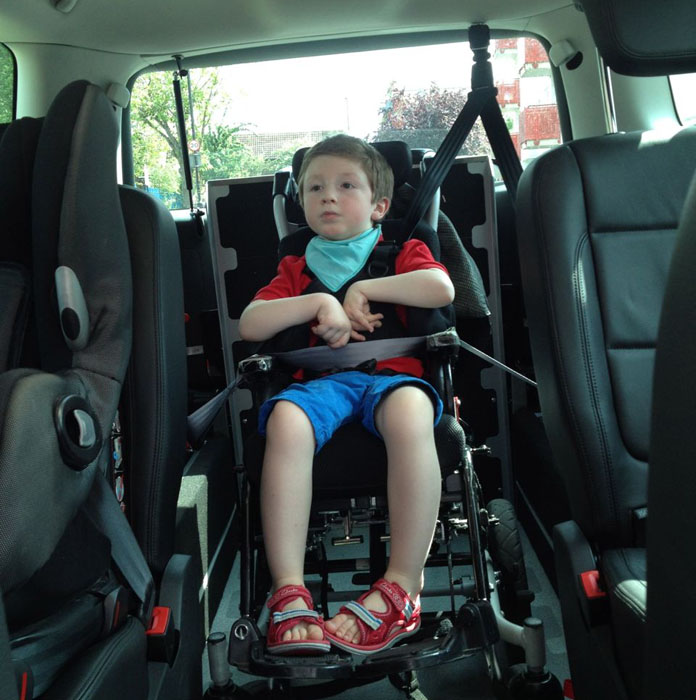
WAVs are normal cars that have been adapted to include a ramp so that a wheelchair can be wheeled in and strapped down. We considered the options.

For us, it was crucial to get Ben as far near the front as possible, so we could keep an eye on him and he wouldn’t be totally separate from Max. There’s something hideous about the idea of me, James and Max sitting in the front two rows and then Ben being stuck back in the boot. We also need enough space to fit all of our other stuff, but for the car to not be too huge. We borrowed a WAV van last year and it was enormous – like driving a minibus to the shops. We live in inner London – we need to be able park.

We are incredibly fortunate – we have been able to get a brand new car, with lots of amazing features, where Ben is safe and comfortable (ish – his wheelchair needs adjusting but don’t get me started on the FOUR -SIX MONTH waiting list for wheelchair services). But still it will take some getting used to. I have a mixed relationship with unfamiliar cars; I can force myself to drive any car, anywhere (I’ve driven happily in Syria and Qatar) but I get extremely attached to the car I know. I’m currently having to remind myself daily that the new car is better than the old car (which was massive, and intimidating for other people to drive, but feels like my friend and I am – boast warning – amazing at parking it in busy central London).
img_0460

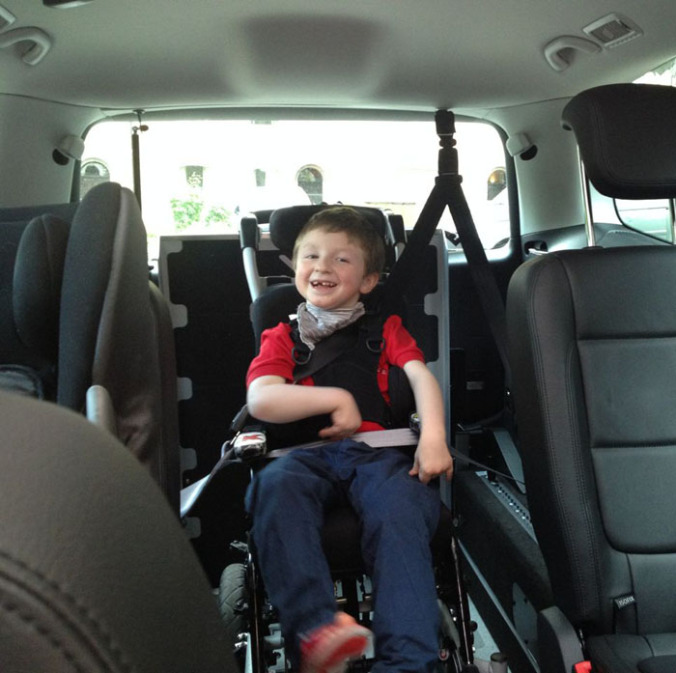
Also, a WAV forces you to rethink everything you know about safety. Up until last week, it was all about putting a seat belt on, checking the car seat was correctly fitted. Now it’s a fiddly routine of belts and clamps, tightening and tensioning, remembering the seat belt on top of all the other paraphernalia. In the past, I’ve become blase about inserting nasogastric tubes and tube feeding – clearly it is within my wits to get this process down but it’s going to take a while. And I’m a tiny bit resentful of all this palaver.

The boys need no convincing. Ben is happy to travel in any vehicle that has Charlie & The Chocolate Factory audio CDs playing, and Max thinks that a car with DVD players and headphones is pretty brilliant. This is a classic example of Max benefitting from his brother’s disability – Ben has a tendency to vomit in the car which is reduced if he watches something on TV while we drive.

So, apart from the business of going over speed bumps painfully slowly to avoid scraping the bottom of the ramp, and needing to find massive parking spaces to leave room for the ramp, the car is good. We will grow to appreciate the ways it helps us. I will learn to love it.

A trip to Westminster

I didn’t realise quite what a difference it would make to our lives once Ben was at school. We’re now coming to the end of his first year of full-time school, and it’s been bloody marvellous. The thing about having a very small disabled child, who’s at home a lot, is that you are responsible for every almost every aspect of their lives; what they’re doing, who they’re doing it with, what they’re learning (or not), how much variety they have in their days. Even with the aspects that aren’t entirely down to you, you are still the one providing taxi services or co-ordinating appointments, having conversations and arranging outings. It’s a lot of pressure and hard not to take things personally.

If you are lucky enough to get your child into a really good school (via interaction with your local Special Educational Needs department, which is bound to be stressful), a significant chunk of responsibility is lifted from your shoulders and you are handed back whole swathes of time. 5-6 hours a day to be precise.

Of course there’s still a lot to do and arrange. And there are school holidays to fill. But every day during term time, your child is with people who are teaching them, playing with them, taking them to go swimming and to other interesting places.

Ben’s school celebrated the election of a new parliament in May by going on a school trip to Parliament for all of the children who are part of the MOVE programme, which is all about integrating physical tasks, goals and skills in to the school day and is designed to involve the expertise of everyone who works with the children – parents, teachers, therapists, classroom assistants and others.

img_0285

Ben’s MOVE goals focus on him sitting unsupported and standing for short periods of time. Being part of the programme means practicing these skills every day at various points throughout the day. The idea is to go beyond just working on this in designated physiotherapy sessions. It a great idea, and Ben’s ability to sit with less support has improved noticeably over the last 6-9 months.

The outing to Westminster was to celebrate the achievements of all of these kids, and where better to take them for a treat than to the heart of power? The place that, for a group of eleven disabled children, ultimately determines so much of their lives, from education and transport, to benefits and healthcare.

If I decided to take Ben on a trip to Westminster, it would be a big deal and I would spend a lot of time planning and fretting. The idea of taking eleven children in wheelchairs, eleven staff and all of the necessary bags on the tube, in order to make an appointment time with an important person would send me into some kind of collapse. But that’s what the school did – cheerfully and enthusiastically. Presumably somebody was planning and worrying, but they gave the impression of easy calm. They even, in the spirit of MOVE, got all of the kids out of their wheelchairs on the tube to practise sitting on seats. Brilliant! Nuts!

on-tube

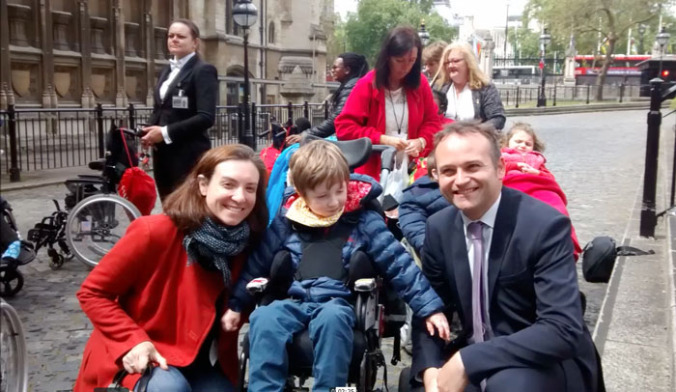
I met the party at the Houses of Parliament and we went though security – all lovely slopey ramps, friendly frisking and smiles for the army of wheelchairs. We went through to New Palace Yard where we were met by Neil Coyle, the very newly-elected MP in whose constituency Ben’s school sits. He’d only had a couple of days to familiarise himself with the workings of the Houses of Parliament but he got us in, and happily chatted to us all, kids included. You could not meet a more welcoming MP.

with-neil-coyle

There’s a video here.

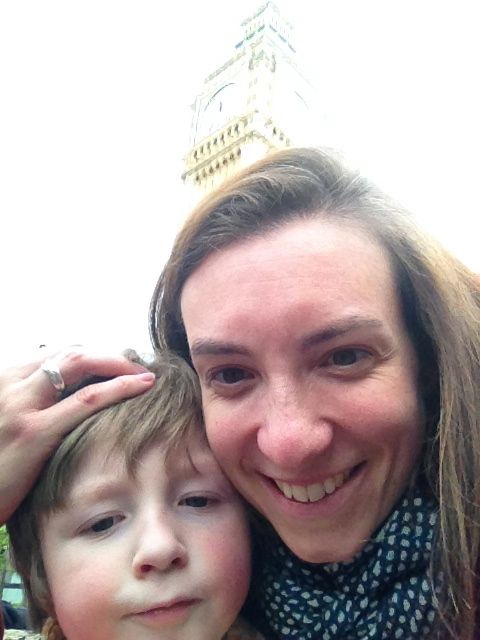
I love the idea of politicians and their colleagues coming across these kids as they walk through the Palace of Westminster. I got by far the best bit of an ambitious day – just swanning in for the photos in front of Big Ben. What a luxury for me – none of the anxiety about logistics or whether Ben would be happy, and all of the fun of the adventure. But mainly, lucky Ben!

IMG_0279

(Surprisingly hard to fit my large head, Ben’s wobbly head and Big Ben in a selfie.)

Listening to the lungs

When you are a parent, there are times when you really can’t be sure you’re doing it right. Much like when you thought all grown-ups knew what they were doing and then got to your twenties and realised the world is full of clueless adults, it turns out a lot of parents are winging it with varying levels of success.

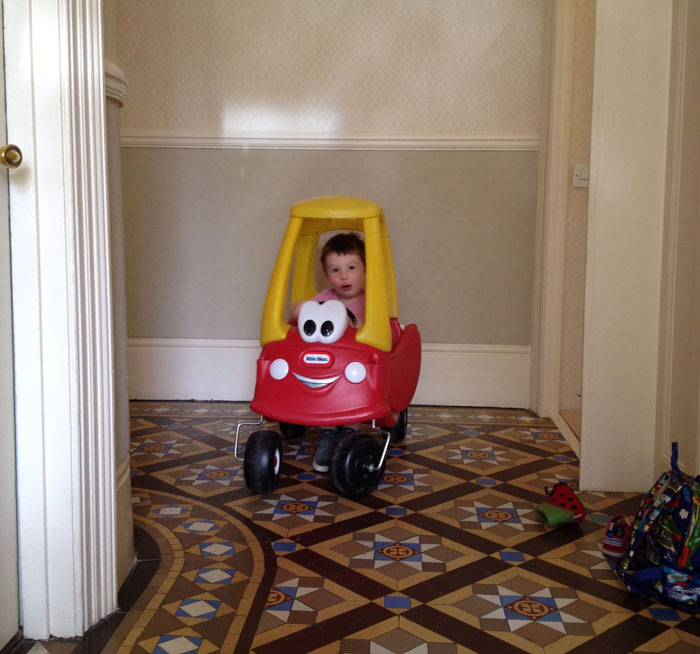
Sometimes I have days like this Saturday, when my three year old found out that the ramps installed to enable his disabled brother to get out to the garden also mean he can drive his outdoor toy car straight up and into the kitchen. Then he repeatedly barged my legs, and on the back of a major toileting incident and various other small but irksome exchanges, I found myself pushing the car (with him in it) back out to the garden, with a noticeable lack of good humour. I then ignored him for a few minutes, so when my husband returned from the shops he was a little alarmed to find Max was standing at the back door screaming, wearing nothing but a pair of pants. At this point I wondered if I had any idea what I was doing.

IMG_0365

I have many moments along this theme – wondering or worrying whether Ben’s doing enough or too much therapy, whether the boys watch too much TV, feeling bad that we haven’t taken them swimming for weeks, or that we’ve made them move house for the second time in two years, and they’ll have to move at least twice more in the next two years, etc, etc.

But then some days I think to myself… Jess, you have this job totally nailed!

Ben had a heavy cold last week, caught from me. He was snotty and a bit feverish but not awfully ill. He started to have a bit of a cough, and on Wednesday night I wasn’t very happy with it. But his temperature wasn’t that high, and he wasn’t that miserable. We put him to bed as usual, and about 10 minutes later he was sick. Which wasn’t ideal, and is relatively rare these days, but it’s not extraordinary. Then he slept well that night, which was very unusual, and by this point my metaphorical ears were pricked.

Ben hasn’t had a chest infection for over two years, but previously he’s had a lot. And I remember the sound of them.

First thing on Thursday morning he still had a bit of a cough, so I phoned the GP. We can normally get an appointment on the same day but they were short of doctors so the best they could offer was going to the surgery and waiting an unspecified length of time to see someone. Nothing sounds less fun than taking a slightly ill boy with a low boredom threshold to sit in a room full of sick people for hours so I dithered a bit. But then Ben coughed and I decided we’d go.

As we arrived, I could hear the administrative staff behind the desk talking about how few doctors there were, and that there were too many people waiting without appointments. Then the doctor came and queried whether all of these waiting people really needed to be seen today.

I was feeling a bit sheepish – on the face of it, yes Ben is disabled and complicated, but his symptoms weren’t that stark: a cough that his mother thinks sounds wrong, a little bit of a fever, some snot, and a really good night’s sleep.

We waited less than an hour before being called in to the doctor’s room. I set out my concerns, and she took his temperature (a bit high) and listened to his chest: crackles on the right! Needs a course of antibiotics!

I mean obviously I’d prefer he wasn’t ill. But the feeling of satisfaction at being proved right was a parenting high point. I know this boy. I know his lungs. And some days I am ALL OVER this mothering (*smug face).

(Max might not agree.)

Extraordinary Bodies

Of the many things that change when you have kids, evening socialising is one of the most dramatic. James and I went from a pretty healthy social life to much rarer escapades, partly because it’s difficult finding people who we can train and trust to look after Ben, partly because babysitters are expensive. Going out is relatively unusual and totally lacking in any spontaneity.

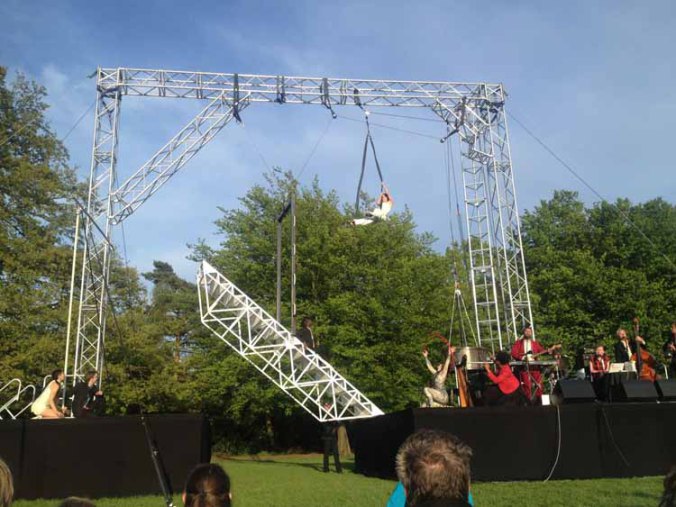
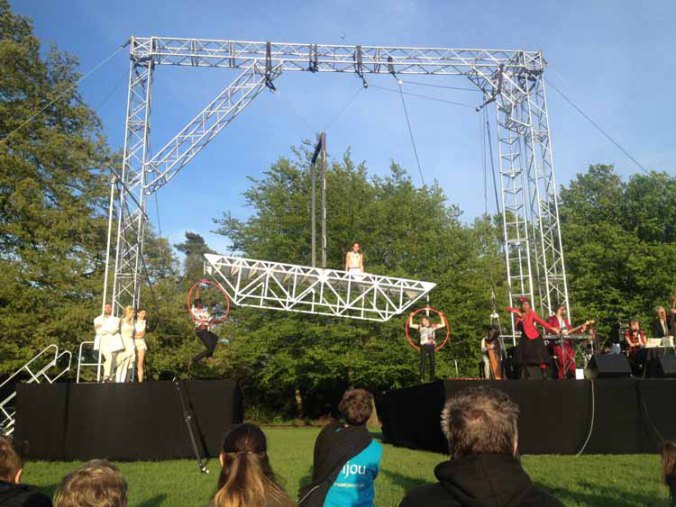
I was therefore excited as we headed to Dulwich Park last Saturday night, for an open-air circus performance called Weighting organised by our local council. I knew it would involve disabled and non-disabled actors and performers, and we would sit on a blanket, and it wasn’t raining. I had high hopes.

I was not disappointed. In a week when the election result had not been what I had hoped for and I’d read a report about Ben that had been unusually pessimistic, this was the antidote to any and all negativity.

IMG_0171

img_0173

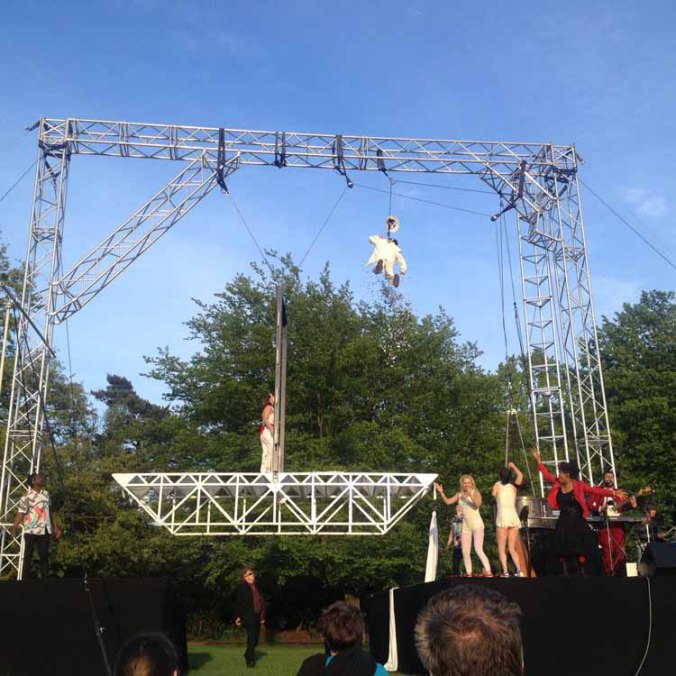
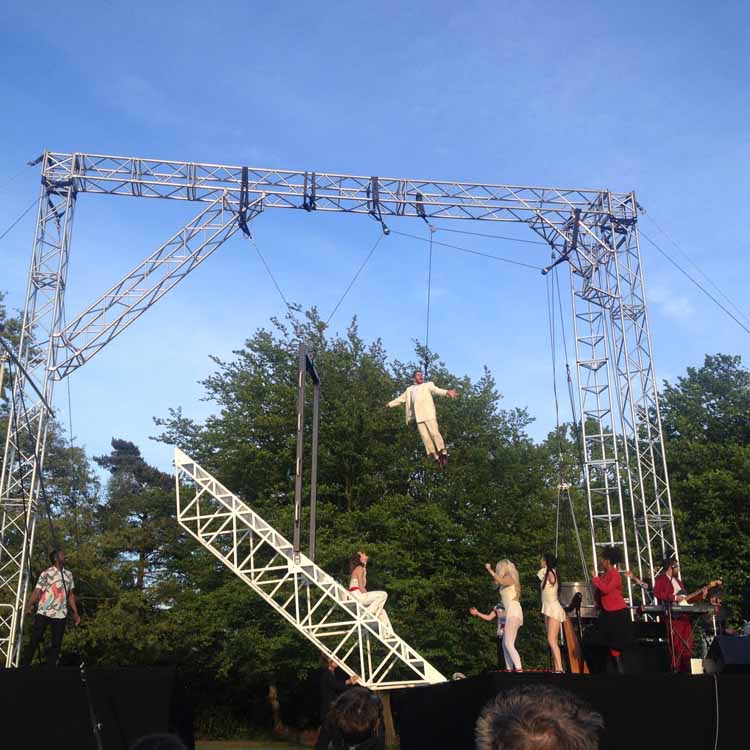
The performance centred around a bridge which separated worlds, and upon which incredible acrobatics were performed. There was brilliant music, and a storyline about a father’s fear of letting his daughters out in to the world. The performers were lit by the sun setting behind us, and the audience was full of every (dis/)ability, race, age and gender. I was loving it.

img_0178

IMG_0182

And then the Father in the show, who had a physical disability which made it difficult for him to walk and who I suspected might have cerebral palsy, started making his way on to the bridge amidst a storyline of him accepting his family must go out in to the world. He got most of the way up the bridge, slowly and carefully, and then leapt off the edge. Attached to a harness, he swung up and down suspended metres from the ground and looked so completely free, and it was so clear that he was enjoying himself, and IT WAS AMAZING. I did a lot of crying.

img_0183

IMG_0185

Then the community choir started, signing along with the lyrics they were singing, and a children’s choir joined them. This did not help my tears dry up.

Both in its preparation and its storyline, this was a show about people, some of whom happen to have disabilities. About the part of London we live in which is diverse in every way. It was about hope, and not letting fear take over, and love, and joy.

The theatre company Extraordinary Bodies celebrates every body, disabled or not, and turns the very fact of its inclusiveness in to its greatest asset. From the sign language interpreter dancing while signing, to the council subsidising such an inspirational piece of theatre so it was free to all, it was an extraordinary performance.

At a time when it feels like disabled people are taking the brunt of austerity in countless ways, Weighting tells us what we need to remember. Let’s regard everyone as extraordinary, help each other, come together and find joy where we can.

Sending Ben down a zipwire

Over the Easter holidays we took Ben away for an activity weekend. We went to Istanbul for a long weekend with Max in March, so now it was Ben’s turn to get uninterrupted time with his parents.

IMG_9848

I did not grow up with activity holidays. My family holidays involved weeks in the British countryside going on long walks, or staying on a smallholding in Spain and swimming in a pond full of frogs. Our dad would occasionally take us to the local swimming pool but we were more likely to be taken round Ronda bullring for the twentieth time than to be put in a canoe. Our meals involved omelettes and family arguments. Not once did we stay anywhere fully catered.

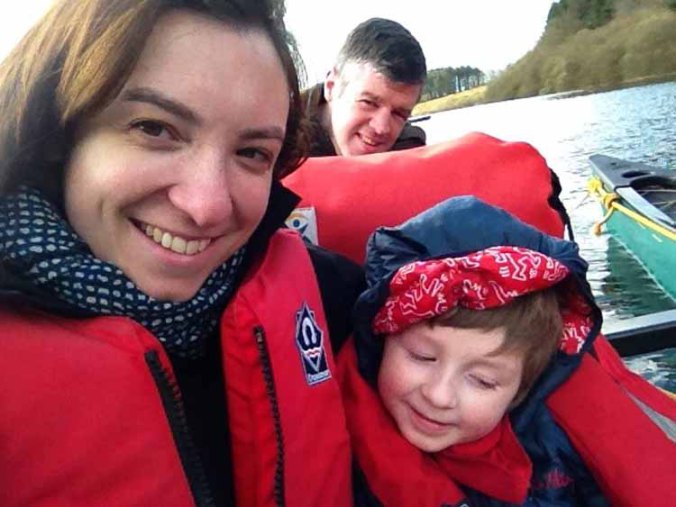
The Calvert Trust Exmoor enables people with various disabilities to experience outdoor activities that might be complicated or impossible otherwise. We had heard great things about it, but I was a bit nervous. Mainly about how Ben would feel about it all, but also because activity centres remind me of school trips. All of the schedules and rules and mealtimes make me feel like I’m 11 years old again, and when we arrived I actually felt a bit homesick, even though I was there with my husband and child, and I’m an adult with a car that I can drive away if I really want to. I had a small weep about leaving Max behind, and then cracked in to the red wine.

We were there for a long weekend. And what a weekend it was – undoubtedly one of the most intense of recent memory.

It’s quite hard to summarise how it went. It could be written one of two ways:

  1. Brilliant adventure! New experiences!

We were told our timetable when we arrived. We were worried about how Ben would deal with any of the activities, but particularly the canoe trip – it would clearly mean an extended period of time with no ipad or books or distraction beyond calm water. And he wouldn’t be able to sit in a supportive chair like normal. What were we going to do when he flipped out, in the middle of a lake on a boat we were sharing with other people?

img_9798

In fact, Ben was great. He was patient as we got ready for the trip, sat perfectly cross-legged in the boat and lasted almost and hour and a half before he got bored.

img_9774

The next day he was attached to the ceiling of a sports hall in a harness and swung around. As far as we are aware that was the first time he’d done that too.

IMG_9822

Then in the afternoon, we pushed him down a zipwire at high speed. Twice. He reacted to this extreme sport by closing his eyes for the entire thing and giving us a wry smile. He looked more relaxed than ever.

IMG_4108

IMG_9855

On both days he went swimming and hung out in the Jacuzzi, where he was relaxed and happy. We walked round a lake, sat by a fire, and read a lot of stories.

Our instructor was friendly and accommodating. He was skilled and experienced so knew how Ben could be supported to do each activity, and quickly worked out if Ben was getting impatient so made sure he went first when possible. He fits in to the category of people we come across pretty often who specialise in maximising the lives of disabled children and do it really well.

In the two days of activities, Ben took part in AND ENJOYED canoeing, swinging from a ceiling and zooming down a zipwire. He had never done any of these things before. If we achieved just one of those things in a normal weekend we would be inordinately pleased with ourselves. We’d spend the rest of the day watching the Paddington Bear film and congratulating ourselves on going canoeing. Canoeing!

  1. Really, extraordinarily hard work

Between all of these amazing activities which Ben enjoyed, we were working incredibly hard to keep the show on the road. Ben was a bit tense almost all the time in such an unfamiliar environment. We were in a group for each activity so there was inevitably some waiting around for our turn. As the weekend went on, we found we couldn’t wait for longer than a couple of minutes before he was getting grumpy. It also became apparent that Ben hates wearing a helmet.

IMG_9803

James and I were working overtime to keep Ben chirpy in between the action. Our timetable was packed with way more stuff that we would usually do with him on one day. Through a combination of fractiousness and tiredness, he didn’t enjoy a forest walk, or a challenge course, or crate stacking. He cried often and whinged a lot. We didn’t even try abseiling – we just stayed in our room listening to audiobooks and napped.

Ben was almost the youngest child there (most of the visitors are adults) so it’s not surprising that he was a bit overwhelmed. I was a bit thrown at times!

Meanwhile, all of our meals were provided but that didn’t include Ben’s gastrostomy feeds, and we didn’t have a kitchen. So we were washing syringes and cleaning the blender in our en-suite bathroom, storing his food in a mini-fridge, preparing medicines on a windowsill. It worked, but nothing makes you appreciate your own kitchen like not being in it.

When I was thinking about visiting The Calvert Trust, a friend told me it was the only place she had ever been where disabled and able-bodied people were viewed equally. She said, if only the rest of the world were like The Calvert Trust it would be a much better place. And she is totally right – we have never been anywhere where people (including James and I) assume Ben will be able to take part in every activity, and someone will have thought carefully about exactly how to achieve that. It is inclusive – both in terms of people participating in activities, and because it brings together a group of disabled and non-disabled people to get to know each other, talk to one another and eat together.

img_9813

But… I didn’t anticipate that being in a place with lots of disabled people, would make me see Ben as more disabled, rather than less. Even in a group of disabled people, Ben is noticeably less able than most. That is what it is – he’s brilliant, and cute, and clever, but his body just doesn’t work very well.

So by the time we got back to London, James and I needed a holiday to recover from the holiday. But instead James went back to work that afternoon, we decided to move house next month, and embarked on a series of hospital appointments with Ben. We are glad we went, and will definitely go back, but let’s be under no illusions that it will be a restorative holiday!

Cycling

In our quest for fun weekend and holiday activities, Ben’s tricycle has been a godsend. We are constantly aiming for variety in Ben’s life; things to do that aren’t us reading him books or watching an ipad, activities that get him out of his wheelchair.

IMG_8510

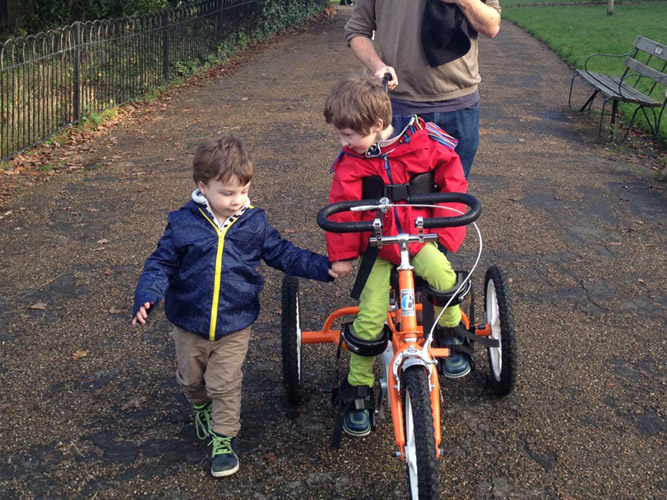
The trike offers all of the above, whilst also allowing a rare opportunity for Ben and Max to do the same thing at the same time and pace. Both boys have got orange bikes/trikes, and we have just hit the moment when Max has worked out how to ride his balance bike for longer than 2 minutes without demanding we carry it. Meanwhile, Ben has hit his stride on the trike.

IMG_9451

This means we can spend fun mornings in the park. Ben is happier, and more active, than he would be if we were pushing him in his wheelchair (and strangely less scared of dogs). The boys like racing each other, and I feel like we’re a normal family. Our boys are learning to ride their bikes together, on sunny days, in parks full of daffodils. We’re living the dream!

IMG_9718

IMG_9726

We’re not the only ones who like the trike – people smile at us as we pass, much more than they would if Ben was in his wheelchair. I think a big orange tricycle gives people a way in – even legendarily unfriendly Londoners find themselves saying hello. One woman asked if she could take a photo.

We bought Ben’s trike last year. We got advice from various physios and had trials with two companies. There is no statutory (e.g. NHS) funding for equipment like this, and they are really expensive, so we took our time deciding what kind would work best.

The trike we decided on, made by a company called Theraplay, can be parent-operated from behind, so Ben can ride the trike normally with us pushing and steering. This allows it to be as normal a riding experience as possible, but with us doing most of the work. Ben chose to have an orange one.

IMG_9741

Whenever we consider buying big pieces of kit like this there’s a tension between enthusiasm and caution. Enthusiasm for the possibility of this being The Thing That Ben Loves, that he can use easily and effectively, that he is able to operate independently and generally makes all our lives brilliant and fun. Caution because we’re about to spend £1400 on something that Ben might not like, might not be able to use, and then we’ll have to work out how and where to store a huge white elephant and manage our disappointment.

This time the gamble has paid off. We have been slowly increasing the distance and speed that we push Ben. He now likes us going really fast. So far, we have been doing all the work – Ben’s feet are forced round as we push the trike forward, but we might be on the cusp of him being able to do some of it himself.

He finds holding on to the handle pretty tricky, but he can sometimes push the foot pedals round on his own now. We still hold the handle in order to steer for him but for a couple of metres we aren’t pushing at all – all of the forward momentum is Ben on his own.

This is the moment that I really hoped might happen, but was worried might not actually materialise. To pedal the trike, Ben needs to control his legs separately and time it right. It is difficult for him but, like so much that he does, he is trying really, really hard. Well done that boy! Well done that trike!

IMG_8492_2

Broadening Horizons

When I was doing my post-graduate diploma to become an architect, I studied at a very well-respected university in London. Through a complicated, confusing process of admissions, I ended up in a teaching unit with two eccentric tutors. They dedicated themselves to broadening the horizons of their students as widely as possible, the manifestation of which was to teach us as little as possible about buildings while having long (and occasionally unintelligible) conversations about cybernetics, pataphysics and (in the case of my work) weaving.

For me, it wasn’t a hugely successful approach and I didn’t thrive in an environment so self-consciously wacky, but I respect their intention. Life, and particularly professional life, is rarely as varied and fun as one would like so it’s important to broaden horizons before they are narrowed by the requirements of a Local Authority Planning Officer.

I carry this idea in to my parenting. I think the role of any parent is to provide as many possibilities as possible, to raise a child that believes they can do what they want and understands how big and rich the world around them is. Of course I have prejudices and opinions which I can’t help projecting on to my kids – I would like my sons to contribute, I might struggle to rouse enthusiasm for them being bankers – but I mainly want them to feel they have options.

Naturally our aspirations for Ben have adapted a bit to fit his talents. James has had to accept that the already low probability that he’d play international rugby has further decreased. But that’s okay – I have never been hugely keen on the idea of my (inevitably) slight sons being pummelled – we just need to find some alternative possibilities and role-models.

Much of the world is still open to Ben. He can read and spell at an appropriate level for his age so as long as we can facilitate his communication there is no reason that he can’t do all sorts of exciting and interesting things. Once you start to look there are lots of people with profound communication difficulties doing brilliant jobs: Stephen Hawking obviously, the media’s favourite disabled person.

I recently came across the work of Jacqueline Smith – an artist who is physically disabled – through my mum spotting something in a Printmaking magazine. Following some internet detective work, I found the Eye Can Draw project which aimed to establish greater access to printmaking for artists with disabilities in Dundee, Scotland. Amongst other things, they linked eye-gaze technology with graphic software, and then used the drawings to make prints using various printmaking techniques.

Once you think about it, it’s an obvious thing to do. But it hadn’t occurred to me. Ben uses an eyegaze computer to play games; why not encourage him to make art this way?

THIS IS WHAT IT’S ALL ABOUT. These are the people we need to know about. Not just taking Ben to art for kids and hoping/helping him to use his hands, but finding role-models, and their work, which is inspirational in both process and end result.

DSC_0476

I loved Jackie’s prints, and I’m pretty sure I would have liked them even if I hadn’t been so heartened and inspired by her methods of production. She is a talented artist who just happens to make her pictures via some specialist technology, which itself requires skill and expertise to use. It is no surprise to me that Jackie’s work was nominated for the Lumen Prize 2014, for art created digitally.

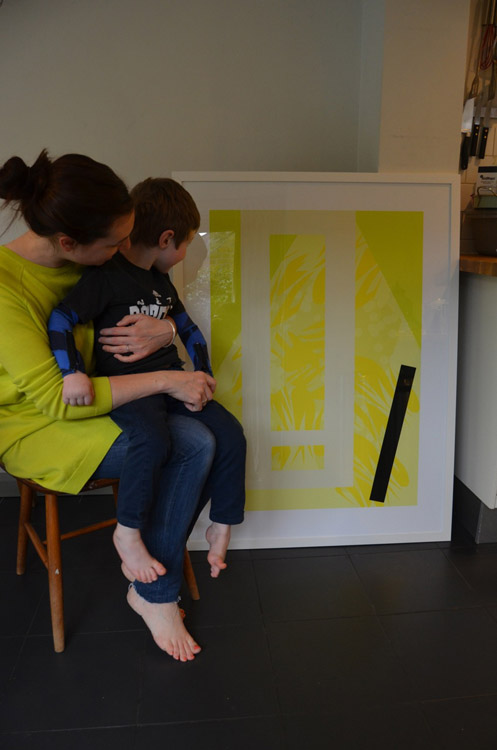
So I bought one! I pretended to myself that it was a present to Ben. I had a very friendly email exchange with Jackie who was concerned that the scale of the print would be intimidating in a domestic environment, but I can’t think of anything better than eye-catching eye-gaze art. Let’s intimidate ourselves with the positivity of disability.

The print is now framed and yes, it is rather large. I might make it my goal to only buy pictures that are the same size as my children.

DSC_0499

Hobbies

IMG_9484

It is tricky for us to encourage Ben’s hobbies. Or find fun stuff for him to do that isn’t watching an iPad or being read a book. Activities often feel like hard work for not that much reward. We have had some successes: swimming and stories at the Horniman Museum in particular.

Over the last couple of months we have been trying two new activities with Ben regularly – music on Mondays and trampolining on Wednesdays.

Music is the very best kind of therapy – therapeutic input with specific goals in a trojan horse of fun! I’m certain Ben has no idea he’s working. I wrote about us starting music therapy here. Since then Ben has got over his upset at each session finishing and is happy to arrive and leave each week. We have just had a review with his therapist, who I will call C, where she showed me videos of some of the sessions and summarised how they were getting on so far.

We rarely have reviews that are as wonderfully positive as this. You could be forgiven for thinking Ben is some kind of musical genius when you talk to C. Her feedback is full of things like:

Ben has been extremely motivated to participate and shown himself to be very sensitive and musical, working hard but also sharing a clear sense of his fun character‘.

And:

‘On a small number of occasions Ben has also very clearly, melodically, and beautifully, sung in response to the music. This is very fragmentary at present and it is likely to be an evoked – rather than consciously directed – response. However, the musicality and sensitivity of this illustrates clear musical understanding.’

In the videos I watched it was striking that during long periods (i.e. up to a minute) Ben was listening intently to music being played and was totally still. This is unusual – Ben is nearly always moving some part of his body. When he did try to participate he managed, despite all of the physical challenges. I saw him bashing a drum at the right time, and kicking a tambourine to a beat. Not always, but often. It is all hugely exciting and Ben is so obviously engaged.

Meanwhile, on Wednesdays we have been going to trampolining before the school day starts, on the amazing big trampoline that is hidden beneath the floor of Ben’s school hall. Ben was pretty relaxed from the beginning, but has been enjoying it more and more each week that we go. He clearly now knows what to expect and is really comfortable with the instructor, who I’ll call D. D has been bouncing higher and doing ever more bold moves as Ben lies on the trampoline surface and is flung around.

Having been invited to come along by the staff at school, Max has taken longer to engage, preferring to play with the PE equipment in the hall rather than venture on to the trampoline. It’s not only disabled kids that need time to acclimatise and build up their confidence. Today, finally, he totally embraced the concept and D helped him to bounce and lie next to Ben. If finding successful activities for Ben is difficult, finding things that both Ben and Max enjoy at the same time is THE HOLY GRAIL. I actually got cheek-ache from smiling so much (video below).

Similar to music, the trampolining is doing all sorts of things for Ben beyond letting him have fun. Being bounced around is excellent vestibular input (to the structures within the ear which provide information about balance, equilibrium and spatial orientation) for a child that doesn’t necessarily roll down hills or go down slides. It gives unique feedback through a body that can’t communicate with itself very well, and is physical therapy in disguise – Ben clearly tries to lift his head and arms throughout the sessions.

img_9477

This is what happens when the stars align and you find something Ben’s interested in, at a time that suits him, in a venue that works, with a therapist or instructor who is really good at what they do. C is really careful – to the untrained eye she appears to be sitting in a room helping Ben play a drum. To a skilled eye, she is getting Ben in the right position, making up a song that interests him, adjusting the timing so he can get organised to move his hand to the beat, positioning the drum where he can bash it, constantly testing and adjusting to get the best out of him. D is filled with enthusiasm and has gently worked out what Ben likes and included Max as much as she can. She works at a pace dictated by Ben, and is unfailingly pleased with every bit of feedback Ben gives her.

It’s all totally bloody brilliant. I couldn’t be prouder of these boys

(Not the best quality photos – iPhone cameras not happy with institutional lighting and bouncing.)

A Missing Tooth

IMG_9204

By the way of pre-amble, let me say I am slightly tempted to record this as a podcast in order for the word Tooth to be pronounced ‘tuth’, rather than the more usual ‘too-th’. This is how my grandmother, Min, said it – I assume it must be a Worcestershire thing. It is how I say it to myself in my head, even though my London accent doesn’t say it out loud that often.

I have had many conversations over the past few months about Ben’s teeth. We seem to have hit a kind of critical mass of dentistry so at least four separate dentists have seen Ben or talked to me or others about him recently. They all work in different settings or hospitals, and have slightly different perspectives, of course united by their love of teeth. They also all happen to be really competent women; if only all fields were so stuffed with talent.

I am not complaining about all this attention. I have good teeth (no fillings, I am intolerably smug about it) and I have a mother who has spent significant time reminding me to brush my teeth, taking me to the dentist, banning me from eating sweets, and generally hassling me in the teeth department. I am trying my absolute best to replicate this aspect of my childhood.

Combine this with horrific stories about other disabled children’s teeth and I am hyperaware that we don’t clean Ben’s teeth very well. Ben can’t (and has never) opened his mouth more than a couple of centimetres. He has a bite reflex so clamps down on a toothbrush if it’s put between his teeth. He has high oral sensitivity and a heightened gag reflex. This all makes it practically impossible to clean his teeth effectively.

Ben is helped by the fact that he doesn’t eat so his teeth aren’t being covered in sugary snacks every day, but he also has reflux and we feed him food with carbs and sugar, so his teeth are getting contact with food albeit from the wrong direction.

We have been assured that we are doing all we can by Ben’s main dentist who is based in the community. The first time we saw her she offered useful tips and was sensible and friendly. She said she would be happy to see Max as well, even though his dentistry is unlikely to be complex, because then I could bring the boys together. This kind of attitude is like GOLD DUST, and we have happily followed her to a different clinic further away for our visit every few months. You do not let these kind of people go unless you have to.

Ben wasn’t as enamoured with her attention as I was in early visits, and clenched his jaw tight shut as soon as she came close. No matter, we kept going, and at our visit last month Ben was relaxed enough with her to allow her a quick peek inside while the dental nurses let Max operate the special chair.

This is progress, but the best way of knowing what’s really going on in there is to look properly when Ben is anaesthetised. It’s important to try and really see the state of his teeth as he will be unable to tell us if any of his teeth start to hurt, and any infection is likely to get pretty bad before we realise what’s going on.

Ben needs to have an (unrelated) investigative MRI in the next few months so we are trying to co-ordinate things so his teeth can be examined and cleaned while he is under general anaesthetic for the MRI. No-one wants to give him a GA purely for dentistry, but it makes perfect sense to kill two birds with one anaesthetic stone. It is a mere task of co-ordinating between the MRI department, a neurology department and two separate dentistry teams, one of which is on a different site. I don’t see what could possibly go wrong.

Meanwhile, at the half-term community appointment we had discussed Ben’s baby teeth falling out. The dentist said Ben’s teeth could start falling out any time from now. I was really anxious about it – Ben doesn’t eat, he rarely has anything in his mouth. He can’t use his hands to get a tooth out. What if his tooth fell out and we didn’t notice and he choked on it? Would he manage to swallow a tooth? What if it happened at night? Should we wiggle all of his teeth all the time and then encourage loose ones out (she thought I was overdoing it by this point)?

Three days later, I got Ben out of bed in the morning and there was a whacking great big gap in his teeth. His bottom front tooth (‘tuth’) was gone! And he was alive! I was, am, very excited and incredibly relieved. There was no sign of the tooth despite much searching of his bed, but Ben (via Granny) notified the Tooth Fairy.

And the Fairy kindly left a pound coin. Which made us realise that because Ben can’t ask us for stuff, we’ve never given him any money. Max is always demanding money (real or fake) but we have never thought to give Ben coins of his own. Now we need to get him a money box.

So Ben looks cute with his toothy grin, and my fears have proved unfounded. Only 19 more teeth to go…

Ben’s Dad

DSC_0228

If I could undo Ben’s disability I would. I don’t have any time for the idea that it is part of some plan, or that Special People have Special Children, or that this is the way Ben was meant to be. Ben was a healthy, fully able baby in my womb, then his brain was damaged and now he is disabled. When he is older he can tell me what he thinks, but in my view it would be better if he wasn’t disabled. There is almost nothing that has followed from his birth I wouldn’t give back in order for him to be able to walk and talk. Of course this becomes more and more theoretical as he gets older, and we can’t imagine him any other way.

Ben is disabled, and he can’t walk and talk. But Ben is happy and healthy so we must get on with it.

However, one thing that I know now, that perhaps I wouldn’t have known quite so clearly without Ben’s disability, is that I married the right man. I am lucky. For this I am extraordinarily thankful.

Last week marked the anniversary of James and I getting together exactly fifteen years ago, when we were undergraduates spending too much time watching Neighbours and drinking too many pints of cheap lager. In the following ten years we had many adventures and a lot of fun, travelling frequently and building careers.

Then, five years ago, when Ben was born everything changed. I have no doubt that I wouldn’t have made it through the first year of Ben’s life relatively unscathed if I hadn’t had James. We were worried and sad. It seemed hard to have fun. But at least we were doing it together.

There is no equivalent to the shared responsibility of parenting, the person who is as interested as you in some domestic anecdote about something your child has done, who is as pleased as you are with a small development. I have taken on the majority of day-to-day care and co-ordination of Ben’s life, but James is always there listening, commenting and encouraging. James can do everything for Ben that I do and will do it happily, be that getting up almost every night with him for 6 months when I was breastfeeding newborn Max, or feeding him and giving him cuddles.

IMG_0162

I do not take this for granted. Statistics about relationships of parents of disabled children are chilling: you are more likely to separate if your child is disabled. The combination of demands (physical, financial and psychological) and stress are too much for many couples.

I can’t help think this isn’t helped by many professionals addressing themselves almost exclusively to mothers. We have had numerous experiences in hospitals, clinics or at home where people talk to me and ignore James. They do not ask his opinion, or literally talk to me about Ben with their back to James (for example, about the risks of an impending general anaesthetic).

But it is a fundamental misunderstanding of the dynamic of our family to think James isn’t interested or involved in Ben’s day-to-day life. It is not only insulting to James by minimising his role as Ben’s father, but also puts more pressure on me as the one who should know everything and shoulder most of the responsibility.

It also doesn’t account for my notoriously unreliable memory versus James’s ability for near-perfect recall. Or that James combines all this parenting with a full-time job. Or that, for example, he’s taken a day of leave from that job to be sat on a hospital ward being ignored by a junior doctor.

Sometimes I look at my kids and I almost can’t cope with the amount that I love them. I felt like this about my younger sisters when they were small – I sometimes almost crushed them with cuddles. Like yesterday when I collected Ben from school; I walked in to his classroom and he was so obviously happy to be there, and then saw me and looked like he was the happiest he had ever been.

The only thing better than that feeling of fierce pride and overwhelming love is witnessing it between your husband and your children. He loves them as much as I do, and we are all Team Ben.

DSC_0207