I spoke to Janette about being a mother to her son Gregory, who is 35 and supremely sociable. I really appreciated speaking to Janette who is a parent to an adult child, and navigating being a carer for much longer than most would expect to be.
My son, Ben, is 13 and I knew very little about disabled people or being a parent when he was born. Being his mother has been a rapid education in the issues surrounding disability. I find it helpful and interesting to read stories about people with similar lives and I hope you might too!

Jess: Can you tell us a bit about you and your family?
Janette: My son Gregory is 35, and I have a younger son Edmund who is now 31. Gregory’s a very sociable person. He loves being with people, going to people’s houses. We’re active members of a lively church and we’ve got lots of good friends there. He loves live music and musicians. He’s very affectionate. He can read more than most people think. He can walk with walking sticks around our bungalow and with a walking frame for short distances. He likes things in a very particular order. He’ll notice when tiny things in our house aren’t in the place that they’re supposed to be. He loves picture books and coloring books.
He goes shopping once a week and loves using the hand scanner at Tesco. He’s very motivated by anything that’s got a button or a switch. We’ve gone through a lot of televisions and DVD players because he breaks the buttons by pressing them so hard. He likes going swimming, when we can find a support worker who is able to go with him. He loves being out and about and going on walks. He goes to a day center once a week. He loves doing cooking. He’s got a great sense of humor. He loves going to see his dad. We split up when Gregory was about nine. My ex-husband is a lot more patient than I am.
Gregory can speak well sometimes. He’ll tend to use the main words in a sentence. He’s very good at remembering people’s names and what socks they wear! He’s surprising to me and I know him really well.
Jess: At what point did you receive Gregory’s diagnosis?
Janette: He was my first child so to me it was a normal birth, but he had a small head and a low Apgar score. He was with me for an hour, then he was taken up to special care. They kept him in for a week while they monitored everything. I had to keep taking him for head measurements after he was born. Feeding was difficult. His legs were stiff and rigid. I was part of the National Childbirth Trust and one of my friends there was a GP. She said to me, ‘I think you need to go and get him checked out a bit more’. Leading up to being one year old, they did start doing a few more investigations. He wasn’t crawling, he wasn’t sitting very well. He had a big day’s assessment and at the end the paediatrician told me that he had special needs. She wasn’t very specific but just said he would be disabled all his life. I don’t remember her saying cerebral palsy. He then started having lots of physiotherapy and eventually they used the word cerebral palsy. He was such a smiley baby. He always wanted to engage with other people. I’m so thankful for the speech therapists in his life. Gregory started speaking when he was four.
Jess: How were Gregory’s school years?
Janette: He went to a mainstream playgroup until he was five, and then to a special school, mainly for children with physical disabilities. He had amazing physio and speech and language therapy (SLT). We asked for him to go two days a week to the mainstream primary and three days a week to the special school, encouraged by his SLT. We weren’t popular with Exeter council – it was like they’d never heard of that before – but it worked for Gregory. I felt he needed to be surrounded by ordinary chatter. It was a challenge, particularly communication between the two schools. As he was coming to the end of the first school the local authority wanted him to go to a special school full-time. The SLT suggested we see the schools in Taunton, where there was a massive push towards inclusion. We decided to move here because of that. We moved when Gregory was eight and it was like a dream. Our other son could go to the same school and there were other children there with similar disability to Gregory. The knock on effect of him being in a mainstream school is that wherever we go there’s bound to be somebody that recognizes Gregory. The first two years of secondary school were ok. The last three years were very rocky. He got suspended for a week for throwing a glass test tube across the chemistry lesson. They said they had to treat everyone the same, but a lot of it depended on the quality of the one-to-one teaching assistants and some weren’t very good.
It was very hard to know if I made the right decision. When he was 14 I went to see a residential special school because things were not good at school. They had communication devices, physio, hydrotherapy. I thought I might be able to go back to work, and then the school decided they wouldn’t have him. I was gutted. I think they felt his learning disability was the more dominant thing in his life than his physical disability but I see them all as part of him. Then he went to college at 16 and it was a breath of fresh air. They were all very embracing. He was at college for five years. He did gardening, pet care, cooking. They went on trips. He doesn’t do as much now as he did at college.
Jess: How do you think things have changed over the course of Gregory’s life?
Janette: I’ve come across a shift in attitude, particularly in social work departments. Social workers and other professionals working with children with disabilities occasionally have an attitude of, ‘You get a break when they’re at school.’ But all children are entitled to an education. They’re not called respite centres, or holiday camps. they’re called schools. If your child has a medical appointment, an orthotics appointment they’re continually missing bits of school. The pressure on services and funding is having a profound impact. I can look back 15-20 years ago and see that things weren’t as squeezed as they are now.
Jess: What support do you and Greg have?
Janette: I fought really hard. One social worker helped me a lot when Gregory was transitioning to adult services. I wanted to go back to college and do some studying. They awarded us 75 hours a week, and I went to college. The 75 hours is still in place, but it hasn’t happened since March 2020. There was absolutely nothing in the early days of March, April and May 2020 and even now the care company are finding it really hard to recruit because they don’t pay enough money, because the government doesn’t give enough money to local authorities to pay for these things. The care company can’t provide the support that they’re contracted to. This is one of the worst things. I might receive a rota on a Wednesday for the following week. Sometimes I only get two days notice until it starts. I can’t plan anything. I have not been able to work for 35 years, and I do feel quite resentful. I had to stop studying for my degree. When a carer goes off sick, there’s nobody to cover them. Often he should have a carer all day, but the care company can only get someone for 5 hours, or not at all.
I’m often having to pivot as the circumstances change and I’ve got to not fall over. I’ve found it less stressful to think I’m not letting an employer down, but I’m 60 now and I want to go to work.
It’s stressful having new carers in the house. Our bungalow’s quite small. People adjusting to you and you adjusting to them. We’ve had some amazing carers, people that you don’t want to ever leave you because they’re so good and they enhance all of our lives. But we’ve also had some shocking carers. Somebody decided that they were going to borrow some of Gregory’s money. Another drove Gregory 30 miles away because he needed a new tyre on his personal car and didn’t tell me. He didn’t know you have to put child locks on the door because Gregory will open the door as you’re driving along.
The relationship between support workers and our children is so important. Are they really interested in making their lives fun and interesting as well as safe and healthy? Does Gregory laugh? Does he go out and do interesting things with them? Are they sitting there at my dining room table on their phone for an hour while Gregory’s in his bedroom reading a book? Good people are intuitive as support workers. They know what Gregory is about.
Jess: How did you find the transition from children to adult services?
Janette: It’s like dropping off the edge of a cliff. The lack of physiotherapy as he gets older is quite worrying when all the physiotherapists I’ve met have said prevention is better than cure. We try to keep the stretches up, make sure he’s active, that he goes swimming and horse riding. They are not just activities, there are health benefits as well.
They closed the day center that the local authority was running. They outsourced to different private companies who do daycare. But if you’re an adult with a learning disability and a physical disability, then you become a minority of a minority. The setting that he goes to on a Friday said he couldn’t go on a trip because there wasn’t enough room for the bags and his wheelchair. I have learned that I can come across quite critical sometimes, but you would have thought an organisation that was supporting disabled people would have thought about it. I’m in the process of applying for deputyship from the court of protection. I haven’t had any problems since Gregory turned 18 about anything medical. Nobody’s ever questioned that I’m acting in his best interests.
Jess: How has being Gregory’s mother made you think differently about politics?
Janette: Care is the most important thing. There isn’t proper recognition of the hard work that carers do and they’re ignored by society. We need a career structure for carers in social care. The system is broken. Our MP is uninterested to the point of it being rude. I protested a year ago at the local elections and I got hounded by the Conservative councillors. I held up a big placard that said, ‘Don’t Vote Conservative’. A councillor came right up to my face and said, ‘You are a stupid woman’. We got into conversation and I was telling him about my son, and he said, ‘So what did you do to cause your son’s disability?’ I said nothing, and justice was served because he got voted out. I’ve never done anything like that before, but I just felt a wave of bravery come over me.
Jess: What would your advice to parents of younger disabled children be?
Janette: I remember never thinking about it when Gregory was growing up, but I wish I’d thought about the future. I think it’s important to think about what you would like Ben’s future to look like, and more importantly what he would like. Talk to your social worker about what older disabled people do, where they live.
Sometimes I think that nobody else can look after Gregory as well as I can. It’s not true, because I’ve seen other support workers be brilliant. My vision is for Gregory to live in a shared house with support workers. Greg thrives in a more social environment, not on his own. Social workers have told me the hurdle is housing, because the amount of suitable housing is negligible. The local authority here have become reliant on parents looking after their adult children because it’s so much cheaper for them. Most authorities don’t have a plan for people with complex disabilities, their health, their housing and their wellbeing. I want carers that we can really rely on, housing that’s suitable, and for Greg to not to be too far away. I want to be able to visit him and then come away secure in the knowledge that he is happy, that he’s safe, that he’s doing interesting things, that his needs are being met. Wanting your child to have a life of their own, outside of their parents, is a normal thing.


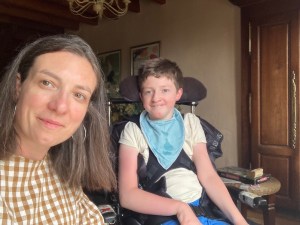






 Son Stories by Jessica Moxham