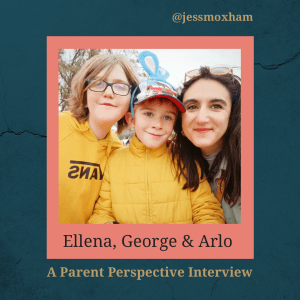
I spoke to Ellena about being a mother to two sons – George has a rare genetic condition and Arlo is autistic. Ellena also works as a teacher with children who have physical and medical needs so her professional life is entwined with her personal experience.
My son, Ben, is 13 and I knew very little about disabled people or parenting when he was born. My experience of being his mother has been a rapid education in the issues surrounding disability. I find it helpful and interesting to read stories about people with similar lives and I hope you might too.
Jess: Tell us a bit about your family?
Ellena: There’s me and my husband Charlie. We are both secondary school teachers. We live in London with two children. Our oldest son, George, is 12 and has a very rare condition called SEPN1 Muscular Dystrophy. It’s an autosomal recessive condition which is quite different to other muscular dystrophies inherited from one parent. We have a younger son, Arlo, who’s nine and has autism. Our oldest son is in a mainstream secondary school, our younger son is in mainstream primary school. Charlie and I lurch from one thing to the next on a daily basis like most families.
Jess: What do your boys like doing?
Ellena: They’re both real characters. George is a very emotionally mature child. He has spent a lot of time in hospital with medical professionals so gets on very well with adults. He is incredibly sociable and very good at making friends. He’s very interested in art – he likes making things and we have tried to nurture his creativity. There are lots of things he finds physically hard – he can walk but not really run or jump, and going up and down stairs is hard for him. He sometimes uses a wheelchair, but he’s physically ambitious. He’s decided that he’s very into badminton. He really likes going swimming – he can’t actually swim, but he’s fearless. He’ll just jump in.
Arlo is nine and has a specialist interest in trains. He can talk to you a lot about the world of Thomas, and he likes making elaborate train setups with tracks. He loves going to flea markets and finding things that appeal to him, which tend to be Thomas related. He’s found some amazing Hornby things, though it can be hard for him to regulate himself with the uncertainty of whether he’ll find anything.
Jess: What is George and Arlo’s relationship like?
Ellena: They get on quite well together. Arlo’s quite triggered by the sound of people singing and unfortunately George and I like to sing, so we get a lot of telling us to be quiet. He finds certain noises hard, so sometimes they’re a flashpoints. George said to me the other day that he sometimes looks at other siblings and wishes he had a different sibling relationship, because Arlo’s not so sociable and he’s not tactile or demonstrative. He is loving on his own terms. Those relationships are hard, especially when they both have quite different needs. At times, they have both had to yield to the other sibling in terms of time, or our attention, and I worry about that.
Jess: Tell me a bit about the births of your children, and your realisation that Arlo was autistic.
Ellena: Nothing has gone according to the plan that we had. Life as a parent is amazing when your child is hypothetical, and then when you actually have your children you realise nothing is ever how you think it’s going to be. Sometimes that means that your child is born with a really serious condition that is life threatening or life limiting, as was the case with our first child, and sometimes it’s not so high stakes.
We went through the genetic counseling process to have second child. We found out Arlo was a carrier for George’s condition but wouldn’t have it himself. When he was born, I very quickly realised things like laughing, smiling, eye contact were not how I thought they were going to be. Initially, for a very short period of time, I felt a very deep depression at this not being what I expected, or what I wanted. Then that went, because we are very lucky to be well supported as a family. We’ve got really good professional knowledge of children. I stopped thinking about all of the things that my life perhaps could have been and started focusing more on the way it actually was. It’s an incredibly privileged position – not all families are able to do that, and we shouldn’t expect them to. Life is very hard lots of the time, but that doesn’t mean that it can’t also be good a lot of the time as well. It’s about these massive contradictions sitting side by side always. You have to cling on to the things that are going well so you are able to keep going when things are really difficult.
Jess: How do your personal and professional lives influence each other?
Ellena: Before I had George, I was an assistant head in charge of inclusion at a secondary school in Hackney. I love teaching English, but I was also interested in how children learn and how we adapted the curriculum to fit individual needs. When we had George it became clear that he was very unwell. We had loads of different tests and I left teaching for a while, then had my other son not that long after. When I went back to work I became a more specialist teacher, and now I’m an advisory teacher for secondary schools. I support mainstream schools to do the best they can to include children who have physical or medical needs. We have a phenomenal number of children with very complex and quite rare medical needs in the borough and we want to make sure we get it right for them.
So I’m in the world of additional needs at work and at home. I sometimes reflect on that. I read things online about parents that are fighting for things or they’re not sure what’s happening, and it’s overwhelming. If I didn’t know all of the things I know through work, I would find it so much more difficult than I already do.
I think most parents, most of the time, do what they think is best. I have an interesting relationship with health professionals, professionally and personally, where judgements are made about parents. I always gently ask them, ‘Do you think that parent has done what they genuinely thought was right at the time?’ The answer is normally yes.
As a parent of a child with a disability, the number of times you are judged for your choices or your parenting is far more frequent than parents of non-disabled children. When George was little if a healthcare professional said something I found it upsetting or inappropriate I wouldn’t say anything. Increasingly I do say. For example, an Occupational Therapist visited our house recently to look at George using the bath. We live in a typical Victorian terrace, tall, lots of stairs. In an ideal world, I’d live in a huge house with great access, but the world doesn’t work like that. We went into our normal bathroom, and she said, ‘This is a very small bathroom. Have you considered moving?’ I said, ‘Out of interest, would you appraise somebody else’s house like that? Why do you think that it’s okay to say something like that because they are a parent of a disabled child? You have no idea what people’s circumstances are.’
It’s really hard to navigate those situations sometimes, because all parents are just scrambling around trying to work out what to do at any given moment. If your child has some sort of additional need, those challenges are multiplied by hundreds. Lots of experiences – going to a playgroup for the first time, or your child starting school, or going swimming – all of those things are completely different experiences for families like ours.
Jess: Do you have any advice for other parents?
Ellena: Never let go of what you think is right for your child, and for you as a family. If there’s a disconnect between that and what professionals are saying, or there’s a disconnect between that and how professionals are treating you, there’s nothing wrong with advocating for yourself and your child. Say if you don’t think something is appropriate.
All parents of children with additional needs could give you examples of mad things that professionals have said to them. I try so hard to think about that in my professional life.
Jess: What has been your approach to supporting George?
Ellena: Last year George had his PEG feeding tube permanently removed which was a big step for him because it was fitted when he was 2. He’s now waiting for the site to heal into a mark that’s going to be there forever. For him, that’s a symbol of a chapter of his life ending and moving on to the next thing. He’s quite philosophical about things, but he’s also a very good advocate for himself and others. I’m very proud of him.
We’ve never held him back or helicoptered over him. Sometimes I’ve had to keep all of my anxieties to myself, which is really hard, but he’ll give everything a go. But because I’m so immersed in this world, I sometimes forget that our life is quite different to other people. It’s not unusual for young people to have an autistic sibling, but George has a physical disability that is progressive on top of that. He has lots of medical equipment and these things impact him if he wants to do a sleepover or go on a school trip. I think George feels the difference quite keenly.
My husband and I have tried to encourage the boys to say what they feel about something, even if they’re worried it might upset us. It’s probably less obvious what the impact is on Arlo because he can’t always articulate his thoughts in a way that we understand. With George, we’ve always been very upfront and encouraged people to ask questions. When he was very little he wore a helmet because he could walk but he had lots of falls, and splints. We always encouraged George to be proud of those things. Recently, we went to a hospital for a sleep study and the next day he wanted to get back to school. It was hours of waiting for a consultant to see him, for no clinical reason. George wanted to leave and when I pushed for them to discharge us, the doctor asked if we had somewhere else wee needed to be. On the way home, George asked if the doctor was saying that because he has a disability, he shouldn’t expect to have a normal life? That he should expect to give up his days to sit in a hospital?
I’m hoping some of our groundwork will support him when he looks around and sees all of these differences. It doesn’t mean that life’s not going to be challenging in lots of ways. I try to acknowledge the differences and be really matter of fact about them, with George and with the families I work with. Say, ‘Yes, this is what my child does.’ I think the reason George is so keen on raising issues when he thinks somebody’s being discriminated against is because we’ve tried to encourage him to feel confident in himself, and with having a sibling who behaves differently. If we’re on the bus and Arlo’s flapping his hands and somebody says something, I’ll say, ‘Yes, he’s flapping his hands.’ You don’t have to get annoyed with people, just reaffirm what’s happening.
We say to our kids that the world is imperfect and there will always be people who are going to say and do things that they shouldn’t. You just carry on doing the things that you are happy with and that you want to do. You’ve got lots of supportive people around you.
 Son Stories by Jessica Moxham